


- 14 Mar 2002
- 21,050
- 18,904
Nearly thirty years after the end of the Second World War, a single Japanese soldier finally returned home. He was Onoda Hiroo (小野田寛郎, 1922–2014), long remembered as the last Japanese holdout, who had remained concealed in the jungles of the Philippines for twenty-nine years after Japan's defeat.
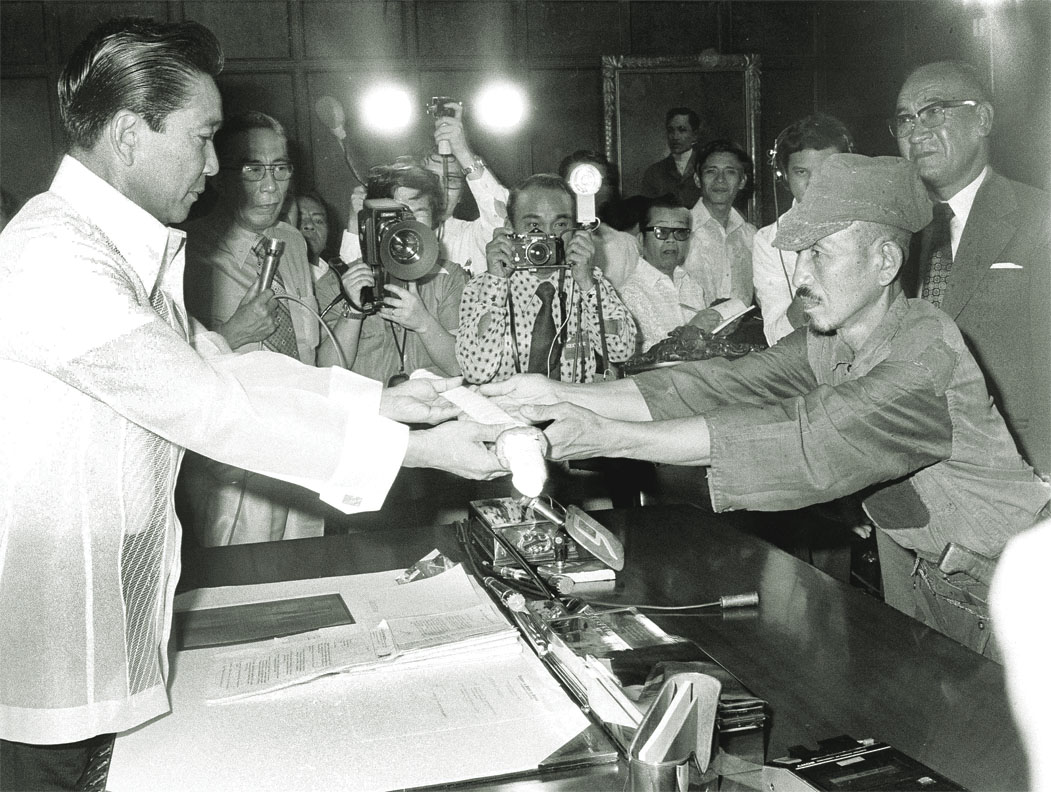
Onoda surrendered his sword to Philippine President Ferdinand Marcos on 11 March 1974
Onoda was dispatched to the Philippines in 1944 with a special intelligence unit known as the Beppan (別班), whose role was to conduct unconventional warfare and operate for long periods behind enemy lines. After Japan surrendered in August 1945, he continued to act on his orders, believing the war was still being fought. It was only much later, through the recollections of those connected to the case, that the depth of his isolation, the influence of his training, and the circumstances of his return came to be fully understood.
In October 1972, Philippine police encountered a suspected Japanese holdout on Lubang Island, west of Luzon. The encounter ended in a firefight that left one officer dead, while the armed man escaped into the jungle. He was later confirmed to be Onoda. The incident prompted immediate action in Japan, where officials from the Ministry of Health and Welfare, together with members of Onoda's family and the Philippine military, organised a large-scale search operation to locate him.
An interpreter involved in the operation later recalled that many on the team assumed Onoda was either wounded or already dead, and that the search would be over quickly. Search parties moved through thick jungle, shouted to him from vessels offshore, and dropped leaflets from aircraft calling on him to surrender. None of these measures had any effect, and Onoda stayed out of sight.
The reason lay in his training. Onoda had studied at the Nakano School (中野学校), a secretive wartime institution in Tokyo that trained intelligence operatives. Students were taught guerrilla warfare, sabotage, intelligence gathering, and survival, and were drilled above all to remain alive and never surrender. Unlike ordinary frontline soldiers, who were commonly taught to fight until death, graduates of the Nakano School were expected to carry on with their assignments for as long as necessary, unless a superior explicitly ordered otherwise.
Former classmates later recalled that Onoda treated this training with marked seriousness, spending long hours studying and preparing for covert work. Survival was treated as a responsibility in itself, and orders were to be followed without exception. When he was sent to Lubang Island, he was clearly instructed never to surrender and never to take his own life.
After the war, notices and leaflets announcing Japan's defeat did reach Lubang Island, but Onoda dismissed them as enemy trickery. He was convinced that any effort to lure him out was meant to kill him. Even when his ageing father and other relatives called to him during later searches, he remained in hiding, sure that surrender would mean death. Three primary search operations were carried out over the years, involving more than 100 people and costing roughly 90 million yen, yet all failed. The turning point came not through official efforts but through Norio Suzuki (鈴木紀夫, 1947–1986), a young Japanese traveller who, in 1974, decided to look for Onoda on his own. Venturing into the jungle alone, Suzuki eventually found him.
Onoda initially aimed his rifle at Suzuki, ready to fire. Suzuki calmly explained that he was Japanese and that the war had ended long ago. Onoda replied that he would only lay down his arms if he received formal orders from his former commanding officer. Suzuki returned to Japan, located that officer, and brought him back to Lubang Island. When the commander formally read out the order releasing Onoda from duty, he finally accepted it. He emerged from the jungle in a uniform he had repeatedly repaired himself, his rifle still functional, nearly three decades after the war's end. He was fifty-one years old.
After his return, a more troubling reality came to light. During the long years in hiding, Onoda and the other remaining holdouts had been involved in incidents that led to the deaths of around thirty residents and injuries to more than one hundred others. The Japanese government feared a backlash in the Philippines and debated compensation.
By that point, however, Japan had already paid 550 million dollars in postwar reparations to the Philippines. Restarting compensation discussions risked diplomatic friction. As an alternative, the Japanese government proposed a 300 million yen payment, described as private assistance. Philippine President Ferdinand Marcos (1917–1989) declined to accept the funds as compensation, stating that he respected Onoda's sense of duty as a soldier and did not wish the matter settled solely in monetary terms.
The money was instead channelled into educational and cultural initiatives, including Japanese language programmes and student exchanges, aimed at improving relations between the two countries. After returning to Japan, Onoda found it difficult to readjust. The society he came back to was vastly different from the one he had known before the war. The following year, he moved to Brazil, where his brother lived, and took up cattle farming. In later years, he returned to Japan periodically and devoted himself to youth education, teaching survival skills and resilience through outdoor programmes.
Hiroo Onoda died in 2014, aged ninety-one. His story stands as one of the most unusual and disputed episodes of Japan's postwar era, marked by absolute loyalty on the one hand and by the lasting human damage of a conflict whose effects did not end with the fighting.
Onoda surrendered his sword to Philippine President Ferdinand Marcos on 11 March 1974
Onoda was dispatched to the Philippines in 1944 with a special intelligence unit known as the Beppan (別班), whose role was to conduct unconventional warfare and operate for long periods behind enemy lines. After Japan surrendered in August 1945, he continued to act on his orders, believing the war was still being fought. It was only much later, through the recollections of those connected to the case, that the depth of his isolation, the influence of his training, and the circumstances of his return came to be fully understood.
In October 1972, Philippine police encountered a suspected Japanese holdout on Lubang Island, west of Luzon. The encounter ended in a firefight that left one officer dead, while the armed man escaped into the jungle. He was later confirmed to be Onoda. The incident prompted immediate action in Japan, where officials from the Ministry of Health and Welfare, together with members of Onoda's family and the Philippine military, organised a large-scale search operation to locate him.
An interpreter involved in the operation later recalled that many on the team assumed Onoda was either wounded or already dead, and that the search would be over quickly. Search parties moved through thick jungle, shouted to him from vessels offshore, and dropped leaflets from aircraft calling on him to surrender. None of these measures had any effect, and Onoda stayed out of sight.
The reason lay in his training. Onoda had studied at the Nakano School (中野学校), a secretive wartime institution in Tokyo that trained intelligence operatives. Students were taught guerrilla warfare, sabotage, intelligence gathering, and survival, and were drilled above all to remain alive and never surrender. Unlike ordinary frontline soldiers, who were commonly taught to fight until death, graduates of the Nakano School were expected to carry on with their assignments for as long as necessary, unless a superior explicitly ordered otherwise.
Former classmates later recalled that Onoda treated this training with marked seriousness, spending long hours studying and preparing for covert work. Survival was treated as a responsibility in itself, and orders were to be followed without exception. When he was sent to Lubang Island, he was clearly instructed never to surrender and never to take his own life.
After the war, notices and leaflets announcing Japan's defeat did reach Lubang Island, but Onoda dismissed them as enemy trickery. He was convinced that any effort to lure him out was meant to kill him. Even when his ageing father and other relatives called to him during later searches, he remained in hiding, sure that surrender would mean death. Three primary search operations were carried out over the years, involving more than 100 people and costing roughly 90 million yen, yet all failed. The turning point came not through official efforts but through Norio Suzuki (鈴木紀夫, 1947–1986), a young Japanese traveller who, in 1974, decided to look for Onoda on his own. Venturing into the jungle alone, Suzuki eventually found him.
Onoda initially aimed his rifle at Suzuki, ready to fire. Suzuki calmly explained that he was Japanese and that the war had ended long ago. Onoda replied that he would only lay down his arms if he received formal orders from his former commanding officer. Suzuki returned to Japan, located that officer, and brought him back to Lubang Island. When the commander formally read out the order releasing Onoda from duty, he finally accepted it. He emerged from the jungle in a uniform he had repeatedly repaired himself, his rifle still functional, nearly three decades after the war's end. He was fifty-one years old.
After his return, a more troubling reality came to light. During the long years in hiding, Onoda and the other remaining holdouts had been involved in incidents that led to the deaths of around thirty residents and injuries to more than one hundred others. The Japanese government feared a backlash in the Philippines and debated compensation.
By that point, however, Japan had already paid 550 million dollars in postwar reparations to the Philippines. Restarting compensation discussions risked diplomatic friction. As an alternative, the Japanese government proposed a 300 million yen payment, described as private assistance. Philippine President Ferdinand Marcos (1917–1989) declined to accept the funds as compensation, stating that he respected Onoda's sense of duty as a soldier and did not wish the matter settled solely in monetary terms.
The money was instead channelled into educational and cultural initiatives, including Japanese language programmes and student exchanges, aimed at improving relations between the two countries. After returning to Japan, Onoda found it difficult to readjust. The society he came back to was vastly different from the one he had known before the war. The following year, he moved to Brazil, where his brother lived, and took up cattle farming. In later years, he returned to Japan periodically and devoted himself to youth education, teaching survival skills and resilience through outdoor programmes.
Hiroo Onoda died in 2014, aged ninety-one. His story stands as one of the most unusual and disputed episodes of Japan's postwar era, marked by absolute loyalty on the one hand and by the lasting human damage of a conflict whose effects did not end with the fighting.
The Truth Behind Hiroo Onoda's 29 Years in the Jungle
Nearly three decades after the end of World War II, one man finally returned to Japan. He was Hiroo Onoda, known as the last Japanese soldier, who had remained hidden in the jungles of the Philippines for 29 years after the war ended.
newsonjapan.com


