


- 14 Mar 2002
- 21,053
- 18,908
Spiders create a silk that rivals steel in strength, stretches with remarkable elasticity, and is produced in harmony with nature. Its possible uses range from surgical sutures to automotive components, making it one of the most versatile materials known. Yet producing it on a large scale has always been the stumbling block. Attempts to raise spiders for their silk have failed, since they are solitary creatures that often turn on one another, while laboratory-made versions have never fully matched the toughness of the natural fibre. That picture has begun to change. A Japanese research team has uncovered the secret of the spider's spinning process and succeeded in replicating it with synthetic materials.
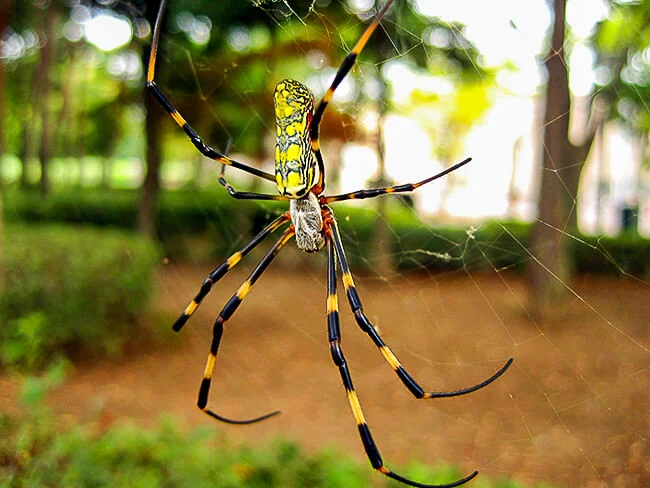
Golden orb spider
With biotechnology firms now preparing to manufacture these artificial silks as eco-friendly substitutes for nylon, polyester, and other oil-based textiles, the prospect of spider-inspired fabrics moving into everyday use is closer than ever.
Artificial spider silk could be put to work in many fields, from surgical applications to shock-absorbing components in vehicles, and even as part of structural materials in construction. Yet one weakness still limits its wider use: it reacts strongly to moisture. When spider silk absorbs water, the fibres stretch; when they dry out, they contract. The researchers are working on modifying the amino acid sequences that make up the spider silk structure to produce synthetic threads that resist water more effectively and are therefore better suited to everyday industrial and medical use.
Golden orb spider
With biotechnology firms now preparing to manufacture these artificial silks as eco-friendly substitutes for nylon, polyester, and other oil-based textiles, the prospect of spider-inspired fabrics moving into everyday use is closer than ever.
Arachnids produce several types of silk for different purposes, including building webs, wrapping prey, protecting their offspring and escaping from predators. These silks are all distinct from one another and are produced in different glands. Of these varieties, "draglines," which spiders use to dangle from and move about, are particularly enticing to researchers. Draglines are believed to have a tensile strength exceeding 1 gigapascal, which is comparable to steel, and more than twice as strong as silkworm silk. In addition, the draglines are tough, capable of absorbing twice as much energy before breaking as nylon, which is among the strongest man-made materials. The idea of putting this marvelous material to practical use is not new. One researcher made a pair of gloves and other items using spider silk in early 18th-century France, and fabrics made of naturally golden spider silk were among the exhibits in the 1900 Paris Exposition.
Artificial spider silk could be put to work in many fields, from surgical applications to shock-absorbing components in vehicles, and even as part of structural materials in construction. Yet one weakness still limits its wider use: it reacts strongly to moisture. When spider silk absorbs water, the fibres stretch; when they dry out, they contract. The researchers are working on modifying the amino acid sequences that make up the spider silk structure to produce synthetic threads that resist water more effectively and are therefore better suited to everyday industrial and medical use.


