


- 14 Mar 2002
- 21,050
- 18,903
The Austrian Pavilion at the Osaka Expo displays a virtual presentation of a rare 17th-century screen depicting Osaka during the Toyotomi period. It found its way to Europe via the Dutch East Indian Company, and it was assumed that it was smuggled out of Japan to prevent it from being destroyed by the Tokugawa bakufu .
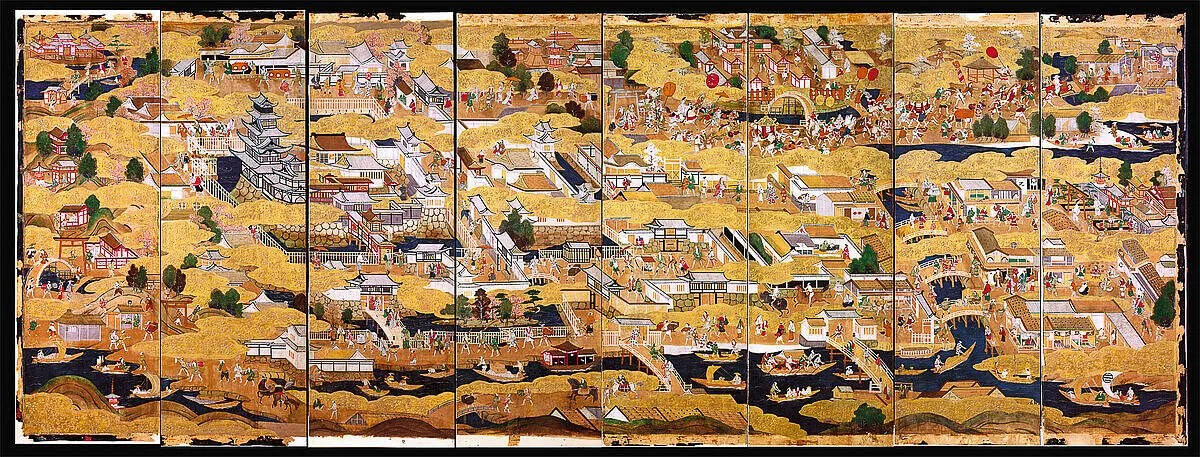
From the 16th century, Europe developed an intense fascination with the exotic artistry of East Asia, particularly admiring Chinese porcelain, silk paintings, and Japanese lacquerware. Between 1660 and 1680, Johann Seyfried von Eggenberg acquired several such luxury items during an opulent renovation of the Eggenberg residences in Graz, including a decorative screen made with "Indian paper," which was present in the family's Graz palace before 1700. During a later refurbishment after 1754, this antique screen was dismantled and repurposed as part of the wall panelling in a fashionable "Japanese cabinet." After the Eggenberg lineage ended in 1774, the origins of the paravent were forgotten. Ironically, this loss of knowledge contributed to the screen's unrecognised survival in Schloss Eggenberg for centuries.
More info on this exceptional screen:
 expoaustria.at
 www.museum-joanneum.at
 www.kansai-u.ac.jp
 www.kansai-u.ac.jp
Ōsaka zu byōbu (大阪図屏風):
From the 16th century, Europe developed an intense fascination with the exotic artistry of East Asia, particularly admiring Chinese porcelain, silk paintings, and Japanese lacquerware. Between 1660 and 1680, Johann Seyfried von Eggenberg acquired several such luxury items during an opulent renovation of the Eggenberg residences in Graz, including a decorative screen made with "Indian paper," which was present in the family's Graz palace before 1700. During a later refurbishment after 1754, this antique screen was dismantled and repurposed as part of the wall panelling in a fashionable "Japanese cabinet." After the Eggenberg lineage ended in 1774, the origins of the paravent were forgotten. Ironically, this loss of knowledge contributed to the screen's unrecognised survival in Schloss Eggenberg for centuries.
More info on this exceptional screen:
Austria at the EXPO 2025 in Osaka
The Austrian contribution to Expo 2025 focuses on the interaction between relationships, people and ideas and creates new partnerships that foster innovation, build business opportunities, expand R&D collaborations and support the achievement of the SDGs.
expoaustria.at
Ôsaka Folding Screen
Osaka-zu Byobu
www.kansai-u.ac.jp
VISUALIZATION PROJECT|RESEARCH CENTER FOR CITYSCAPE AND CULTURAL HERITAGE OF OSAKA|KANSAI UNIVERSITY
関西大学「大阪都市遺産研究センター」Webサイト。


