Art Ukiyo-e: Japanese woodblock prints and paintings

Topics, threadsm and news related to Japanese art and artists
Kitagawa Utamaro, Snow in Fukagawa (深川の雪 Fukagawa no Yuki).

It depicts a temporary brothel in Fukagawa with the theme of 'snow'. The horizontal painting is a hanging scroll in coloured pigments on eight joined sheets of Xuan paper, measuring 198.8 by 341.1 centimetres. The painting is part of the Okada Museum of Art collection in Hakone.

Snow in Fukagawa (深川の雪 Fukagawa no Yuki)
 
These from a museum visit the other day--recent prints (relatively speaking) by Miyamoto Saburo. He's a local, and there's a small museum of his work (not only woodcuts) down in central Komatsu. I've been by it, but haven't gone in since they post it as 'no cameras' and I was carrying a camera at the time.

IMG_4939.webp


IMG_4938.webp


IMG_4940.webp
 
Also, here's my personal ukiyo-e collection--all three pieces. These were given to me a very long time ago ('85?), friend of a friend sort of thing, and this person was running a shop down in a fashionable part of tokyo. They said to choose a few, and I did. Somehow, they've survived all these years in great condition.

IMG_4969.webp


IMG_4970.webp


IMG_4971.webp


IMG_4972.webp


IMG_4973.webp


IMG_4974.webp
 
Ohara Koson (小原古邨, 1877-1945), also known as Ohara Hōson and Ohara Shōson) was a Kanazawa-born painter and woodblock print designer of the late 19th and early 20th centuries, at the forefront of shinsaku-hanga and shin-hanga art movements.

Ohara Koson was a prominent shin-hanga (new prints) artist who emerged in early 20th-century Japan to revitalize traditional ukiyo-e art and its time-honoured production methods. While shin-hanga artists often incorporated Western techniques such as lighting and shading, they primarily focused on classic Japanese subjects, including bijin-ga (portraits of beautiful women), landscapes, and kachō-e (birds-and-flowers prints). Ohara, in particular, was known for his exquisite depictions of nature, demonstrating meticulous attention to detail, especially in elements like feathers and delicate gradations of colour. His mastery is evident in this 1927 artwork, where his refined technique brings each intricate detail to life:

A Group of Herons in the Snow (雪中白鷺 Secchu Gunro)

A Group of Herons in the Snow (雪中白鷺 Secchu Gunro)
 
Kitagawa Utamaro, Snow in Fukagawa (深川の雪 Fukagawa no Yuki).

It depicts a temporary brothel in Fukagawa with the theme of 'snow'. The horizontal painting is a hanging scroll in coloured pigments on eight joined sheets of Xuan paper, measuring 198.8 by 341.1 centimetres. The painting is part of the Okada Museum of Art collection in Hakone.
I was wondering why it was called "temporary" but I guess it's more accurate to say "unregulated."

The term "temporary brothel" in the context of Kitagawa Utamaro's painting Snow in Fukagawa (深川の雪, Fukagawa no Yuki) refers to the nature of the establishment depicted in the artwork. Unlike the officially sanctioned pleasure districts such as Yoshiwara, which were permanent and regulated by the Edo government, temporary brothels were informal or semi-legal establishments that operated outside these regulated areas. These were often set up in areas like Fukagawa, which was known for its teahouses and entertainment venues, and catered to a more transient clientele. Such establishments were not officially recognized as part of the licensed pleasure districts (yūkaku) but still provided similar services, often blending with other forms of entertainment like dining and music
 
One of the artists I've been turned onto in the past few years is Takehisa Yumeji. He was a Taisho era artist, and almost a missing link between Ukiyo-E and manga. He did prints of all sorts, lots of fashionable women, covers for sheet music which was a trend of the time. Lots of postcards. He has a bit of a tragic end, peaking earlier in his life, and always chasing success after; but that's only if you judge success in money earned. He had a solid output up to his somewhat early death.

927871241.webp


takehi2.webp
 
Last edited:
Kobayashi Kiyochika (小林 清親, 1847-1915), Kaiun Bridge and First National Bank (海運橋第一国立銀行 Kaiunbashi Kokuritsu Daiichi Ginko), 1878.

Kaiun Bridge and First National Bank (海運橋第一国立銀行)

Kobayashi Kiyochika was a ukiyo-e artist active during the Meiji era. He was renowned for his series Famous Views of Tokyo (東京名所図 Tōkyō Meisho-zu), which captured the rapidly changing cityscape amid Japan's modernization. This particular work is a representative series piece depicting the First National Bank, which opened in 1873, set against a snowy backdrop.

In the foreground, a woman in a kimono walks away from the viewer, holding an umbrella. Ahead of her, a stone bridge named Kaiunbashi spans the river, bustling with rickshaws, while an imposing Western-style building rises in the distance. This structure, the First National Bank, was one of the most notable examples of pseudo-Western architecture from the early Meiji period. The vast grey sky, empty except for three birds in flight, emphasizes the building's remarkable height—an unusual sight in Tokyo at the time.

Rather than exaggerating the grandeur of this new architecture, Kiyochika seamlessly integrates it into the city's seasonal landscape and daily life. By only partially revealing the bank's upper floors beyond the bridge, he employs a compositional technique reminiscent of Edo-period ukiyo-e, where Mount Fuji's silhouette often played a similar role in adding depth and intrigue.

The print also contains interesting textual details. The words Ginza and Kishida inscribed on the woman's umbrella refer to Kishida Ginkō's Ginza shop, which produced Japan's first eye drops, Seiki-sui. This suggests that the artwork may have also served a promotional purpose.

Kiyochika's Famous Views of Tokyo series, known for its delicate use of colour, is also called kōsenga (光線画, light and shadow pictures). At a time when the ukiyo-e world was dominated by kaika-e (enlightenment prints), which heavily featured synthetic dyes in bold reds and purples, his works introduced a fresh and innovative approach to the genre.


Original location: 4-3 Nihonbashikabutochō, Chūō-ku, Tōkyō 103-0026
 
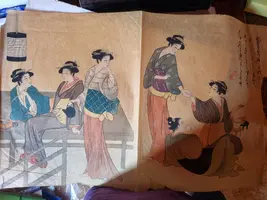
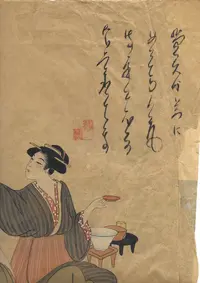
Konnichiwa. I found this beautiful print in my attic but don't know who the artist is or the year - in fact, no-one I've showed it to (Southeby's and other Asian art dealers) can identify it. I love its delicacy and poise anyway !
 

Attachments

  • Japanese 1.webp
    Japanese 1.webp
    4.1 MB · Views: 219
  • Japanese 2.webp
    Japanese 2.webp
    639.1 KB · Views: 216
Perhaps a modern-era reproduction of an Edo-era print?
Is this actually a print? It looks like an ink painting.
 
Well, it does look like an ink painting to me but I know nothing about Japanese art and one gallery in the US said it looked like a print to them. I had hoped one of the experts I sent the photos to might be able to read the inscription that might give more of a clue but no-one I've asked can read/interpret it. Not as good as a fine Japanese locked room mystery but pretty close to it !
 
These are modern/recent, so I hope they are acceptable here. From a week or so ago, a local exhibition. Two that I liked, and that also got prizes.

tree.webp

tree ID.webp


red.webp

red ID.webp


And then this series, showing how the prints are produced with different blocks. Unfortunately, on the left there was some information on it all that I missed, and didn't include in this shot, or get a detail of... :(

stages.webp
 
We are in March; the snow has melted away, the ume has whithered, and we're in anticipation of sakura.

Utagawa Toyohiro (歌川豊広, 1773–1828), The Third Month, Triptych (豊広豊国両画十二候 三月 三枚続), 1801, woodblock print (Nishiki-e); ink and colour on paper, vertical ōban triptych, 39 x 73.9 cm, Museum of Fine Arts Boston.

Utagawa Toyohiro (歌川豊広, 1773–1828), The Third Month, Triptych (豊広豊国両画十二候 三月 三枚続)
 
I sent the pics above, post #53 to Mita gallery in Tokyo, and asked for a quick appraisal. The reply was, "Unfortunately these are reproductions so value about $50 each." (not that I thought I was sitting on a fortune...)

 
Tsuchiya Kōitsu (土屋光逸, 1879-1949), Geisha and Cherry Tree a Ueno Park, 1939

Tsuchiya Kōitsu (土屋光逸, 1879-1949), Geisha and Cherry Tree a Ueno Park, 1939

As a key figure in the celebrated Shin-hanga movement, artist Tsuchiya Kōitsu was essential in revitalising the ukiyo-e tradition in the early 20th century. This particular woodblock print, created in 1939, portrays a geisha standing beneath a sakura tree in Ueno Park, with a pagoda visible in the distance. Ueno Park remains a popular spot for Hanami. Although the artwork was designed in 1939, it was not printed until 1948.
 
The cherry blossoms have just reached Hokkaido. Here's another one from Utamaro.

Kitagawa Utamaro, Display of Treasures at Mimeguri Shrine (三囲神社の御開帳 Mimeguri jinja no onkaichō), 1799.


full.jpeg.webp
 
The position of the torii in the ukiyo-e above may appear strange, but it will become clear in the prints below.

Utagawa Hiroshige I (1797-1858), Mimeguri Embankment on the Sumida River (隅田三囲堤 Sumidagawa Mimeguri tsutsumi), from the series Famous Places in Edo (江戸名所 Edo meisho), woodblock print (nishiki-e); ink and colour on paper, horizontal ōban; 21.5 x 34.3 cm, 1854. Parts of the torii are visible on the left:

full.jpeg.webp

Utagawa Hiroshige II (aka Shigenobu, 1826–1869), Mimeguri Embankment on the Sumida River (隅田川三囲り堤 Sumidagawa Mimeguri tsutsumi), from the series Thirty-six Views of the Eastern Capital (東都三十六景 Tōto sanjūrokkei), woodblock print (nishiki-e); ink and colour on paper, vertical ōban; 38 x 25.7 cm, 1862.

full.jpeg.webp

Here's the top part of the torii as seen from the embankment again:

Utagawa Hiroshige (1797-1858), Mimeguri no Kei (Toyoha-ya), 三囲之景 出羽屋, 江戸高名会亭尽, woodblock print; ink and colour on paper, horizontal ōban, ca. 1840.

full.jpeg.webp

Tsukioka Yoshitoshi (月岡 芳年, 1839–1892), Bewitching Foxes at the Mimeguri Shrine on the Sumida Embankment (墨堤三圍社野狐の愉快 Sumida-zutsumi Mimeguri yashiro nogitsune no yukai), from the series Famous Places and Humorous Images of Modern Life in Tōkyō (東京開化狂画名所 Tōkyō kaika kyôga meisho), woodblock print (nishiki-e); ink and colour on paper, horizontal chūban; 17.6 x 22.8 cm, 1881.

full.jpeg.webp

Mimeguri Shrine (三囲神社) exists to this day (Google maps):

 
Katsushika Hokusai (1760–1849), Sekiya Village on the Sumida River (隅田川関屋の里 Sumidagawa Sekiya no sato), from the series Thirty-six Views of Mount Fuji (冨嶽三十六景 Fugaku sanjūrokkei), ca. 1830–32; Oban, woodblock print; ink and colour on paper.

full.jpeg.webp
 
I've found this gruesome print for sale for £150, in an unexpected place but I'm not sure what to make of it, not least due to the ropey images of it. Does it look suspicious to any of you? It has Kuniyoshi's seal on it!!

IMG_4408.webp

IMG_4406.webp

IMG_4407.webp
 
Back
Top Bottom