News Japan's Transport Ministry eyes conveyor belt between Tokyo and Osaka

thomas

Unswerving cyclist
Admin
Joined
14 Mar 2002
Messages
21,056
Reaction score
18,910
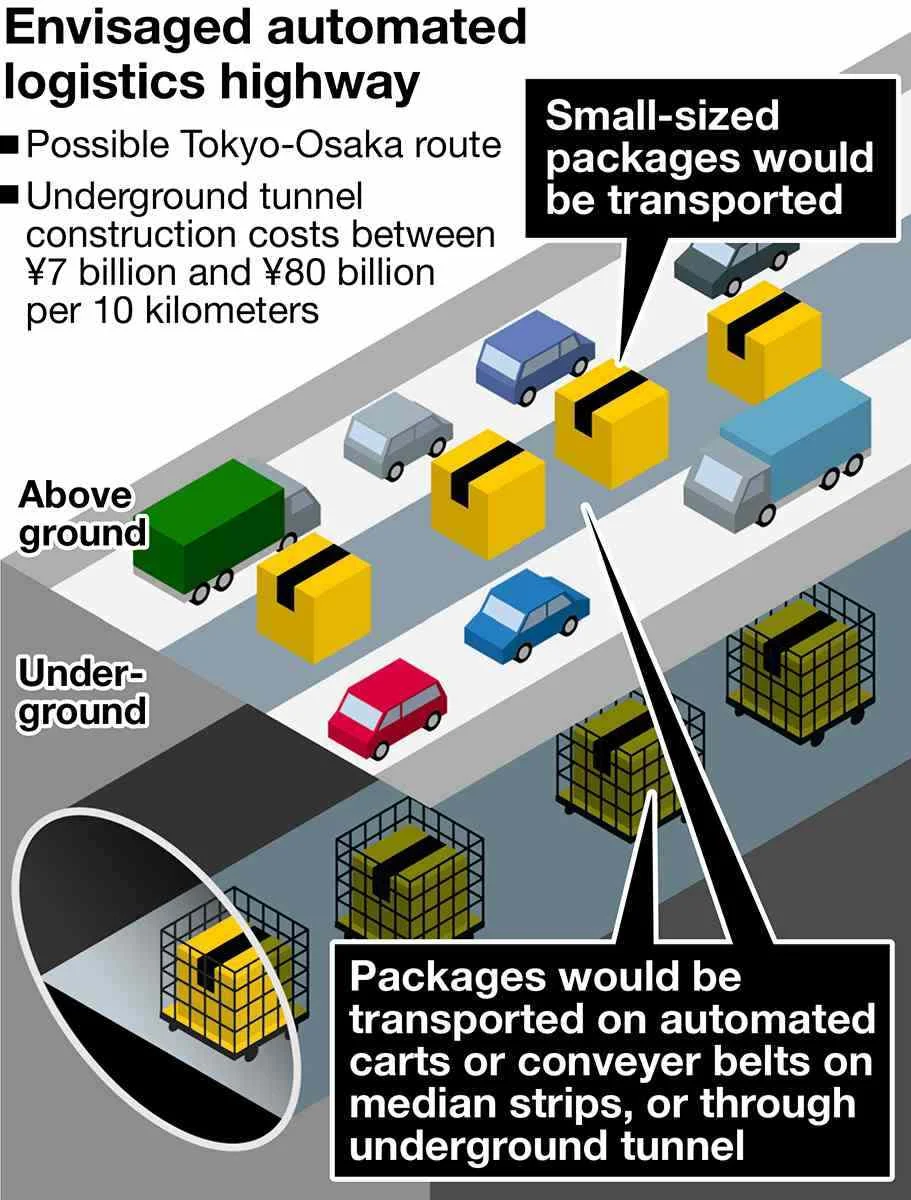
Is it a bureaucratic pipe dream? An expert panel from the Land, Infrastructure, Transport and Tourism Ministry has suggested creating automated logistics routes on median strips or through underground tunnels along expressways. Discussions on this new system began in February. The ministry aims to complete the project, potentially between Tokyo and Osaka, by 2034. With the rise of online shopping, small parcel deliveries have doubled over the past 30 years. By 2030, labour shortages may result in about 30% of packages not being delivered.


Tokyo-Osaka conveyor belt

Photo credit: Daily Yomiuri


The number of small parcel deliveries has doubled in the last 30 years amid the spread of online shopping. By the year 2030, it is estimated that about 30% of packages will not see delivery due to labour shortages. The panel estimates that automated logistics highways could cover the cargo carried by the equivalent of 25,000 truck drivers per day. Pallets that can carry up to a ton of small-sized cargo, such as agricultural and marine products and daily necessities, would be used. The biggest challenge is cost. According to a survey of construction companies, the cost of building an underground tunnel ranges from JPY 7 billion to ¥80 billion per 10 kilometres, so a system linking Tokyo and Osaka would cost up to JPY 3.7 trillion. When the ministry in 2000 first planned logistics links above ground, it estimated construction costs of JPY 25.4 billion per 10 kilometres. The outline calls for discussions on using the private sector to fund the project, along with creating an organization to allow a wide range of companies to participate in the scheme.


sounds way too expensive to build and maintain vs gains but I am not an expert. Using existing rail seems better heck even having freight shinkansen is probably cheaper. Rail due to the regularity and defined routes and schedules seems easier to automate than self driving cars so I expect that to spread as well so automated trains just seems cheaper than new underground tunnels for a conveyor belt.
 
Trials for the projected expressway transport lane are scheduled to start by 2027. Meanwhile, the projected cost seems prohibitive.

08d33b4a967930ed44ff2ff13157fd94.webp

The trial project will take place on the Shin-Tomei Expressway between the Shin-Hadano Interchange in Kanagawa Prefecture and the Shin-Gotenba Interchange in Shizuoka Prefecture. The 25-kilometre stretch is currently under construction. Dedicated lanes for self-driving cargo will be created using existing medians and shoulders or by building underground tunnels. Standardized cargo pallet sizes will ensure seamless transfers to ships, trains, and airplanes. The estimated construction cost per 10 km is 25.4 billion JPY (USD 165 million) for above-ground infrastructure and 7 billion to 80 billion JPY for underground tunnels. The government plans to cover a significant portion of the costs with private-sector investments. The trial aims to test technologies and collect data on driverless vehicles before the section's scheduled opening in fiscal 2027.

 
Japan's "conveyor belt road" project is slowly taking shape:

The new automated cargo transport corridor connecting Tokyo and Osaka aims to utilize 24/7 automated and unmanned transportation, creating dedicated lanes for logistics within existing road networks. The auto flow road is expected to reduce carbon emissions by streamlining the delivery process and reducing reliance on human drivers. The government envisions a future where large cargo containers, each carrying up to a ton of goods, move autonomously along these dedicated lanes. At the same time, regular vehicles continue to operate on adjacent lanes.


Automated forklifts will load items into the containers as part of a network that links airports, railways and ports. Test runs will begin in 2027 or early 2028, with the road going into full operation mid the next decade. While no official estimates have been released, the Yomiuri Shimbun newspaper said a road linking Tokyo and Osaka could cost up to ¥3.7tn [£18.6bn] given the many tunnels that would be needed. If the project is successful, it could be expanded to include other parts of Japan. But humans will not be out of the picture altogether – they will still have to make door-to-door deliveries until the possible introduction of driverless vehicles. The ministry estimates logistics motorways could do the work of 25,000 truck drivers per day, the Yomiuri said. The shortage of truck drivers, who carry about 90% of Japan's cargo, is expected to accelerate after introducing a law this year limiting their overtime to address overwork and reduce the number of accidents.

 
Is examination Switzerland by "lane for exclusive use of the distribution" setting in the expressway; construction examination | of "the distribution lane of 5.7 trillion yen under the ground" TBS NEWS DIG

The way of the distribution may change from root and trunk. The Ministry of Land, Infrastructure, Transport and Tourism made "a lane for exclusive use of the distribution" in the expressways newly and carried baggage with an automatic driving cart and began examination about a method of the new distribution.

The traffic jam that is generated chronically in each places of the whole country. When, according to MLIT, add up the time of the individual who was lost in a traffic jam a year of 2021, the astronomical number called = about 254 million days is ... for "6.1 billion hours"

It is "the basement distribution lane" where what "big cause that distribution is delayed" and MLIT to bring into question fixed on by a traffic jam is examined in Switzerland. The thing which I make the exclusive tunnel of 500 kilometers of total extension under the ground, and an automatic driving cart carries baggage to. It is assumed that I carry a part of the trucking instead.

MLIT Road Bureau Director Katsuhiko Niwa
"I want to aim at the correspondence to a distribution crisis to draw near with sense of speed to come true"

At the well-informed person meeting of MLIT, I made "a lane for exclusive use of the distribution" on a safety zone and the shoulders such as expressways in reference to examples such as Switzerland, and I could not make the mechanism which carried baggage with an automatic driving cart, or examination was performed today. I aim at the operational start ten years later.

On the other hand, becoming the problem "construction costs." According to MLIT, it is assumed that a Swiss "distribution lane under the ground" costs the big sum of 5.7 trillion yen.

In Japan, a vast expense is anticipated for the construction of "the lane for exclusive use of the distribution", and the problems pile up whether the understanding of the nation is got.
 
Back
Top Bottom