


- 14 Mar 2002
- 21,050
- 18,903
Repurposing deserted railway tracks into specialized cycling paths is a popular strategy in Japan's rural regions, which are counting on tourists in cycling attire to stimulate their economies. The national government has recognized cycling as a potential growth sector that can attract investment from domestic and international cycling enthusiasts, leading to the construction and planning of cycling trails nationwide. Approximately ten such trails have been established on former railway lines, stretching from Hokkaido north to Nagasaki and Oita south on Kyushu Island. Once vital to local communities, these regional railways were gradually decommissioned due to the rise of automobiles, population decline, and the transition to high-speed intercity trains, which reduced passenger numbers. In addition to these factors, some regional rail lines were permanently closed due to damage from natural disasters, as they could not be restored due to insufficient funds and demand.
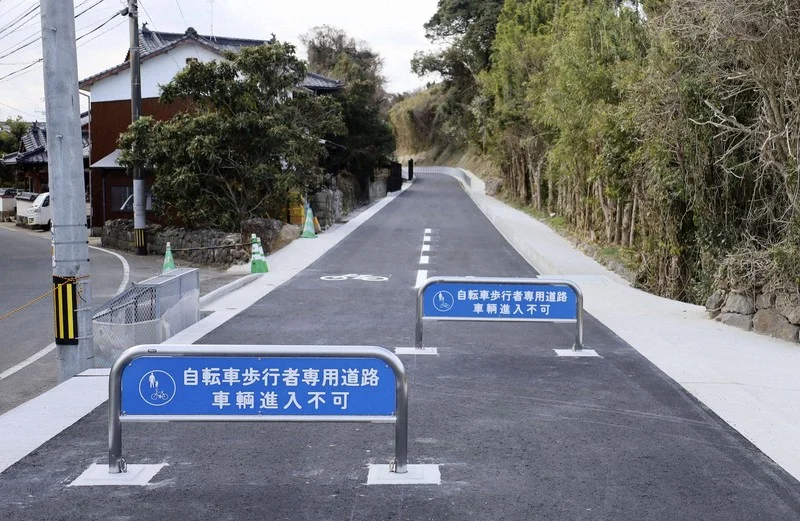
Cycling path built on the site of the abandoned Shimabara Railway line in Minamishimabara, Nagasaki
Two examples of repurposed train tracks are the Shimabara Railway in Nagasaki and the Tsukuba-Kasumigaura Ring Ring Road in Ibaraki .
Other paths available are:

 mainichi.jp
Cycling path built on the site of the abandoned Shimabara Railway line in Minamishimabara, Nagasaki
Two examples of repurposed train tracks are the Shimabara Railway in Nagasaki and the Tsukuba-Kasumigaura Ring Ring Road in Ibaraki .
Other paths available are:
- The city of Minamishimabara, which has jurisdiction for areas encompassing the section, decided in 2019 to convert most of it into a cycle and pedestrian path. The cycling trail was partially opened in 2022, and the rest is expected to be available during the 2024 fiscal year starting in April. However, snowballing construction costs are giving city authorities significant headaches. The city is home to the ruins of Hara Castle, a World Heritage site and the scene of the Shimabara Rebellion, a fierce battle between peasants, most of whom were Christians, and the Tokugawa shogunate that took place nearly 400 years ago. There are also hot springs along the way.
- Even before the government endorsement, a 180-km cycling course opened in Ibaraki Prefecture, northeast of Tokyo, in 2016, featuring the abandoned tracks of the former Tsukuba Railway and a public road that runs along the Kasumigaura lakeshore. The Tsukuba-Kasumigaura Ring Ring Road is attracting many cyclists who appreciate its easy-to-access location and the retro-tinged atmosphere surrounding old-fashioned station buildings used as rest stops.
- The Kubiki Cycling Road in the Joetsu area of Niigata Prefecture stretches a little more than 30 km along the coast of the Sea of Japan. It was transformed from railway tracks used for a rerouted Hokuriku Line section. The road has gained popularity among young people for its public relations character, Kubiki Rin, which was created by students at a local vocational school and plays a major social media promotional role.
- Other designees include the Shimanami Kaido Cycling Road, a 70-km toll road running along the expressway linking Hiroshima and Ehime prefectures across the Seto Inland Sea in western Japan, and the 403-km Tokapchi 400 route in Hokkaido that is laid amidst vast plains.
Japan promoting pedal power to give abandoned railways new prospects - The Mainichi
NAGASAKI (Kyodo) -- Transforming abandoned railway lines into dedicated cycling trails has become a fashionable option for rural areas of Japan that a


