- 14 Mar 2002
- 21,050
- 18,903
We had a thread on the topic a few years ago. Sadly, nothing has changed!
In Japan, the conditions for farmed animals remain concerning. Ninety-five per cent or more of laying hens are confined to battery cages, while 90% of pork producers employ gestation crates that severely limit sow movement. Additionally, Japanese cattle farmers dehorn their animals without anaesthesia, a practice banned in New Zealand and the U.K.
Unfortunately, Japan ranks poorly in farmed animal protection among the Group of Seven countries, as documented by the World Animal Protection Index. Leading Japanese food industry players, including Seven & i Holdings and Aeon Group, also fare poorly in global rankings by the Business Benchmark on Farm Animal Welfare. While these companies have not publicly addressed the assessments of their inadequate animal welfare policies, there is growing awareness and discussion about animal welfare within Japan's food supply chains due to global trends and reports.
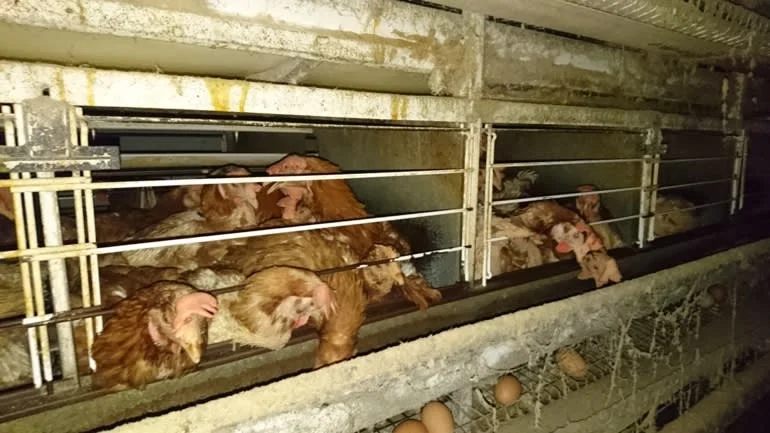
Photo credit: Animal Rights Center Japan
Jasmine Ortlieb-Hirose, the global corporate relations coordinator for the Asia region for Mercy for Animals, a group campaigning to prevent cruelty to farmed animals, described Japan's lousy track record in an article on Nikkei Asia:
Cage-free environments, on the other hand, significantly reduce the pain hens endure and allow them to engage in behaviours essential to their well-being, such as spreading their wings and nesting. Research has found that transitioning from cages to cage-free environments can reduce a hen's suffering by thousands of hours. Thus, a cage-free climate is essential for achieving the five freedoms.
Some corporations have cited Japan-specific issues, such as a lack of space or public concern about the safety of cage-free eggs, in holding to battery cages. Research suggests, however, that cage-free eggs are no less safe than conventional eggs. Studies associate cage confinement with a higher risk of salmonella. Further, some research has found that cage-free hens have a lower mortality rate than their caged counterparts.
Paywall alert:

 asia.nikkei.com
In Japan, the conditions for farmed animals remain concerning. Ninety-five per cent or more of laying hens are confined to battery cages, while 90% of pork producers employ gestation crates that severely limit sow movement. Additionally, Japanese cattle farmers dehorn their animals without anaesthesia, a practice banned in New Zealand and the U.K.
Unfortunately, Japan ranks poorly in farmed animal protection among the Group of Seven countries, as documented by the World Animal Protection Index. Leading Japanese food industry players, including Seven & i Holdings and Aeon Group, also fare poorly in global rankings by the Business Benchmark on Farm Animal Welfare. While these companies have not publicly addressed the assessments of their inadequate animal welfare policies, there is growing awareness and discussion about animal welfare within Japan's food supply chains due to global trends and reports.
Photo credit: Animal Rights Center Japan
Jasmine Ortlieb-Hirose, the global corporate relations coordinator for the Asia region for Mercy for Animals, a group campaigning to prevent cruelty to farmed animals, described Japan's lousy track record in an article on Nikkei Asia:
Some companies, such as Seven & i and mayonnaise manufacturer Kewpie, have endorsed what are known as the "five freedoms" of animal welfare on their global corporate websites. The five freedoms, endorsed by the World Organisation for Animal Health and formalized in the U.K. in 1979, comprise the freedom to express natural behavior, freedom from hunger and thirst, freedom from discomfort, freedom from disease and pain, and freedom from fear. While good welfare is important for all farmed animals, of particular concern in Japan are conditions for caged hens. Japanese rank among the most avid consumers of eggs in the world. Yet cage-free eggs are relatively rare in the country, although Seven & i sells one type that is said to be "kind to hens and the planet" and "allows hens to be reared stress-free." An estimated 95% of Japan's eggs are laid by hens confined for life in wire cages, crammed together with other birds and thus restricted severely in terms of movement and natural behavior that is critical to their health and well-being.
Cage-free environments, on the other hand, significantly reduce the pain hens endure and allow them to engage in behaviours essential to their well-being, such as spreading their wings and nesting. Research has found that transitioning from cages to cage-free environments can reduce a hen's suffering by thousands of hours. Thus, a cage-free climate is essential for achieving the five freedoms.
Some corporations have cited Japan-specific issues, such as a lack of space or public concern about the safety of cage-free eggs, in holding to battery cages. Research suggests, however, that cage-free eggs are no less safe than conventional eggs. Studies associate cage confinement with a higher risk of salmonella. Further, some research has found that cage-free hens have a lower mortality rate than their caged counterparts.
Paywall alert:
Japanese hens deserve equal concern from Japan's food sellers
Seven & i and Kewpie should extend U.S. cage-free pledge to domestic operations
asia.nikkei.com