Culture Setsubun - the Japanese bean-throwing festival

thomas

Unswerving cyclist
Admin
Joined
14 Mar 2002
Messages
21,050
Reaction score
18,903
Annual "Bean Scattering" Held At Narita Temple

The annual "Bean Scattering" ritual was held at Naritasan Shinshoji Temple in Chiba Prefecture Monday to mark "setsubun", the day before the first day of spring according to the lunar calendar.

At this year's "Bean Scattering" ritual held Monday at Naritasan Shinshoji Temple in Narita City, Chiba Prefecture, celebrities and sumo wrestlers tossed beans while yelling, "Out with the ogre! In with the happiness!" SOUND BITE: "Oniwa soto! Fukuwa uchi! (Out with the ogre! In with the happiness!)" At Naritasan Shinshoji Temple, the event has taken place continuously since the Edo era. This year, popular sumo wrestlers, including new Yokozuna Asashoryu, Yokozuna Musashimaru and Ozeki Chiyotaikai, performed the "Bean Scattering". Many actors also appeared, including kabuki performers Ichikawa Danjuro and his son Shinnosuke, whose hereditary stage title of "Naritaya" is related to the temple. The celebrities tossed soybeans and peanuts timed to the shouts of the crowd. Customarily, the beans are scattered by people born in the years of the current Oriental zodiac sign, who pray for world peace, happiness and good health for the year. This year at the temple, 250 people scattered the lucky beans. The event was to be repeated twice in the afternoon.


=> news.tbs.co.jp/headline/tbs_headline-e693090.html

More info on setsubun

=> Setsubun | Japan Forum
 
A couple odd questions related to Setsubun no Hi...

Here is my goal. I need to know how to CORRECTLY (I say correctly, because while I can guess myself, I want to make sure it is 100% right) label a box with "21 and a half Kidney beans." My guess is, 二十一半個隠元豆

Well, at least that is my best shot. (Yes, I know soybeans are supposed to be used, however there is a reason I'm using Kidney beans.)

Anyway, one easy question for grammar aces. Using omedetou for two days. I.E. Setsubun AND Valentine's Day. Would it be "(Day) de (Day) omedetou"?

Thanks for the help and anyone who responds.
:)
 
The beans thing I can't really comment on, but I would guess that you can't really go wrong with ko. There is one thing, though: switch the order, or insert a no between the ko and the "beans." There is a difference, by the way, owing to the quantifier float.

For the days thing, I would guess "day to day o omedetou," just because it seems similar to the use of arigatou.
 
So then...

二十一半個の隠元豆

and

節分の日とバレンタインデイをおめでとう

ね?
 
1) If you mean "the twenty-one and a half kidney beans," yes.

2) That's my guess, but I need it confirmed as much as you do.
 
Hmm, I mainly mean it as an indication of how many in a container. Not emphasis on "The" but maybe it doesn't matter? Thanks for the help though, I'm getting there!
 
If you want it to be indefinite, then put the beans before the number with no no (i.e. "twenty-one and a half kidney beans"). If you want it to be marked definite, then put the number before the beans with no (i.e. "the twenty-one and a half kidney beans").
 
I think I understand what you mean. So I would be aiming for something along the lines of 隠元豆二十一半個
 
粒 (tsubu), anyone?
 
Well, I think it sounds a bit stilted... :geek:

I'd say 21個と半分のインゲン豆 (nijyu-ikko to hanbun no ingen mame). (粒 is probably OK, too, but kidney beans may be too large for that counter...)

Also, we don't say おめでとう about 節分 or 春分、秋分、冬至、or 夏至. It's probably because they are only markers of change in season. I'm not 100% certain about the explanation, but we definitely don't say "omedetou" about setsubun.

I don't know how to combine "setsubun" and Valentine's Day..
 
Also, we don't say おめでとう about 節分 or 春分、秋分、冬至、or 夏至. It's probably because they are only markers of change in season. I'm not 100% certain about the explanation, but we definitely don't say "omedetou" about setsubun.

I don't know how to combine "setsubun" and Valentine's Day...:?
節分などの日は特にめでたいという事ないので、これは言いません。 :p
 
Setsubun is on February 3rd this year, and there is a neat site explaining why you better rush down to the supermarket right this very minute and buy those special beans before your neighbour gets the last bag.

oni.jpg


Get Out Ogre! Come In Happiness!
Setsubun in Japan: A Lunar "New Year's Eve"

By Steve Renshaw and Saori Ihara
February, 2000​

On February 3rd 2000, Setsubun will be celebrated throughout Japan. Falling at the end of the period defined by the solar principal term Daikan (Severe Cold), Setsubun occurs one day before the sectional term Risshun (Spring Begins). The setsu of Setsubun (literally "sectional separation") originally referred to the eve of any of the 24 divisions of the solar year (see The Lunar Calendar in Japan for an explanation of these divisions). However, the Setsubun associated with "Spring Begins" gained significance as a symbol of Toshi Koshi (year passing) or Jyo Jitsu (accepting the old year) by marking the completion of the cycle of the 24 divisions of the solar year. Only this Setsubun is still marked on the official calendar. Setsubun achieved the status of an imperial event and took on symbolic and ritual significance relative to its association with prospects for a "returning sun", associated climatic change, renewal of body and mind, expulsion of evil, symbolic rebirth, and preparation for the coming planting season. Customs surrounding this day apparently date as early as the Ming Dynasty in China, and in Japanese form, began to take shape in the Muromachi Era (1392-1573), that era of Japanese history in which the country saw little internal peace but in which such customs as tea ceremony and other genteel arts and practices so often associated with Japan developed.

Setsubun generally always precedes the Lunar New Year; in the ancient ideal, it was often referred to as New Year's Eve. In 2008, solar and lunar cycles coincided enough to make the ideal almost real: February 4 marked Risshun (Spring Begins), and February 7 was the lunar New Year in China and Japan. In 2012, Setsubun occurred after the lunar New Year (January 23), thus making "New Year's Eve" somewhat late.

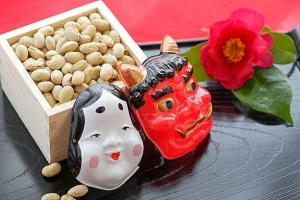
Setsubun has been celebrated in many ways, but perhaps the most common custom found throughout Japan is the traditional Mame Maki or the scattering/throwing of beans (mame) to chase away the evil oni (ogres, evil spirits, as depicted in the illustration which heads this article). In some ritual forms, the Toshi Otoko [literally "year man" but referring either to the "man of the house" or to men who are born in the animal sign of the coming year (rabbit for the year 2011)] will throw mame within the house or at someone perhaps dressed as oni and repeat the saying Oni wa Soto; Fuku wa Uchi (Get out Ogre! Come in Happiness!). After the ritual throwing of the beans, family members may pick up the number of beans corresponding to their age; eating these brings assurance of good fortune in the coming year. These days, of course, it is not uncommon to see children dressed in masks of oni, others madly throwing beans, and all gleefully shouting for evil to hit the road. Prominent temples in Japan may also find monks or celebrities showering large crowds of people with mame to ward off spirits and welcome the renewal of the coming New Year.

setsubun.jpg

Depiction of an Edo Era celebration of Setsubun. The Toshi Otoko (left) throws beans about family members of the house to chase away evil. (From Sasama, 1995)

Several stories relate to the origin of throwing beans at Setsubun. Still, perhaps one of the most famous can be seen in a Kyougen (No Comedy) performed at Mibu Temple in Kyoto. Roughly translating (and perhaps with a bit of poetic license), the play's plot goes something like this: One day, an ogre disguised himself and came to the house of an old widow. He possessed a magic mallet and fashioned a beautiful kimono with it. Temptation got the best of the old widow, and she succumbed to its beauty. She plotted to steal it away from the ogre by getting him drunk. Not satisfied with just the kimono, she thought she would also get the magic mallet. Surprised by the abrasive greed of the old woman, the ogre revealed his true self. So scared, the old widow got hysterical and started throwing the first thing handy, a bunch of beans she had on hand. They must have hurt because the ogre fled the scene, leaving the widow without her greedy desires but nonetheless wiser and healthier.

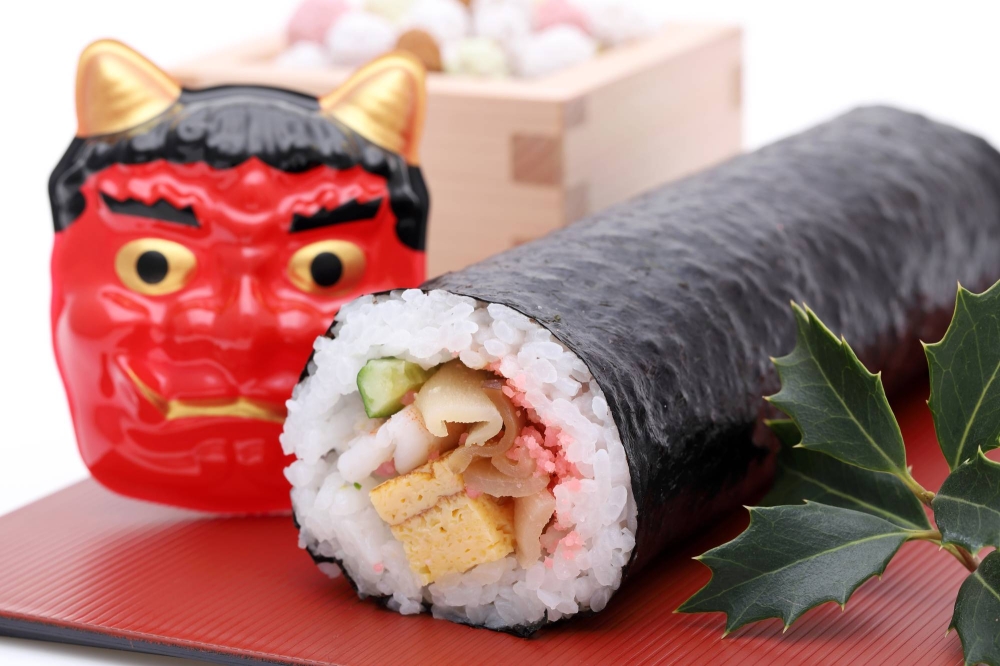
Other celebrations of Setsubun involve eating Nori Maki, a special sushi roll. Particularly in Western Japan, many may face a "lucky direction" (in geomantic form) and try to eat the entire sushi roll without saying a word. Those who can accomplish this feat (the roll is about 20 cm long) are promised luck with their business, longevity, and freedom from illness. In Osaka, where this tradition originated, some people say the practice started when a young Geisha ate the tasty delicacy to ensure she would be with her favourite lover in the coming year. In some areas, the Nori Maki is made with a stuffing of seven colours representing Shichi Fukujin (seven gods of happiness). These gods can be seen in the "happiness beans" illustration below.

OniBeans.jpg

Fuku Mame (Happiness Beans) are sold at Setsubun. Beans such as these may chase many an ogre away. This brand also sports images of Shichi Fukujin (the Japanese seven gods of happiness) sailing merrily along.

On the night of Setsubun, many Japanese decorate a holy tree in front of their houses with a head of a sardine, a clove of garlic, or an onion. Such talismans are designed to keep the one away as the New Year approaches (though the neighbour's cat may not be so intimidated). Oni are said to be stung by the leaf of the holy tree (a vitalistic Shinto symbol in its own right) and thus keep their distance from the home for the coming year.

In more ancient times, with a Chinese-based lunar calendar superimposed on indigenous ritual, the seasonal significance of Setsubun was more pronounced, incorporating traditional values of lineality, optimism, and vitality in ritual behaviour and in ritual objects themselves. Beans, seeds, the source of life... rice rolled in seaweed, fruits of land and sea... all used to ward off coming evil and ensure future productivity... objects whose ingestion assured vitality and purification. The centrality of this "last event of the year" and its implication for activities of a culture dependent upon an agrarian and marine base still holds at least symbolic significance for many in Japan.

These days, because of its solar orientation, Setsubun is one of the few festivals celebrated in Japan relative to actual astronomical reckoning, although most young Japanese have no idea that there is any incongruence throwing beans on a day occurring over a month past their memory of a Gregorian New Year. Of course, when a lunisolar calendar was used, another source of confusion regarding Setsubun occurred. As mentioned in our article on The Lunar Calendar in Japan, years with leap months could contain 383-385 days. "Leap" years could thus often have 2 "Spring Begins", one at the beginning of the year and another at the end or 12th month. The confusion of having two "New Year's Eves" was eloquently described by famed poet Motokata Arihara in Kokinshu (see Watanabe, 1994), although our translation does not do justice to his dry wit:

Before the year is over
"Spring Begins" comes
The year is not over
It is still the year

Oni wa Soto! Fuku wa Uchi!


References:

  • Campbell, A., D.S. Noble, et al. (1993) Japan; An Illustrated Encyclopedia. Tokyo: Kodansha Ltd.
  • Nojiri, H. (1992) Hoshi Sanbyaku Rokujyu Go Ya (365 Starry Nights). Tokyo: Kouseisha Kouseikaku.
  • Okada, Y. and S. Akune (1993) Gendai Koyomi Yomikaki Jiten (Modern Calendar Dictionary). Tokyo: Kashiwa Shoubou.
  • Sasama, Y. (1995) Fukugen; Edo Seikatsu Zuroku (Restorations; Picture Book of Edo Era Life). Tokyo: Kashiwa Shobou.
  • Sasama, Y. (1992) Shiryou; Nihon Rekishi Zuroku (References; Japanese Historical Illustrations). Tokyo: Kashiwa Shobou.
  • Shinmura, I. ed. (1994) Koujien (Japanese Etymological Dictionary). Tokyo: Iwanami Shoten.
  • Watanabe, T. (1994) Koyomi Nyumon; Koyomi no Subete (Introduction to the Calendar; All about the Calendar). Tokyo, Yuzankaku.
 
And lest we forget: get your roasted soybeans ready for tomorrow, it's setsubun.

We have updated our page here

=> Culture - Setsubun
 
Even as a non-religious person, I have to admit some few superstitions in my mind. This is is one of them. I am not deathly serious about it, but if I fail to do the chant and throw the beans, I will find myself blaming bad luck on it all year long.

I suppose I have been able to rid my mind of other superstitions because I grew up with them. But this one hit me when I was still young enough to be impressionable but too old to have such control over my sub-conscious as to eradicate it.

When the "out with the demons" part comes up, I always make a physical joke of having to hang on to something to avoid being sucked out of the house, or grab my kid and make like he is being sucked out.

In a way I guess its a quaint little tradition sort of like our jack-o-lanterns on Halloween designed to keep the demons away. I still don't appreciate having silly superstition implanted in my head though.
 
Even as a non-religious person, I have to admit some few superstitions in my mind. This is is one of them. I am not deathly serious about it, but if I fail to do the chant and throw the beans, I will find myself blaming bad luck on it all year long.

You must have been living in Japan for quite a while now! My wife strictly forbids the throwing of any kind of victuals in the house, so we have adopted the eho-maki habit. At last once a year food of reasonable proportions!
 
I've forgotten all about Setsubun since I was a child. Thanks Thomas! I've got some dried soybeans that I'm going to throw for some good luck tomorrow..
 
On the occasion of Setsubun, the German ambassador to Japan presented a German version of ehomaki, served with - no kidding - meat, sauerkraut, and mustard filling.


Around 3 February, ehomaki are sold in supermarkets and combinis, and every year, more non-traditional adaptations seem to become available. Sauerkraut and meat are a first, though! :)

More on setsubun and ehomaki here:

Setsubun

Culture  Setsubun

Setsubun is a traditional ceremony to dispel demons, usually observed on 3 February. The practice of scattering beans (豆撒き mamemaki) to drive away demons is one of some magical rites performed to ward off evil. The word setsubun (節分) originally referred to the eve of the first day of any of...
 
It's not German ehomaki without fleisch! They should have made him eat the whole thing on camera.

We just had 恵方巻 for dinner. Traditional style. (Only one style available here.)
 
Our local supermarket offered three metres of ehomaki today. I wish they had them throughout the year. :)

ehomaki.jpg

Here's a feature on how ehomaki, which are, in fact, nothing other than uncut futomaki, became a fixture in setsubun festivities.


The holiday marking the beginning of spring and the banishment of evil spirits from the previous year dates back to classical Japanese history and China before that. But over the past 25 years or so, a new "tradition" has stealthily glommed onto the fun, causing parent-age adults across Japan to scratch their heads. Wait, since when is this a thing? Eating ehōmaki on Setsubun requires one to sit facing the year's auspicious direction as determined by an old Chinese calendar system — east-northeast in 2024 — and eat an entire uncut futomaki sushi roll silently in one go. As early as December last year, advertisements for ehōmaki preorders started popping up in the windows of supermarkets and convenience stores.

 
We got ours and we properly faced East-Northeast and ate them silently. Sort of. My kids were trying to make each other laugh so it wasn't completely silent. But hopefully enough to keep the oni at bay.

IMG_9160.webp
 
But over the past 25 years or so, a new "tradition" has stealthily glommed onto the fun, causing parent-age adults across Japan to scratch their heads. Wait, since when is this a thing? Eating ehōmaki on Setsubun requires one to sit facing the year's auspicious direction as determined by an old Chinese calendar system — east-northeast in 2024 — and eat an entire uncut futomaki sushi roll silently in one go.

Since when, indeed! This is the first I've ever heard of this. I remember someone putting on an oni mask and then everyone else throwing beans at the poor soul. This new "tradition" sounds like a lot less cleanup, though. lol
 
Somehow I am always the target of the thrown soy beans, as well as the person responsible for picking them all up. I have noticed that the tradition, which once took place only at the entrance to the living space now included the entirety of the living space, and cleanup now takes a good 20-30 minutes. Given all this I can understand why some might want to go in another direction. ;)
 
Back
Top Bottom