Tech Japanese scientists create a rechargeable, remote-controllable cockroach

News stories related to technology and innovation.

thomas

Unswerving cyclist
Admin
Joined
14 Mar 2002
Messages
21,053
Reaction score
18,908
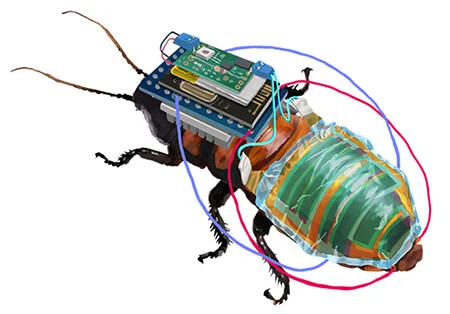
Researchers have engineered a system for creating remote-controlled cyborg cockroaches equipped with a tiny wireless control module powered by a rechargeable battery attached to a solar cell. Cyborg insects—part insect, part machine—can help inspect hazardous areas and monitor the environment. Handlers must be able to control them remotely for long stretches of time. This entails wireless control of their leg segments, powered by a tiny rechargeable battery.


remote-controlled-cockroach.webp


Led by Kenjiro Fukuda, RIKEN CPR, the team experimented with Madagascar cockroaches, which are approximately 6 cm long. They attached the wireless leg-control module and lithium polymer battery to the top of the insect on the thorax using a specially designed backpack, which was modeled after the body of a model cockroach. The backpack was 3D printed with an elastic polymer and conformed perfectly to the curved surface of the cockroach, allowing the rigid electronic device to be stably mounted on the thorax for more than a month. The ultrathin 0.004 mm thick organic solar cell module was mounted on the dorsal side of the abdomen. "The body-mounted ultrathin organic solar cell module achieves a power output of 17.2 mW, which is more than 50 times larger than the power output of current state-of-the art energy harvesting devices on living insects," according to Fukuda.

 
Researchers have engineered a system for creating remote-controlled cyborg cockroaches equipped with a tiny wireless control module powered by a rechargeable battery attached to a solar cell. Cyborg insects—part insect, part machine—can help inspect hazardous areas and monitor the environment. Handlers must be able to control them remotely for long stretches of time. This entails wireless control of their leg segments, powered by a tiny rechargeable battery.


View attachment 89632


I feel like solar power would not be very useful in a lot of the hazardous areas that would need something as small as an insect to inspect. I also feel like environmental monitoring could be done in more reliable ways then using a cyborg insect.

Don't get me wrong, its an interesting idea but I am curious what specific problem this would be a solution to. It would seem to me that the most obvious use case would actually be spying....
 
I feel like solar power would not be very useful in a lot of the hazardous areas that would need something as small as an insect to inspect. I also feel like environmental monitoring could be done in more reliable ways then using a cyborg insect.

Don't get me wrong, its an interesting idea but I am curious what specific problem this would be a solution to. It would seem to me that the most obvious use case would actually be spying....
I'm sure it's the same problems they would use insect-sized robots for. They always talk about using them to find people in collapsed buildings or to investigate toxic or radioactive environments. But I'm sure spying is on the list. Probably the insects have some advantages in that they need less electrical power and won't become disabled if the power runs out.
 
I'm sure it's the same problems they would use insect-sized robots for. They always talk about using them to find people in collapsed buildings or to investigate toxic or radioactive environments. But I'm sure spying is on the list. Probably the insects have some advantages in that they need less electrical power and won't become disabled if the power runs out.

But that is my point, those places would not generally be anywhere that would have enough light in order to recharge them and I doubt that they would have much of a battery life given the size constraints.

However having one hang out in a bush or tree or on the side of a wall in an office would probably have enough light, but that doesn't seem like the type of thing you would need for a rescue or toxic/radioactive environment situation. Maybe I am just being skeptical or cynical but the use cases seem to be a bit limited.
 
More on the bugbot:


The scientists, primarily from the Riken research institute, said a Madagascar hissing cockroach fitted with a ultrathin solar cell and a Bluetooth short-range wireless communication unit turned right or left in accordance with their instructions. "We may be able to mobilize cyborg insects to find people buried under debris in a disaster if we can put a thin temperature sensor on the bugs," said Kenjiro Fukuda, a senior research scientist at Riken. A power generator is essential for controlling the movements of insects and collecting data from them. Fukuda and his colleagues developed a 4-micrometer-thick solar cell, the world's thinnest, to not impair the motion abilities of insects. The battery can be recharged as long as the insects are alive.

 
I wonder how well they'd do on Mars. Or Europa.

(even without the battery/solar)
 
Here's the next generation of cyborg roaches, remotely guided by humans using ultraviolet light emitted from a tiny helmet attached to their heads:

insect-cyborg.webp


At first, the researchers inserted electrodes into antennae and other parts and guided the insects in the desired direction by applying stimulation. But this method placed a heavy burden on the insects, and repeated stimulation gradually made them less responsive. [...] Among the findings, he focused on a trait in which shining ultraviolet light into one eye causes the insect to move in the opposite direction. Ultraviolet light produces a slower initial response than electrical stimulation, but repeated use is less likely to dull the reaction. Because the electronic devices are attached with beeswax and other materials, the burden on the body is small and the devices can be removed. The team is also using sensors to monitor heartbeat, nerve signals and body movements, and is studying the relationship between environmental changes and insect responses. By understanding the insects' condition, Morishima said, they can guide them without placing excessive strain on them.

The research team is also working to extend battery life and give the insects greater autonomy, allowing them to make more of their own decisions rather than relying on human control. Morishima said the technology could eventually be used not only in disaster search and rescue but also for inspections in low-oxygen sewers, archaeological surveys and even planetary exploration.

He acknowledged that people trapped after a disaster might be startled if a Madagascar hissing cockroach crawled towards them, as the technology is still little known. But researchers in the field believe public attitudes would quickly change if the insect robots helped save even a single life.


Waseda University experimented with a cockroach diving suit:

 
Back
Top Bottom