Firstly, I suspect I could have been a little less so hardcore with my criticism of TEPCO in that post above, but I still have serious ill feelings toward the company. BUT I do appreciate that they provide a necessary service in this modern age. It's just that the executives seem so seriously big-headed, or something. The "something" could be better defined, but that is enough, for now.
The reason I am posting is that I finally had some time to do some research and I still feel that something isn't quite right. (There's that 'something' again. eh?)
So I'll start with a Japan Times article from Friday and I want to quote a professor's thoughts included toward the end of the article.
News on Japan, Business News, Opinion, Sports, Entertainment and More article expired

www.japantimes.co.jp
......................................................................---Quoting Starts---
Masakazu Kato, a professor at Tokyo Denki University who specializes in electrical systems engineering, said it will be impossible for Tepco to restore power in just a few days, given how long it took to recover from Typhoon Jebi last year in western Japan.
"As the (Tokyo) metropolitan area rarely experiences damage from typhoons, the lack of experience likely made the company take an approach that was too optimistic," he said.
In the wake of the March 2011 triple core meltdown at its Fukushima No. 1 plant, Tepco's investments in power lines and other facilities fell to ¥209.7 billion in fiscal 2015, down from ¥298.4 billion in fiscal 2009.
......................................................................---Quoting Ends---
<> <> <> <> <> <> <> <> <>
That Professor Kato seems to have better access to information than we and he seems to be of the mind that something isn't quite right.
I mean, I have been studying some edu tagged material and one example I'll place below, BUT the key thing I keep seeing some professionals are writing about is seeing the danger coming and getting ready for it.
I really hope that we can get beyond the usual bovine excrement we consumers frequently are fed and find out why the heck them TEPCO folks weren't better prepared.
And I will be placing a fair bit of text below from that book you will see the link for and which I have properly identified. I believe the pdf format is available without charge for what I have copied here.
<> <> <> <> <> <> <> <> <>
The National Academies Press of The National Academies of Sciences, Engineering, Medicine
"
Enhancing the Resilience of the Nation's Electricity System"
(2017)
[https://]www.nap.edu/read/24836/chapter/5#67 (I disabled the hotlink.)
......................................................................---Quoting Starts---
Prepare
The preparation phase begins when a specific threat is identified—for example, when a hurricane forms with a projected track that will impact a specific utility. Some hazards have no advance warning, while others can be identified and monitored with sufficient time for utilities and other responders to move beyond general planning and develop specific actions. For example, utilities preparing for impeding hazard may check the health of critical components (including the health of cyber systems), check stocks of spare equipment, activate mutual assistance agreements, and bring local crews to a state of readiness, potentially pre-staging supplies and repair crews at specific locations. Operators assess the level of generation available, likely bringing additional reserve generation online, evaluate the adequacy and vulnerability of different fuel stocks and supply chains, and verify the state of charge of utility-scale storage assets if available. During preparation, utilities can begin coordinating with relevant disaster response organizations and encourage the public to purchase fuel and test backup generators. Utilities that have built and maintained strong relationships with local emergency management organizations know whom to engage, whereas organizations that have not built these relationships may waste valuable time and resources trying to connect with local efforts. There are growing opportunities to engage distributed energy resource (DER) owners so that system operators know the state of these resources, although current interconnection standards and contractual arrangements need to be revised to promote utility visibility and controllability of DERs.
......................................................................---Quoting Ends---
<> <> <> <> <> <> <> <> <>
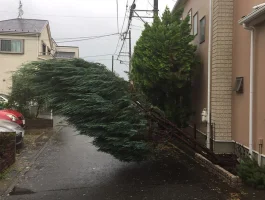
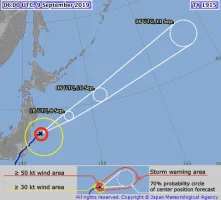
So we now get back to whether those TEPCO folks did enough to prepare for a typhoon they had what might seem to some folks enough warning was heading toward that area that is now in so much turmoil?
Do you think they had enough warning before that typhoon struck?
I mean, we have ourselves here an area of the planet that shakes a lot and sometimes shakes really hard and so if these individuals that are responsible for maintaining an electric grid can't be better prepared for some disaster they can see is coming, how much can we trust they can handle a bad shake they might only give them seconds of warning before it happens?
And do we consumers have a right to ask that sort of question?






 (Now which one was it?)
 (<- Did I do this right?)


