Typographic symbols

eeky

先輩
Joined
8 Jun 2010
Messages
2,431
Reaction score
22
1. In the book I'm reading, a few (not many) paragraphs start with long vertical lines as highlighted below. I cannot identify any reason for this. In terms of the meaning of the text or flow of the story there seems nothing different about these paragraphs than any others. What do these lines signify?
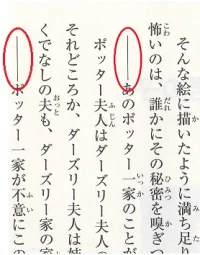
hp1.webp

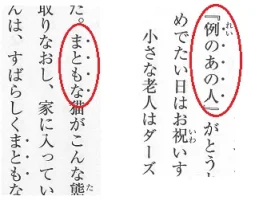
2. Are the dots next to まともな below to help the reader understand that it is one word?

What about the dots next to 例のあの人?
hp2.webp
 
Im not sure about 1, but I believe 2 is for emphasis. For example in manga I believe they translate the words into bolded words. I guess you could say "epic" parts.
 
Well I googled it and it seems more obvious now. Are you reading harry potter?
Yeah, that's right...

I'm not to sure what rei exactly means here though or if this is a set phrase they made for voldemort.
I think 例の・・・ is a set expression which means "a certain...", or, as described in WWWJDIC, used to form expressions like "you-know-(who, what, etc.)"
 
I'm not exactly sure what the first is called, but it's commonly used to link the current sentence to the previous one. Kind of like adding a relevant idea. A varied version of a semi-colon, you could say....with different criteria on the usage.

The second is called wakiten, and is used to emphasize words. In speech(quotes), the word highlighted in bouten is actually emphasized when the speaker says it. In writing(i.e. normal text), it often indicates a sort of irony. English writing often does this in the form of italics.
"If you actually tried, you would've finished it on time." as an english example. Of course, the choice in which words to emphasize often differs from english.
 
1)
The line shows that the sentence(s) following it (e.g. あのポッター一家のことが誰かに知られてしまったら一巻の終わりだ。) is a direct quotation of Dursley's thought or voice in his mind, similer to 「」 for what a person said.

2)
I think your interpretation "used to demarcate words where it might not be obvious where word boundaries lie" is correct in this case.
 
Back
Top Bottom