Yellow sand (黄砂)

thomas

Unswerving cyclist
Admin
Joined
14 Mar 2002
Messages
21,050
Reaction score
18,904
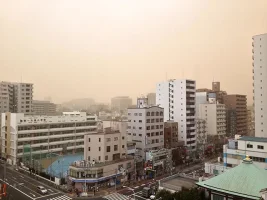
Yesterday, it wasn't just spring in the air: the blue skies turned into a yellowish haze within just a few minutes (see the pic below taken in eastern Tokyo, original colours).
yellow_sand.webp

"Kosa" (黄砂 Yellow Sand) a phenomenon that's been striking Japan for a couple of years it seems, I have never experienced it first-hand in the Kanto region.

=> Asian Dust - Wikipedia, the free encyclopedia

=> BBC NEWS | Asia-Pacific | China dust storm hits East Asia

The skies are back to blue, nothing but a thin layer of dust remains. Seems we have to get used to it.
 
Oh, so is that what this was all about? I didn't watch it immediately because I figured the title had something to do with music or something. :P
 
i never thought that sand storm could reach Japan !
As i see in the picture and the video it's not as bad as Sand storm in Arabia..Look what we get XD
sandstormepic10-1.webp


23516820copy-1.webp


D8BAD8A8D8A7D8B120D8A7D984D8B1D98AD8A7D8-1.webp


the tower in the last picture is 302 metre high...
 
I think its been going on longer than that.

Yes, that's correct. "Kosa (yellow sand or loess)" has been an annual event since god-knows-when. I studied about it in elementary school, and that's in the 1960s. It is only in recent years that it is regarded a problem first because the sand particles stuck with pollen to aggravate pollen allergy, which is growing among the Japanese, and lately because pollutants in the air in China are carried together with it.

Loess Plateau - China - YouTube
 
I think it's funny that it was yesterday when it hit Tokyo that suddenly millions of photos popped up everywhere, but the day before when it hit the Kansai region, I so almost no photos at all! *g*
It was pretty bad here on Saturday (one day before it hit Tokyo). I spent the day in hospital because my hay fever became REALLY bad - and I was not the only one. There were a lot of people in the hospital.
 
I think it's funny that it was yesterday when it hit Tokyo that suddenly millions of photos popped up everywhere, but the day before when it hit the Kansai region, I so almost no photos at all! *g*
It was pretty bad here on Saturday (one day before it hit Tokyo). I spent the day in hospital because my hay fever became REALLY bad - and I was not the only one. There were a lot of people in the hospital.

"Kosa" level declines over distance, so the concentration is higher in Kyushu and more or less high in other parts of western Japan. It has never been thick in Tokyo, causing only a very thin layer of sand settling on cars parked for hours. It has never been thick as it was in Tokyo yesterday.

The sandy mist that covered Tokyo actually was not "kosa" but sand flushed by strong winds from the mountains north of Tokyo. It was a totally different and very rare phenomenon. I don't remember it happening as far as I can recall. (But then, my confidence in my memory is waning... :p)
 
It looked pretty bad here as well, but as I rushed from the hospital to work, I didn't have time to take a photo of it.
I admit that it didn't look as bad as the photos I've seen of Tokyo thus far, though! ;)
 
Was plenty of it on Sunday in Saitama. Couldn't see past 150 metres I guess, I got more than enough sand in my eyes too.
 
The sandy mist that covered Tokyo actually was not "kosa" but sand flushed by strong winds from the mountains north of Tokyo.

Where did you get that information? What mountains?

I am in chubu and we got some sand as well, though not that bad. That would suggest that either the sand came from north of Chubu (which does not make much sense as there was not as much) or the sand came from south of here (which means the wind blew both north and south at nearly the same time).

Now, I may have missed something, but it seems strange. I guess its also possible that both mountains north and south of my position were being eroded. Its also possible the wind changed directions mid day. Or that the sources were different between here and Tokyo.
 
Where did you get that information? What mountains?

It was reported so in the weather news here in Tokyo. I wasn't listening to everything they said, but it reportedly was caused by the winds coming from the mountains in Gunma and nearby. It was a local phenomenon, I guess.
So, it must have been dreadfully thick in Saitama (with Gunma being north of Saitama).
I live in western Tokyo and saw some haze out my window but nothing like what I saw on TV. (Was home all day.)

Edit: I was just checking the new reported in English, and all of them claim the sandstorm to come from China. It was pretty local for having crossed all this way to hit Japan, especially only the Pacific side and not the other side of Japan. lol
While the Japanese meterologists say it is a sandstorm raised by northerly winds picking up dust and raising them up into the sky due to rapid change in air temperature, a lot of people on the Web are fanning fear that it is pollution from China. If it is, this should have happened more frequently from years ago.
 
Yesterday's and today's weather reports warned of the annual "kosa attack", the yellow sand (aka "Asian dust") stirred up by winds in the desert regions of Mongolia and China and spread over large parts of East Asia, including Japan.


It seems that large portions of the dust cloud will reach Japan tonight, though Kanto will - most likely - be not affected.

kosa-16032021.webp


The website of the Ministry of the Environment has more real-time info:

LIDAR (Light Detection And Ranging) is a remote sensing technology that can distinguish DSS particles that cannot be seen with the naked eye from other atmospheric pollutant particles (e.g. air pollutants) and that can monitor such particles on a real-time basis. On this page, the DSS distribution near the ground is estimated and represented as a point of colour based on the monitoring results (provisional data) of LIDAR.

 
Japan's fifth season, the Yellow Sand Season, is upon us: the Japan Meteorological Agency warned that seasonal yellow sand (黄砂 kōsa) is expected to blow across vast areas from northern to western Japan on April 12 and 13, creating a possible hazard for transportation systems.

Yellow sand (黄砂 kōsa)


In some areas, visibility could be reduced to under 10 kilometers, the agency said. Yellow sand is fine dust particles churned up by strong winds from deserts on China's mainland. In some areas of China, yellow sand reduced visibility to less than 2 km on the morning of April 11. The last time yellow sand was observed in Tokyo in April was 16 years ago, the agency said. Yellow sand last reached the capital in May 2021. Yellow sand was already observed in Niigata Prefecture on March 24, but it had not spread to wide areas so far this year. Although yellow sand is often observed during this season in western Japan and the Kyushu region, it is rare for the dust to cover wide areas up to Hokkaido, the JMA said.


I think it should actually be called 'dust', since anything that makes it to japan is far finer than sand.


But anyway, I just wiped down the windows on my car (=poor man's car wash). I hope it won't be too bad.
 
Over here it's called "sand wind". It carries fine red sand particles from the sahara. It usually happens in spring and autumn. Last year it reached the Alps
 
Was out for a ride mid day, the 'dust' slipped my mind and I didn't even remember to think about it.

But the wind? Yeah, I was thinking about that...!
 
It seems parts of western and northern Japan were more affected. Below is a picture taken in Osaka:

kosa-osaka.webp

Osaka on Wednesday (photo credit: Kyodo)


And here is some medical advice for those suffering from dust symptoms:

They advised people, especially those with respiratory conditions, to minimize their outdoor activities, wear masks that cover the nose, and apply moisturizer and sunscreen to exposed skin. Emergency calls for heart attacks and cerebral infarctions increase on the day after yellow sand arrives from China, according to Kazunari Onishi, associate professor of environmental epidemiology at St. Luke's International University, who specializes in health damage from yellow sand. Yellow sand inhalation causes symptoms similar to those from pollen allergies, such as sore throats, itchy skin and excess phlegm.

 
Yellow sand carried by westerly winds was observed in Osaka on 16 January, an unusual event for the winter season, according to the Japan Meteorological Agency. The concentration was not high enough to affect public transport. Still, the agency said the dust could continue to spread across parts of Shikoku and Kyushu until the morning of 18 January. Yellow sand is rarely seen in winter, as desert surfaces on the Asian continent are usually frozen, which limits the amount of dust that can be lifted into the air.

adc10414d18c2b50d2e659d24e58d235.jpg

The agency urged residents to watch for dust settling on laundry and vehicles. The phenomenon was confirmed visually in Osaka at 9:30 a.m. on 16 January, while no such observation had been made in Tokyo as of late afternoon. Meteorological officials said the dust was likely stirred up when a low-pressure system moved across the Gobi Desert around 13 January, generating strong winds that carried the sand eastward over the Sea of Japan and toward Japan.

 
We regularly have Sahara desert's sand carried over the UK and washed down by the rain onto our cars 😡 A few years ago our skies were eerily red for a day or two as a result. These photos were taken at midday but the red tinge and darkness aren't really captured.
20171016_143601.webp

20171016_143646.webp
 
It looked like we were on Mars and the song that was rattling around my head was…

"The chances of anything coming from Mars are a million to one," he said.
"The chances of anything coming from Mars are a million to one – but still they come!"
 
Back
Top Bottom