

Navigation
Install the app
How to install the app on iOS
Follow along with the video below to see how to install our site as a web app on your home screen.
Note: This feature may not be available in some browsers.
More options
Style variation
System
Light
Dark

You are using an out of date browser. It may not display this or other websites correctly.
You should upgrade or use an alternative browser.
You should upgrade or use an alternative browser.
Translate some handwritten kanji i got as a gift please?
- Thread starter kibishi
- Start date

undrentide
Japa'n vagyok
- 18 Jan 2006
- 3,652
- 310
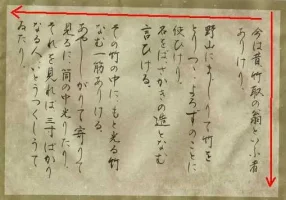
First of all, it is not in the right direction... it should be rotated 90 degree (clockwise). 
It is written from top to down, and from right to left.
The text is the first part of 竹取物語(taketori monogatari/The Tale of the Bamboo Cutter) which is supposed to have been written in the 10th century. Like Canterbury Tales are very different from the present English, Japanese language at that time is very different from the modern Japanese.
今は昔、竹取の翁といふ者
ありけり
野山にまじりて、竹を
とりつゝよろずのことに
使ひけり
名をばさかきの造となむ
言ひける
その竹の中にもと光る竹
なむ一筋ありける
あやしがりて寄りて
見るに、筒の中光たり
それを見れば三寸ばかり
なる人いとうつくしうて
ゐたり
(rough translation)
Once upon the time, there was a person called the Old Bamboo Cutter.
He went into the fields and mountains, cutting bamboos to make them into various utensils.
His name was Sanuki no miyatsuko.
Among the bamboos he found the one which glowed at the base.
He wondered and went up to it, to see its inside was shining.
He looked into it and found a person of 3 sun (= approx. 9cm) who is very beautiful.
http://www2s.biglobe.ne.jp/~Taiju/taketori.htm
Original text of The Tale of the Bamboo Cutter (Japanese)
The Tale of the Bamboo Cutter - Wikipedia
About the story (Wikipedia)
It is written from top to down, and from right to left.
The text is the first part of 竹取物語(taketori monogatari/The Tale of the Bamboo Cutter) which is supposed to have been written in the 10th century. Like Canterbury Tales are very different from the present English, Japanese language at that time is very different from the modern Japanese.
今は昔、竹取の翁といふ者
ありけり
野山にまじりて、竹を
とりつゝよろずのことに
使ひけり
名をばさかきの造となむ
言ひける
その竹の中にもと光る竹
なむ一筋ありける
あやしがりて寄りて
見るに、筒の中光たり
それを見れば三寸ばかり
なる人いとうつくしうて
ゐたり
(rough translation)
Once upon the time, there was a person called the Old Bamboo Cutter.
He went into the fields and mountains, cutting bamboos to make them into various utensils.
His name was Sanuki no miyatsuko.
Among the bamboos he found the one which glowed at the base.
He wondered and went up to it, to see its inside was shining.
He looked into it and found a person of 3 sun (= approx. 9cm) who is very beautiful.
http://www2s.biglobe.ne.jp/~Taiju/taketori.htm
Original text of The Tale of the Bamboo Cutter (Japanese)
The Tale of the Bamboo Cutter - Wikipedia
About the story (Wikipedia)
Attachments


- 15 Mar 2002
- 16,758
- 2,298
Just this one more please? very tiny.
窶堋?窶堙ァ窶堋ス窶堙ヲツ(ツ?ツ)窶堙
窶堙??堋オ窶堙
窶堙坂?堋カ窶堙溪?堙娯?堙ヲ窶堙ォ窶堋ア窶堙鯛?堙ー
窶堙?窶堋、窶堋オ窶堋?窶堋ー窶堙懌?堋キ

JimmySeal
Tubthumper
- 5 Mar 2006
- 1,516
- 78
Where did this come from? It looks like a January birth announcement or something.Just this one more please? very tiny.
- 15 Mar 2002
- 16,758
- 2,298
Where did this come from? It looks like a January birth announcement or something.
More like a New Year's card, judging by the content.
undrentide
Japa'n vagyok
- 18 Jan 2006
- 3,652
- 310
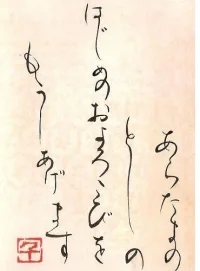
窶堋?窶堙ァ窶堋ス窶堙懌?堙個 aratamano
窶堙??堋オ窶堙 toshino
窶堙坂?堋カ窶堙溪?堙娯?堋ィ窶堙ヲ窶堙ォ窶堋ア窶堙鯛?堙ー hajimeno oyorokobi wo
窶堙?窶堋、窶堋オ窶堋?窶堋ー窶堙懌?堋キ moushiagemasu
It's a very polite and a little old-fashioned greeting for the New Year, which is roughly translated as "I would like to express the joy for the New Year".
窶堋?窶堙ァ窶堋ス窶堙懌?堙個(ツ新窶ケテ岩?堙個) ... this is called makura-kotoba, it's a kind of old rituals to add a certain word to a specific word, but does not always means any specific thing.
窶堙??堋オ窶堙娯?堙坂?堋カ窶堙溪?堙個(窶扼窶堙個鞘?ー窶堙溪?堙個) of the start of the year
窶堋ィ窶堙ヲ窶堙ォ窶堋ア窶堙鯛?堙ーツ(窶堋ィナ?テャ窶堙鯛?堙ーツ) joy, pleasure, celebration
窶堙?窶堋、窶堋オ窶堋?窶堋ー窶堙懌?堋キツ(ツ申窶堋オツ湘」窶堋ー窶堙懌?堋キツ) to express
窶堙??堋オ窶堙 toshino
窶堙坂?堋カ窶堙溪?堙娯?堋ィ窶堙ヲ窶堙ォ窶堋ア窶堙鯛?堙ー hajimeno oyorokobi wo
窶堙?窶堋、窶堋オ窶堋?窶堋ー窶堙懌?堋キ moushiagemasu
It's a very polite and a little old-fashioned greeting for the New Year, which is roughly translated as "I would like to express the joy for the New Year".
窶堋?窶堙ァ窶堋ス窶堙懌?堙個(ツ新窶ケテ岩?堙個) ... this is called makura-kotoba, it's a kind of old rituals to add a certain word to a specific word, but does not always means any specific thing.
窶堙??堋オ窶堙娯?堙坂?堋カ窶堙溪?堙個(窶扼窶堙個鞘?ー窶堙溪?堙個) of the start of the year
窶堋ィ窶堙ヲ窶堙ォ窶堋ア窶堙鯛?堙ーツ(窶堋ィナ?テャ窶堙鯛?堙ーツ) joy, pleasure, celebration
窶堙?窶堋、窶堋オ窶堋?窶堋ー窶堙懌?堋キツ(ツ申窶堋オツ湘」窶堋ー窶堙懌?堋キツ) to express
- 15 Mar 2002
- 16,758
- 2,298
I never would have guessed the あらたまの. Given the context, and knowing that あらた likely meant "new" (as in 改めて), it was pretty easy to work out that it was a New Year's card.
This is actually one of the easiest to read of all the calligraphic things I've seen. It really helps once one knows that し usually gets dragged straight down with no curve at all.
This is actually one of the easiest to read of all the calligraphic things I've seen. It really helps once one knows that し usually gets dragged straight down with no curve at all.
undrentide
Japa'n vagyok
- 18 Jan 2006
- 3,652
- 310
Japanese Wikipedia about 窶督最スナ has a list, maybe not a complete but might be interesting.
枕詞 - Wikipedia
枕詞 - Wikipedia
- 15 Mar 2002
- 16,758
- 2,298
A little bit off topic maybe.
No kanji at all in that handwriting. Does it has any special meaning?
I think this explains it well: http://tinyurl.com/26sctr
JimmySeal
Tubthumper
- 5 Mar 2006
- 1,516
- 78
I guess I kept reading 窶扼窶堙個鞘?ー窶堙溪?堙固?テャ窶堙鯛?堙ーツ申窶堋オツ湘」窶堋ー窶堙懌?堋キ and kept hearing "Announcing the first joy of the new year" in my head, which did seem a bit of a strange thing to say, but it didn't make sense to me as a New Year's card either.More like a New Year's card, judging by the content.
Incidentally, aside from being a 窶督最スナ? the combination 窶堋?窶堙ァ窶堋ス窶堙懌?堙娯?扼 has the specific meaning ツ新窶扼.

Nagato
後輩
- 14 Feb 2007
- 58
- 4
Thanks, I've read it.I think this explains it well:
But my question is that some times I read hiragana-only text.
Is there any special meaning (polite, elegant, etc)?
When we use hiragana-only text, and when use kanji is better
P.S.
Error message:
"You do not have enough posts yet to add URLs to third-party websites."
So, I can't insert URLs yet, no?
JimmySeal
Tubthumper
- 5 Mar 2006
- 1,516
- 78
I believe in this case it's probably because hiragana is seen as intimate and simple, and therefore well suited for a New Year's card. Unless you're planning on designing greeting cards or writing children's books, you don't need to worry about writing things in all hiragana.Thanks, I've read it.
But my question is that some times I read hiragana-only text.
Is there any special meaning (polite, elegant, etc)?
When we use hiragana-only text, and when use kanji is better
P.S.
Error message:
"You do not have enough posts yet to add URLs to third-party websites."
So, I can't insert URLs yet, no?
I think you need 20 posts to start posting URLs. But you can be sneaky and, for example, put a space between ht and tp, or something like that.

epigene
相変わらず不束者です
- 10 Nov 2004
- 4,354
- 179
But my question is that some times I read hiragana-only text.
Is there any special meaning (polite, elegant, etc)?
When we use hiragana-only text, and when use kanji is better
If you see the image, you can see that is it not only written in hiragana but in calligraphic style. It is called "cursive kana calligraphy," sometimes called "onna-de (women's writing)" because women of Heian court wrote in hiragana.
It was written intentionally so as a form of art.
Calligraphy Styles
There are three basic style: kaisho, gyousho, and sousho. Kana might be added as a fouth style. Kaisho, a block style with little movement, is also called shinsho. Gyousho is an intermediate style neither as stiff as kaisho nor as flowing as sousho. Sousho is a highly cursive style written with swift strokes. Its freedom and aesthetic appeal has made sousho very popular with calligraphy masters.
Kana originated in the more extreme forms of sousho. Because it was the primary script for Heian women, kana was at one time referred to as onnade (women's writing). Kana developed with the growing popularity of waka poetry. Compared to the boldness of Chinese characters kana is elegant and refined. Japanese calligraphy is judged not only by its surface beauty and meaning but also by the calligrapher's character.
From: Calligraphy styles

Similar threads


- Replies
- 167
- Views
- 117K
