Business Don Quijote unveils new food-focused store format

thomas

Unswerving cyclist
Admin
Joined
14 Mar 2002
Messages
21,053
Reaction score
18,908
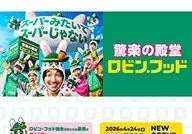
Don Quijote Co., Ltd. has opened the first outlet of its new grocery-focused retail format, Robin Hood (ロビン・フッド), moving into an increasingly crowded supermarket market where major retailers are competing hard for price-conscious shoppers. The first Robin Hood store opened on Thursday in Ama, Aichi Prefecture . Interest appeared strong from early on. Even an hour before opening, people were already lining up outside, and by 9 a.m., around 500 shoppers had gathered.


One shopper said she ended up buying more than she had planned because prices were so low. The new format is built around two main selling points — value for money and saving time. That is the pitch, at least. Products on offer include rice balls for 85 yen each, chicken wings for 106 yen, and boxed lunches in the 300-yen range. Low-priced, quick meals are clearly central to the concept.
The store also features a buffet-style section offering Sanuki udon for 214 yen per bowl. Customers can choose between eastern and western Japanese broth styles, while toppings such as green onions and wakame seaweed are free. Tempura can also be added at a discounted price. In the fresh food section, convenience is heavily emphasised. Prepared fish dishes only need to be grilled, while meat dishes can be heated directly in their trays in a microwave. The company is highlighting private-label products designed to be both easy and quick to prepare. [...] The launch of Robin Hood could reshape Japan's supermarket landscape. The operator of Don Quijote has announced plans to acquire the mid-sized supermarket chain Olympic. Roughly half of Olympic's stores are expected to be converted into Robin Hood outlets. The company plans to expand into the Tokyo metropolitan area next year and increase the chain to as many as 300 stores by 2035. Competition is also intensifying as regional supermarket operators expand into major urban markets. Valor, which operates 249 stores mainly in Gifu and Aichi prefectures, opened its first Kanto-region store last year. Its key attraction is a seafood section resembling a wholesale market, with more than 30 varieties of fish available year-round. The company plans to open another Kanto store this year.


Links:

Don Quijote Co., Ltd.

Don Quijote Co., Ltd.

Don Quijote is a Japanese discount store chain known for carrying a wide range of goods, from everyday groceries to electronics and clothing.

Robin Hood Food

Robin Hood Food

Robin Hood is a new food-focused retail format launched by Don Quijote Co., Ltd.

Beisia Co., Ltd.

Beisia Co., Ltd.

Beisia is a major Japanese supermarket and shopping-centre operator based in Gunma Prefecture.
Valor

Valor

Valor is a major regional supermarket chain based in Gifu Prefecture and centred largely in central Japan, particularly the Tōkai region
 
value for money and saving time
My wife likes to shop at one of the DQ here, she always comments on the prices being good. But she has a reason to go past it once a week--it's on the way to (way back from) where here mother is in a care home. So it's convenient for her to shop there--once a week. And that's on a weekday, mid day, so not much traffic and the store itself is not as busy. But we have three supermarkets within about five minutes drive, also a smaller gyomu super. And a couple more just a little farther--never needed. On other days that's where she goes.

The DQ is a good 10, maybe 15min each way, also a huge parking area to navigate (and then farther from parking into and thru the store, and back to the car). Not worth the extra 'cost' in time for me. (Similar for our costco, which is maybe 30min each way, not counting the zoo getting in and out of parking there.)

Best quality for us is a Sankyu, 1.8km away (best quality fish and produce, tho pricier); next is a cheaper Albis, 1.4km. There's a second Sankyuu, also 1.4km, but the management is not as good (reflected in their selections/presentation).

That first Sankyu is kind of upmarket, lots of nice housing close by, they'll have certain veggies like cauliflower when nobody else does. Also a minor selection of imported cheese--pecorino, gorgonzola, and so on.

We also have Valour, not so good, imo.
 
The first Robin Hood store opened on 24 April in Ama, western Aichi Prefecture, marking the chain's entry into the Tokai region, where local supermarket operators already compete fiercely for customers. Centred on Nagoya, the Tokai region is Japan's third-largest economic zone after the Tokyo-area Kanto region and the Osaka-centred Kansai area.


The new format is trying to set itself apart by combining a larger grocery section with the everyday goods and miscellaneous products long associated with Don Quijote, better known as "Donki". The company appears to be betting that the chain's familiar discount style will help it stand out in the crowded local market. A day before the opening, rows of onigiri filled the prepared foods section during a media preview on 23 April.

Several varieties of what the company described as a signature Robin Hood product were priced below comparable items sold at convenience stores. A "dashi gohan" rice ball made with broth-flavoured rice rather than large fillings sold for ¥85 including tax, while ume plum and Japanese-style tuna mayonnaise versions were priced at ¥106.

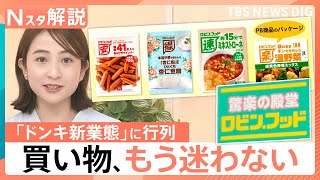
The format leans not only on "cospa," a portmanteau of "cost performance," but also on "taipa," or "time performance" that focuses on time-saving convenience. Taipa items include steamed vegetables that go straight into the microwave, bag and all, for 193 yen including tax. At the meat and fish counters, shoppers will find pre-seasoned cuts and deboned fillets, ready to cook. Each private label item is stamped with one of four kanji characters for "easy," "cheap," "value" or "fast" to convey its defining feature at a glance and underscore the format's emphasis on simplicity and speed.

The format leans not only on "cospa" (コスパ), shorthand for "cost performance", but also on "taipa" (タイパ), or "time performance", a term used in Japan for products and services designed to save time and effort. Taipa-oriented products include steamed vegetables that can be placed directly in the microwave, still in the bag, priced at ¥193 including tax. Meat and fish sections also offer pre-seasoned cuts and deboned fillets ready for immediate cooking. Each private-brand item is marked with one of four kanji (漢字) characters meaning "easy", "cheap", "value", or "fast", allowing shoppers to recognise the product's main feature at a glance and reinforcing the store's focus on simplicity and convenience.

 
Back
Top Bottom