


- 14 Mar 2002
- 21,051
- 18,904
City officials in Kyoto are dealing with graffiti showing up again in the Arashiyama bamboo forest, a popular spot for visitors. An inspection turned up carvings on roughly 350 bamboo stalks along the path that cuts through the grove north of Tenryuji temple, a UNESCO World Heritage site.
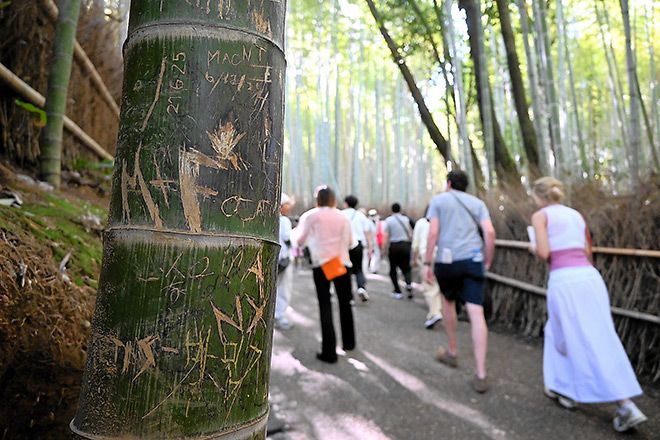
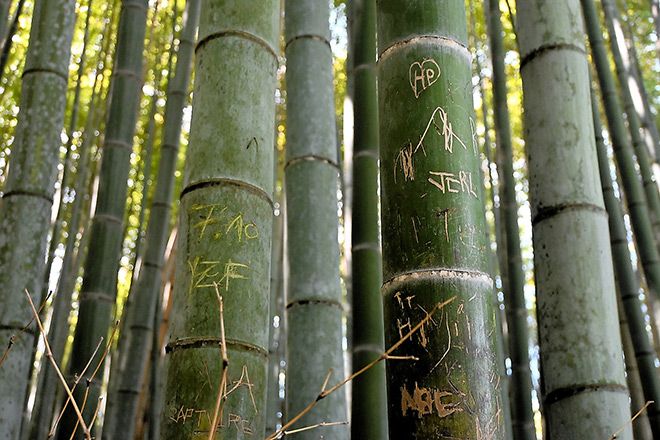
Most of what's been scratched into the bamboo is in Roman letters, though there's some Japanese, Chinese, and Hangul mixed in. City officials attribute the damage to the surge in tourism after COVID-19 restrictions lifted.
About half the grove belongs to the city—around 7,000 bamboo stalks spread over 2.3 hectares. Officials point out that deep cuts can actually kill the plants and make them topple over. Their current plan involves removing the most severely damaged stalks and pushing for more responsible behaviour from tourists.
Most of what's been scratched into the bamboo is in Roman letters, though there's some Japanese, Chinese, and Hangul mixed in. City officials attribute the damage to the surge in tourism after COVID-19 restrictions lifted.
About half the grove belongs to the city—around 7,000 bamboo stalks spread over 2.3 hectares. Officials point out that deep cuts can actually kill the plants and make them topple over. Their current plan involves removing the most severely damaged stalks and pushing for more responsible behaviour from tourists.
Experts at the Kyoto Botanical Gardens note that carving into bamboo causes permanent damage. The local tourism community has responded by covering the graffiti with green tape, a makeshift solution that compromises the forest's natural beauty. Graffiti was also a major issue in 2018 that prompted members of the local tourism community and monks from Tenryuji temple to launch a public anti-defacement campaign. Fewer tourists during the pandemic meant fewer incidents, but the amount of graffiti has rapidly increased since this spring, particularly during the summer months.

 We have Roman graffiti in places here in the UK and Isaac Newton left some in our school's library.


 Poor things need feeding up!


 influence is strong so youth tag everywhere and councils can't afford to clean it up.


