

Navigation
Install the app
How to install the app on iOS
Follow along with the video below to see how to install our site as a web app on your home screen.
Note: This feature may not be available in some browsers.
More options
Style variation
System
Light
Dark
You are using an out of date browser. It may not display this or other websites correctly.
You should upgrade or use an alternative browser.
You should upgrade or use an alternative browser.
Art Meiji Era brought to life
- Thread starter Ukigumo
- Start date
Topics, threadsm and news related to Japanese art and artists

Ukigumo
後輩
- 15 Mar 2025
- 1,382
- 2,684
- Thread starter
- #2
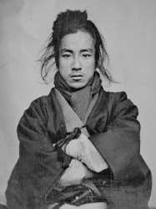
The unidentified Samurai , Yokohama 1864-65 (1:54) has long been favourite image of mine because he looks really unpleasant and a complete bas*ard; u wouldn't mess with him. I have him printed on birthday and Christmas cards I send out, with appropriate, threatening messages that I write inside! So it's funny to see him articulated and in colour looking somewhat less mean!
If you look at the weirdness of the woman playing shamisen at 1:37. AI has made her try to for a guitar-like G major chord, with her second finger extended out at an angle and a bit of an open D major chord! Also her bachi (plectrum) initially held in her hand becomes melded with the skin of her shamisen body like a flap of paper which she proceeds to crumple and handle
Still, it's pretty amazing to see.
If you look at the weirdness of the woman playing shamisen at 1:37. AI has made her try to for a guitar-like G major chord, with her second finger extended out at an angle and a bit of an open D major chord! Also her bachi (plectrum) initially held in her hand becomes melded with the skin of her shamisen body like a flap of paper which she proceeds to crumple and handle
Still, it's pretty amazing to see.
Ukigumo
後輩
- 15 Mar 2025
- 1,382
- 2,684
- Thread starter
- #3
Here's another
At 1:18, the seated samurai looks very uncomfortable when the standing samurai puts his hand on his shoulder Then the standing samurai looks intensely at seated samurai as if to say 'I'm going to make gentle but confident love to you later!' before glancing over to invited the ?Russian? soldier to join them!
If a picture speaks a thousand words, a moving picture tells ten thousand
At 1:18, the seated samurai looks very uncomfortable when the standing samurai puts his hand on his shoulder
Then the standing samurai looks intensely at seated samurai as if to say 'I'm going to make gentle but confident love to you later!' before glancing over to invited the ?Russian? soldier to join them! If a picture speaks a thousand words, a moving picture tells ten thousand

- 18 Jan 2005
- 11,682
- 3,641
I've heard that these souvenir photos feature commoner actors. These photos, on the other hand, show samurai, feudal lords, and members of the imperial family from the late Edo and early Meiji periods whose names are known.
Ukigumo
後輩
- 15 Mar 2025
- 1,382
- 2,684
- Thread starter
- #5
Oda Nobuyoshi (1:37) was a dentist, civil rights activists and chair of Kochi City Council. This photo was taken when he was 20 years old. Was he samurai as his name might suggest?
He obviously had a hard life as this is how he looked in later life.
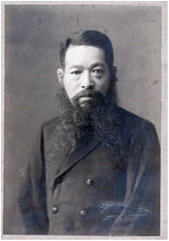
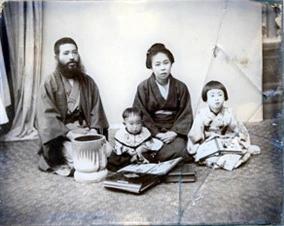
He obviously had a hard life as this is how he looked in later life.

- 6 Mar 2003
- 9,317
- 9,444
What do you mean? He doesn't look that rough.He obviously had a hard life as this is how he looked in later life.
 Perhaps you don't suffer my 'curse'
- 18 Jan 2005
- 11,682
- 3,641
Oda Nobuyoshi was born on February 9, 1860, in Sukumo, Hata District, Tosa Province (present-day Sukumo City, Kōchi Prefecture). His father was Oda Daihachi, a samurai of the Tosa Domain, and his mother was named An. His original name was Hada Masaburō. In 1868 (Keiō 4 / Meiji 1), he served as a retainer of the Iga family in Sukumo. On December 28, 1873 (Meiji 6), it was recorded that Hada Nobuyoshi had graduated from the 7th class of the Lower Elementary School No. 208 in Sukumo Village, Hata District.
Oda Nobuyoshi was a complex and intriguing figure from the early Meiji period of Japan. He was noted for his striking good looks and gained popularity as one of the "handsome men" of his time. However, beyond his appearance, he was also known for his radical political beliefs and actions.
Nobuyoshi was actively involved in the Freedom and People's Rights Movement (民権運動, Minken Undō), a political campaign in the late 19th century advocating for democracy, civil liberties, and constitutional government in Japan. Frustrated with the slow pace of reform and the government's authoritarian stance, he eventually turned to more extreme measures.
He became infamous for engaging in political terrorism, including bomb-related activities aimed at challenging the government. This earned him a reputation as one of the rare examples of a Japanese anarchist or revolutionary who resorted to violent means during that era.
Interestingly, aside from his political activism, Oda Nobuyoshi was also a trained dentist, making his life story all the more unusual. His combination of charisma, intellect, radicalism, and professional skill has made him a curious footnote in Meiji-era history.
The dental clinic established by Oda Nobuyoshi is still in operation today.
 oda-dental-office.jp
Oda Nobuyoshi was a complex and intriguing figure from the early Meiji period of Japan. He was noted for his striking good looks and gained popularity as one of the "handsome men" of his time. However, beyond his appearance, he was also known for his radical political beliefs and actions.
Nobuyoshi was actively involved in the Freedom and People's Rights Movement (民権運動, Minken Undō), a political campaign in the late 19th century advocating for democracy, civil liberties, and constitutional government in Japan. Frustrated with the slow pace of reform and the government's authoritarian stance, he eventually turned to more extreme measures.
He became infamous for engaging in political terrorism, including bomb-related activities aimed at challenging the government. This earned him a reputation as one of the rare examples of a Japanese anarchist or revolutionary who resorted to violent means during that era.
Interestingly, aside from his political activism, Oda Nobuyoshi was also a trained dentist, making his life story all the more unusual. His combination of charisma, intellect, radicalism, and professional skill has made him a curious footnote in Meiji-era history.
The dental clinic established by Oda Nobuyoshi is still in operation today.
織田歯科医院の歴史 - 織田歯科医院 ODA DENTAL OFFICE
明治19年(1886年) 初代信福開業(博済病院歯科)大正15年(1926年) 二代正敏、升形(現在地旧建物
oda-dental-office.jp


- 18 Jan 2005
- 11,682
- 3,641
Beauties of the Bakumatsu and Meiji Eras
Among them were three princesses of the Tokugawa family and Ryoko Mutsu, wife of Munemitsu Mutsu. In 1888 (Meiji 21), Ryoko accompanied her husband when he was appointed Minister Plenipotentiary to the United States. With her beauty, personal charm, and eloquence, she was acclaimed as a first-class lady, earning the titles "The Belle of Washington Society" and "The Flower of the Japanese Legation in the United States."
Among them were three princesses of the Tokugawa family and Ryoko Mutsu, wife of Munemitsu Mutsu. In 1888 (Meiji 21), Ryoko accompanied her husband when he was appointed Minister Plenipotentiary to the United States. With her beauty, personal charm, and eloquence, she was acclaimed as a first-class lady, earning the titles "The Belle of Washington Society" and "The Flower of the Japanese Legation in the United States."
Ukigumo
後輩
- 15 Mar 2025
- 1,382
- 2,684
- Thread starter
- #11
It'd be interesting to take a contemporary person's photo, AI that photo in this fashion, and then compare it with the actual person moving in the same way.
One of the pioneers of forensic facial reconstruction (with little pegs and clay) worked at Manchester Royal Infirmary where I once worked. The medical illustration department was a grotty place on the top floor of the medical wards of this Victorian building (I always felt spooked up there in the middle of the night…I hated it!). Anyway…they famously reconstructed the face of some famous historical person (I can't remember who) and it was all over the media. I went in there department to borrow a camera and saw a large framed photo of the reconstructed face of Philip of Macedonia they'd also done, a number of years ago. It looked just like the other one they'd just completed (but with one eye missing, of course). When I pointed this out, they responded with, "Yes, everyone says that!"
One of the pioneers of forensic facial reconstruction (with little pegs and clay) worked at Manchester Royal Infirmary where I once worked. The medical illustration department was a grotty place on the top floor of the medical wards of this Victorian building (I always felt spooked up there in the middle of the night…I hated it!). Anyway…they famously reconstructed the face of some famous historical person (I can't remember who) and it was all over the media. I went in there department to borrow a camera and saw a large framed photo of the reconstructed face of Philip of Macedonia they'd also done, a number of years ago. It looked just like the other one they'd just completed (but with one eye missing, of course). When I pointed this out, they responded with, "Yes, everyone says that!"
Last edited:
Similar threads

- Replies
- 14
- Views
- 14K


