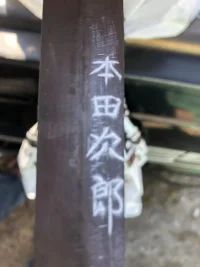
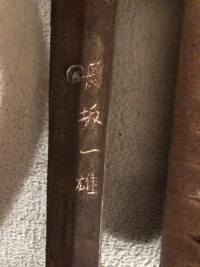
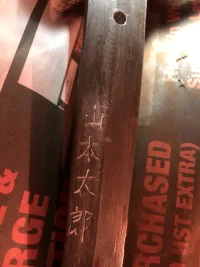
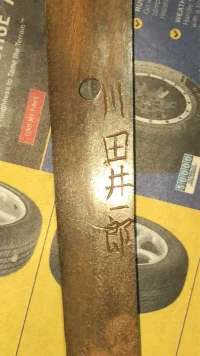
Can any one translate these

Macabees

Registered
Joined
20 Apr 2023
Messages
3
Reaction score
1
I have 4 swords that I am told have Japanese inscription. If anyone can tell me the meaning of each inscription on the handles by translating it to English from 1st to 4th I would appreciate it.
 

Attachments

  • 02CB3EDB-84CA-494C-8838-A19624A1D711.webp
    02CB3EDB-84CA-494C-8838-A19624A1D711.webp
    43.1 KB · Views: 96
  • 48B7155A-0241-4715-8CF2-1C72DEE49386.webp
    48B7155A-0241-4715-8CF2-1C72DEE49386.webp
    99.5 KB · Views: 115
  • 4B301C26-5A56-4E78-A746-3202EB303373.webp
    4B301C26-5A56-4E78-A746-3202EB303373.webp
    92.5 KB · Views: 103
  • B1F7F96C-F51D-446E-974D-E30237AACB6B.webp
    B1F7F96C-F51D-446E-974D-E30237AACB6B.webp
    173.2 KB · Views: 99
1. 本田次郎 Honda Jirō
2. 長坂一雄 Nagasaka Kazuo
3. 山本太郎 Yamamoto Tarō
4. 川田井一郎 Kawadai Ichirō

They are all fake swordsmith names. Its common for people to make counterfeit swords by engraving fake names such as these on the tangs.
 
Thank you very much for your quick reply. I really appreciate your time in helping out. So would these swords have been made in Japan or some other country? Do you have any tips on how to recognize an authentic Japanese sword, are they heavier or on the lighter side etc.in case I ever come across one. What should I be looking for? Thanks again.
 
I can't tell without looking at the whole sword, and even then it might be difficult. Typically, you find a lot of cheaper swords made in China, and then they carve a Japanese (or Japanese-sounding) name on it to give it the appearance of authenticity. If you have studied Japanese swords for a while, you can recognize a fake signature when you see it. If you can't read Japanese, it becomes difficult, especially without the sword in hand.

If you are looking for an authentic Japanese sword, its best to buy from a dealer who trades in such things. If you try to buy from ebay or any online auction site, you risk buying a fake. Or, you could get lucky and find a real sword, but it might have some fatal flaws (cracks or blisters in the steel).

One thing to help you separate the fakes from the real swords, is the authentication papers that come from the NBTHK (Nihon Bijutsu Token Hozon Kyokai). These are the yellow-ish papers that are issued by the NBTHK (Society for the Preservation of Art Swords) in Japan, and each one carries a photograph of the sword's tang, and tells you what the sword is, when it was appraised, and has its own anti-counterfeit measures (watermarks and embossing). This group examines the sword, then they will issue an authentication certificate if the sword is legitimate.

Other things to look for are patina on the tang, activities in the steel, swordsmith's name that has some history to it, peg holes that are punched rather than drilled*, etc...

*Note some antique swords can have drilled peg-holes, so this is not always a good identifier of fake swords.
 
Thank you very much for your quick reply. I really appreciate your time in helping out. So would these swords have been made in Japan or some other country? Do you have any tips on how to recognize an authentic Japanese sword, are they heavier or on the lighter side etc.in case I ever come across one. What should I be looking for? Thanks again.
Look up and spend decent money on reference books. You'll be spending hundreds if not thousands on "legitimate" swords, take the time to do research prior to buying one. FAQ - Nihonto Message Board has a recommend reading list to start.
 
Back
Top Bottom