Looking for Info About This Good Luck Flag

six

Registered
Joined
30 Aug 2022
Messages
7
Reaction score
5
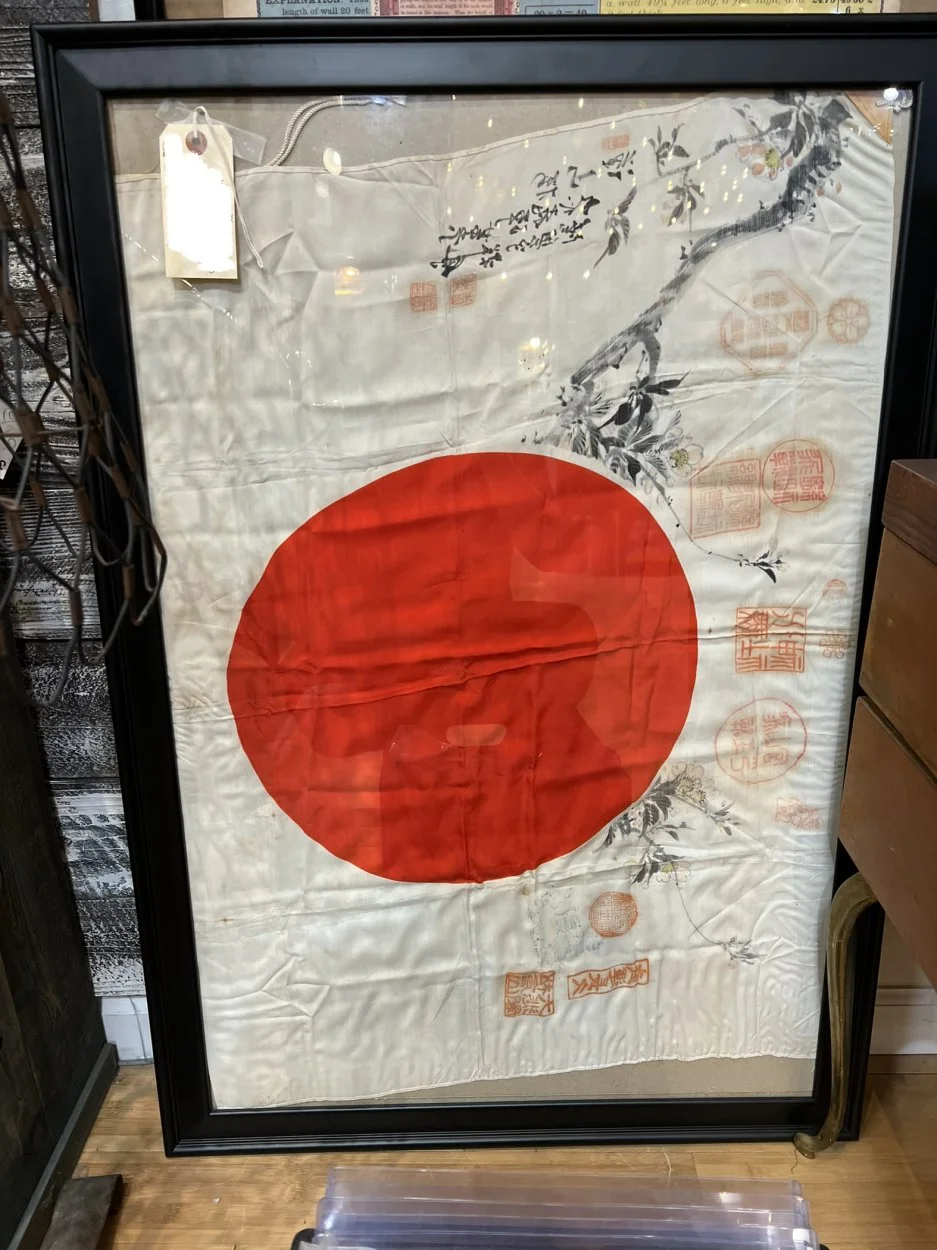
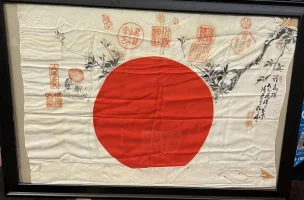
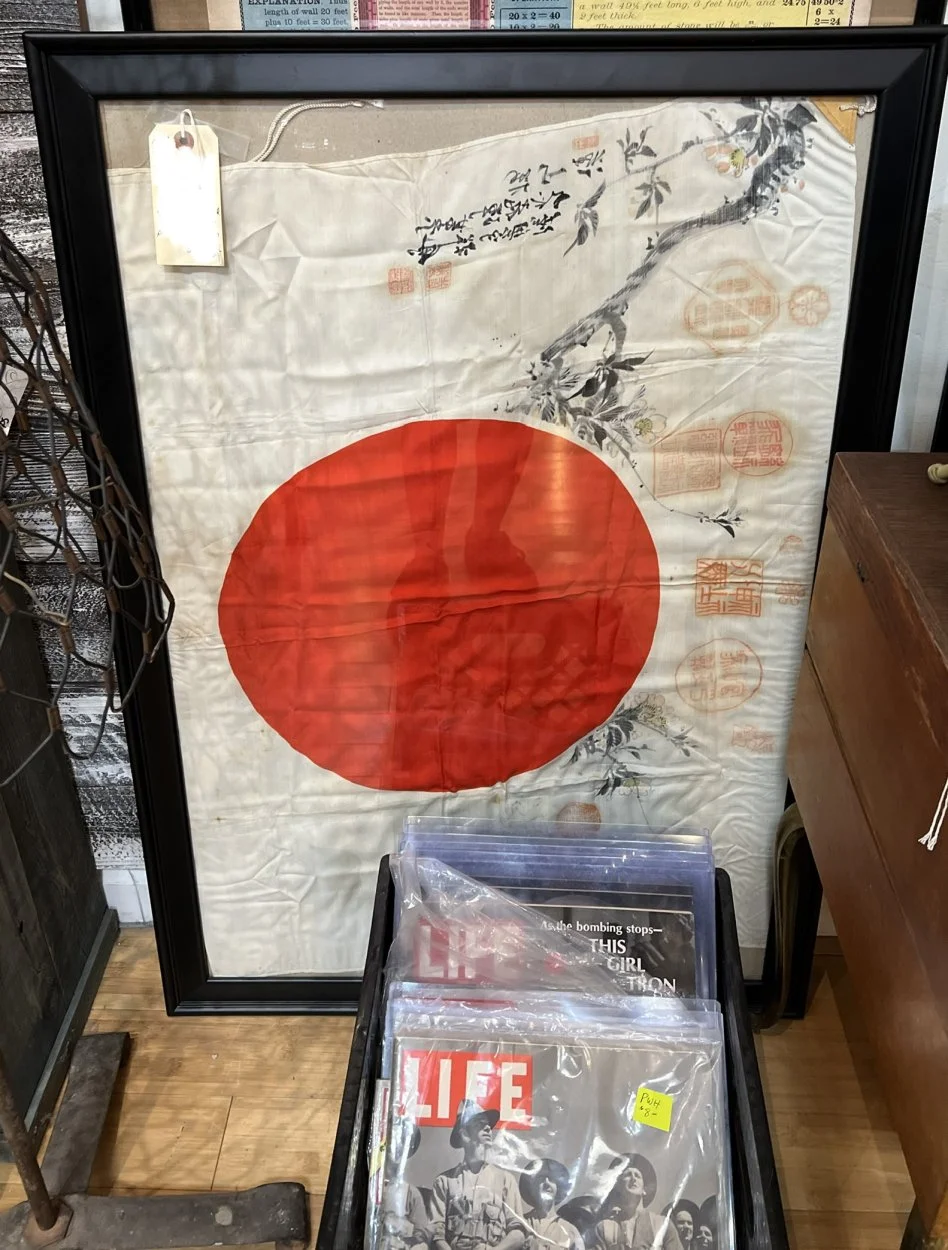
I have been trying to research this flag I saw in a shop last week. It is made of silk and is said to be from World War II, and likely a flag from an officer. When searching other good luck flags, they have well wishes, and some have tigers. This one has cherry blossoms, which I can't find another example of. It also has little writing, but does have red stamps (from shrines, I read online).

What would this flag have been used for? Would it have been a good luck flag, but "blessed" with the red seals and just not happen to have much writing?

Thank you for helping expand my knowledge!
8B673701-3520-4878-A9C8-C157BCE0E2DC.webp
1D25F3FA-7028-413F-8629-3089F9CF96CE.webp
 
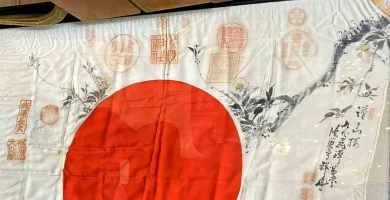
Flipped it but may need more closeups?
Unfortunately, I live about three hours away from the shop, but I can crop the original photo and maybe that would be clear enough to read? What sections did you want to see better?
 
Give it some time. It may be OK for someone to read as is. If our helpers need more , they will let us know. Sometimes it takes a day or two for a good response.
 
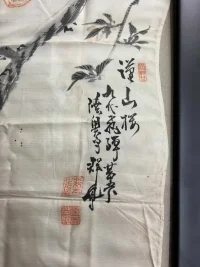
Its also mounted backwards (the wrong side is facing the glass). I can't make out the letters, other than to say the writing in black is a dedication to whomever the flag was given. Looks like someone named 山様 (To Mr. Moriyama) or something like that. Not confident in the first character.

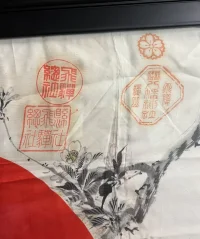
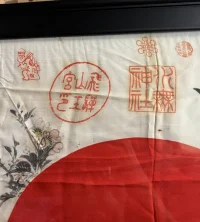
The red seals are from shrines. One is from the Hida Sōsha Shrine

One of the seals says "Good Luck in Battle". So we can assume this is a vintage WW2 flag, normally given to young men as they go off to war. As you mention, usually you see many people sign the flag.This one has no signatures so maybe it was just presented by one person.
 
There must be a button in PhotoShop to flip it , but I'm not clever enough to figure it out?
 
Its also mounted backwards (the wrong side is facing the glass). I can't make out the letters, other than to say the writing in black is a dedication to whomever the flag was given. Looks like someone named 山様 (To Mr. Moriyama) or something like that. Not confident in the first character.

The red seals are from shrines. One is from the Hida Sōsha Shrine

One of the seals says "Good Luck in Battle". So we can assume this is a vintage WW2 flag, normally given to young men as they go off to war. As you mention, usually you see many people sign the flag.This one has no signatures so maybe it was just presented by one person.
Wow. That's a lot of information from what I'm beginning to realize were not very good pictures! Do you have any idea why there would be a drawing of cherry blossoms? It doesn't seem to be a common theme with these flags. Do you think it is a true/authentic flag from WWII? Also, do you have any resources you would recommend to try to figure out what seals are what and what they say? Or would you recommend getting close ups (with the flag the right way around!) of the seals and posting them here? I'd hate to trouble the lovely folks here or flood your forum if it's something I can eventually figure out.

Sending a HUGE "thank you" for your help so far!
Edit: somehow quoted the same thing twice.
 
This flag is a mere drop in the veritable Niagara Falls of requests we get for Japanese war flags. No problem to send better pictures here when you get them. It looks like the red stamps are mostly from Hida Shrine, and not really informative of the person to whom the flag was presented, or the circumstances surrounding his sendoff, except to suggest that he was from around that area.

Regarding authenticity: I like to see names, dates, and locations on the flag. I don't like to see uniformity of writing, anachronistic phrases/dates, or obvious false signatures (eg. Tojo Hideki, etc.). Your flag has a name on it, so it ticks one of the good boxes. It doesn't have any of the negative attributes. As I mention above, I feel its a good candidate for being authentic.

Drawing on flags isn't uncommon. The cherry blossom (sakura) is symbolic of Japan, and symbolic, in a way, of warriors, so it feels appropriate to the flag. It seems to be drawn with great care and skill, which also is a good thing.
 
Good evening! I ended up getting the flag. It certainly needs a bigger frame, as roughly three inches is folded over on the bottom. Here are close ups of the seals and the writing on the side.

I stopped at a second store and saw another Japanese flag. Would one that was original to a Japanese soldier ever have been sewn so haphazardly? From all the threads on this forum on the subject, it seemed to be one of the SeaBee recreations. For giggles, I'll include it in this post.

goodluckflag-six-01.webp


goodluckflag-six-02.webp
 

Attachments

  • goodluckflag-six-03.webp
    goodluckflag-six-03.webp
    331.4 KB · Views: 157
  • goodluckflag-six-04.webp
    goodluckflag-six-04.webp
    337.9 KB · Views: 151
  • goodluckflag-six-05.webp
    goodluckflag-six-05.webp
    337.9 KB · Views: 155
  • goodluckflag-six-06.webp
    goodluckflag-six-06.webp
    387.1 KB · Views: 153
  • goodluckflag-six-07.webp
    goodluckflag-six-07.webp
    128.9 KB · Views: 143
Hmm. Hard to say now that we can see it up close. The writing on the right doesn't say someone's name, but it says something Yamazakura, which is the name of another shrine around the Hida area, and after that it mentions something else about Hida shrine. Almost all of the stamps relate to Hida shrine, except for the one that says Good Luck in Battle.

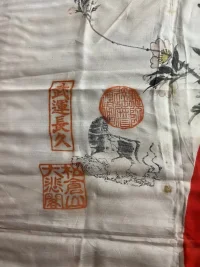
Your other flag his hanging sideways. It should be hanging so that the black letters are vertical. The letters say 忠義 (Tadayoshi) , presumably a name.
 
Hmm. Hard to say now that we can see it up close. The writing on the right doesn't say someone's name, but it says something Yamazakura, which is the name of another shrine around the Hida area, and after that it mentions something else about Hida shrine. Almost all of the stamps relate to Hida shrine, except for the one that says Good Luck in Battle.

Your other flag his hanging sideways. It should be hanging so that the black letters are vertical. The letters say 忠義 (Tadayoshi) , presumably a name.
Supposing it's not a true good luck flag, what would another purpose for it be? Would it have been a family heirloom or wedding gift to bless a new home? Would there have been another battle/war these were maybe used in to a lesser extent than World War II? I suppose either way it is very cool!

Sorry for so many questions, and as always, thank you immensely for your help! I appreciate it very much!

Edit: reworded a question
 
Last edited:
I´m far from an expert but this stamp seems quite strange to me:

1662109627149.png


Maybe some of the experts could translate it? I´ve heard about someone called "cupman" who used to make some fakes and put some strange stamps on them. Maybe could be the case of this flag?
 
The stamp above says 山王除去 "Yamaō, dispel evil". Dispel evil is a common phrase to find on good luck charms and other items available at a shrine or temple. I don't know what the image or "Yamaō" represents.

The red stamp that says "Good Luck In Battle" hints at a WW2 era flag. But its just a hint. That phrase would have no use on a wedding flag. It would be rather inappropriate. It could be an elaborate fake, or it could be something contemporary with WW2. It doesn't have any name or date on it, but it is from the Hida area, as we can tell from the stamps and the writing.

Unusual, to be sure.
 
The stamp above says 山王除去 "Yamaō, dispel evil". Dispel evil is a common phrase to find on good luck charms and other items available at a shrine or temple. I don't know what the image or "Yamaō" represents.

The red stamp that says "Good Luck In Battle" hints at a WW2 era flag. But its just a hint. That phrase would have no use on a wedding flag. It would be rather inappropriate. It could be an elaborate fake, or it could be something contemporary with WW2. It doesn't have any name or date on it, but it is from the Hida area, as we can tell from the stamps and the writing.

Unusual, to be sure.
Thank you for your information! This was a rather large purchase for me, and I'm hoping it is not a fake. It doesn't seem like it is, due to the staining and small holes in the fabric, but I agree with your assessment of "unusual"- that it certainly is! It is a puzzle, and I'm very grateful to everyone for trying to help me try to nail it down!

I at least have a small "warranty" from the shop, so if it's clearly fake I will be taking it back. However, it seems like it was from WWII era. Is there anything definitive pointing toward real vs. fake?
 
OK I've dug around a bit more. Some of the stamps are not from Hida Shrine (Hida Sōja - 飛騨総社), but from a nearby, affiliated shrine: Hida Sannō no Miya (飛騨山王宮). The stamp with the monkey is a stamp from this shrine (the writing on his back is Sannō, not Yamaō). The monkey is a talisman of this shrine. There is also a stamp from Minashi Shrine (水無神社). All of these shrines are located in the same city, Takayama in Gifu Prefecture.

日枝神社 (高山市) - Wikipedia Japanese only

The writing is
謹山桜 Kin Yamazakura
代?飛騨?? 9th ? Hida ??
陸奥守?? Lord of Mutsu Province ? ?

Too many blanks to figure out what the meaning is. Hida is obviously the location. Mutsu Province is an old name for the region in the north of the main island of Japan. In this context, it probably refers to an honorary title of someone around Takayama city, rather than an actual "Lord" of the northern province. Its kind of like how the Queen's husband was the "Duke of Edenborough", even though he didn't have any authority over the government of Edenborough, and it was just kind of a hereditary title that was conferred because of a quirk of history. Likewise, this "Lord of Mutsu" shouldn't be taken at face value. Its just an honorary, courtesy title. Unfortunately I can't read the name after that. Hard to tell what this is, but I don't think it has any obvious connection to WW2, even though it may be from that era. In other words, I don't think its trying to be a fake WW2 flag. I think it may just be an antique from that era.
 
OK I've dug around a bit more. Some of the stamps are not from Hida Shrine (Hida Sōja - 飛騨総社), but from a nearby, affiliated shrine: Hida Sannō no Miya (飛騨山王宮). The stamp with the monkey is a stamp from this shrine (the writing on his back is Sannō, not Yamaō). The monkey is a talisman of this shrine. There is also a stamp from Minashi Shrine (水無神社). All of these shrines are located in the same city, Takayama in Gifu Prefecture.

日枝神社 (高山市) - Wikipedia Japanese only

The writing is
謹山桜 Kin Yamazakura
代?飛騨?? 9th ? Hida ??
陸奥守?? Lord of Mutsu Province ? ?

Too many blanks to figure out what the meaning is. Hida is obviously the location. Mutsu Province is an old name for the region in the north of the main island of Japan. In this context, it probably refers to an honorary title of someone around Takayama city, rather than an actual "Lord" of the northern province. Its kind of like how the Queen's husband was the "Duke of Edenborough", even though he didn't have any authority over the government of Edenborough, and it was just kind of a hereditary title that was conferred because of a quirk of history. Likewise, this "Lord of Mutsu" shouldn't be taken at face value. Its just an honorary, courtesy title. Unfortunately I can't read the name after that. Hard to tell what this is, but I don't think it has any obvious connection to WW2, even though it may be from that era. In other words, I don't think its trying to be a fake WW2 flag. I think it may just be an antique from that era.
Sorry it's taken a few days to get back to you. I just wanted to say thank you one more time. This is some interesting information. For a few days I had that sick to my stomach feeling, wondering if I had made a mistake in buying it, so thank you for at least putting that at ease! It's a bummer it's not directly from WWII, but it is still a pretty flag. I'm glad you were able to help me learn more about it so it can be more than just a pretty flag I don't understand beyond its looks. Thank you!
 
Thanks for the reply. It gives me an excuse to correct my spelling of "Duke of Edinburgh".
And on that note: Long Live The King.
 
Back
Top Bottom