WW2 Sword tang translation

MtnView

Registered
Joined
27 Sep 2023
Messages
6
Reaction score
9
Hello, I am looking for some help translating the Japanese writing on a sword tang.
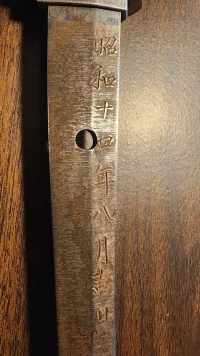
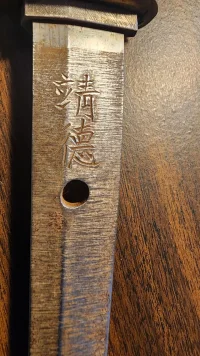
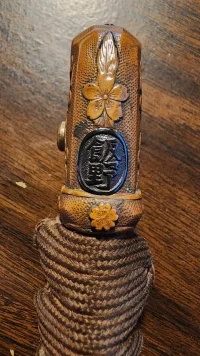
I received a WW2 sword from a family friend about 45 years ago and would appreciate any information you could give me about what is written on the tang. There is also some writing or a symbol on the handle that I'm curious about.
I had thought about trying to get it back to the family of the soldier that carried it in the war if that's appropriate and assuming it's genuine.
Thanks in advance for any help!
 

Attachments

  • 20230926_101858.webp
    20230926_101858.webp
    258.1 KB · Views: 143
  • 20230926_101911.webp
    20230926_101911.webp
    230.1 KB · Views: 123
  • 20230926_172512.webp
    20230926_172512.webp
    216.6 KB · Views: 126
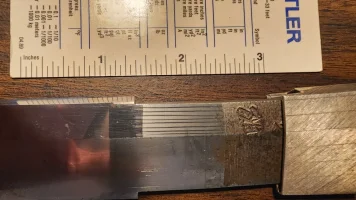
昭和十四年八月吉日
Shōwa 14 (1939) a lucky day in August

靖徳
Yasunori
Yasunori is the name of the swordsmith. He was one of the swordsmiths working at the forge located in the Yasukuni Shrine in Tokyo. These swords are considered to be very good swords, and highly collectible. They require a bit of care so as not to rust (they rust really easily). Ideally it should be kept always with a very, very light coating of lightweight oil. Just a super thin film of oil is all that's needed. Not so much so that the oil will pool and then collect or drip off the sword. You should never touch the blade with your bare hands, as the moisture in your fingertips will stay on the sword and cause the sword to rust in that spot. If you have a microfiber cloth I would wipe down the sword with the cloth very carefully.

The emblem on the hand guard is a family name 飯野 (Iino - pronounced eeno, Like Brian Eno). It is a common family name in Japan.

With only this information it would be impossible to reunite this sword with any remaining family members. If you have some other documents or items that might tie it to a specific person, it might help.

If you want more detailed information on the sword, you can upload pictures of the blade itself and I can take a look. Or, you can go to a site called "Nihonto Message Board", and upload pictures of the blade there. The blade is the important thing. The scabbard and pommel isn't super interesting, as they were more or less standardized.
 
Thank you for such a quick reply!
I dug out the letter that accompanied the sword. It was dated 5 Dec, 1945 from a Lt. Col. at the headquarters of the 1st Cavalry Division. He was stationed in Gamagori, Japan. He seemed to think that the blade was very old, over 300 yrs at the time of his writing. (although everyone that finds an old violin thinks they have a Strad).
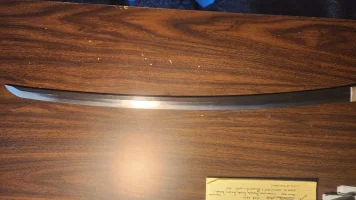
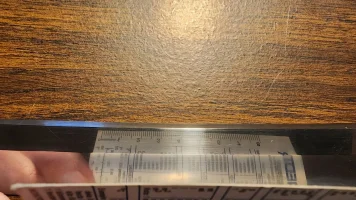
I have attached pictures of the blade but I am not sure what views would be best. I have included an overall view, a view of the blade next to the tang and one view with the reflection of a card to show how polished it is. Let me know if you need anything specific.
Once again, thank you for your help.
 

Attachments

  • 20230926_185027.webp
    20230926_185027.webp
    171.6 KB · Views: 117
  • 20230926_185518.webp
    20230926_185518.webp
    130.6 KB · Views: 119
  • 20230926_185639.webp
    20230926_185639.webp
    220.8 KB · Views: 124
OK - it looks to be in excellent condition. I don't think there is any doubt it is an authentic, vintage, WW2 blade from Yasukuni smith Yasunori. If the letter you have doesn't specify anything about the person who turned in the sword, then I think discovering who the previous (Japanese) owner was will be a lost cause. I wouldn't fret over this too much. WW2 blades are still problematic to import to, and register in Japan. After the war, the Americans deemed all weapons of any kind to be illegal, so all swords (even heirlooms and museum pieces) were confiscated, and it was only after several months of negotiations did the Americans allow an exemption for family heirlooms and artistic treasures.
Blades made for/during the war were deemed weapons of no artistic merit, so WW2 blades continued to be confiscated, destroyed, or in some cases (like your sword) allowed to be taken back to America as war trophies. To this day, WW2 blades are seen as weapons, and may not be registered in Japan. In other words, its illegal to own them in Japan. However, the old rules are slowly being reinterpreted, and the current generation of Japanese have different attitudes compared to the immediate postwar generation, and also there is no occupying army watching over the registration process, so we are starting to see a bit more leniency in regards to the registration of some WW2 blades (including Yasukuni blades). Anyway, it's a grey area and if you or the import agent isn't well-versed in bringing in a wartime blade, it could end up being a big headache for everyone. Plus, there are families who do not wish to be reminded of the past, and families who are reluctant to accept a weapon like this (for the legal reasons above, or just because they do not wish to own a sword)

It's very honorable that you would like to return it to the family from which it came, and I am 100% in alignment with that sentiment. Alas, the insurmountable difficulty of locating which Iino family it came from, together with the legal obstacles in importing weapons into Japan, make it very problematic.
 
Thank you very much for your time and for the information about the sword as well as the difficulties in returning it to Japan. It gives a tangible history dimension to the sword that is much appreciated.
Best Regards
 
I see you are getting some good info over at Nihonto Message Board. Also, you are approaching the point where you start to get diminishing returns. People will come out of the fringe and start to ask for all sorts of details (more and more photos), and in lieu of anything of real value to add, they will start nitpicking over minor things. Already they are asking you to orient the photos vertically so that the inscription may be read, but of course you've already got the translation for the inscription, and anyone who reads Japanese can figure out the orientation. You will not gain any further insight by orienting the photos of the sword vertically. And if you do, people will just continue to ask for more and more photos, and in lieu of anything of value to add, they will start to nitpick.

"Is that a rust spot I see?"
"That tiny bit on the tang looks like a forging flaw!?!"
"The third stroke of the 2nd kanji character looks funny to me. Are you sure this isn't a forgery"?
etc.

It's inevitable, unfortunately. Already some of the posters are drowning you in jargon (hamon, hada, koto). Your sword's identity is obvious, and I think there is little doubt as to its authenticity. So doing a forensic analysis of the steel will not reveal much more to you than you already know. I do agree that if you want to know more about the smith or the background of the sword, the book mentioned (The Yasukuni Sword) would be a good book to get.

If the sword were unsigned, or if it were centuries old and had a major name on it, you would want to look at the minute details of the steel, especially of the forging pattern on the sharp edge, because the details here would give you a hint at when and where the sword was made, and possibly who made it. Those details would validate the signature. Or they would be in contrast to it, therefore indicating the signature could be a forgery. But as I said, your sword doesn't suffer from any such ambiguity. It has a name, and a date on it, and I think we can be pretty sure it is what it claims to be. There are many, many fake swords out there, but yours is certainly the genuine thing.
 
As I was hiking this morning I was thinking of thanking you again. Thanks for referring me to that message board. It took 3 different people to give me the info you gave me. The book was a good suggestion but I'll have to see if any libraries have it since it's a little pricey.
Anyway, thanks again for your translation and today's advice as well.
 
As I was hiking this morning I was thinking of thanking you again. Thanks for referring me to that message board. It took 3 different people to give me the info you gave me. The book was a good suggestion but I'll have to see if any libraries have it since it's a little pricey.
Anyway, thanks again for your translation and today's advice as well.
There's one of Abc books for $84 (The Yasukuni Swords: Rare Weapons of Japan, 1933-1945 by Kishida, Tom; Kenji Mishina: Near Fine Hardcover (2004) First Edition. | Recycle Bookstore) though don't know what price you saw in your search. Seeing as it's a second hand store you might be able to just send them an offer and see if they'll slash the price.
 
Thank you Dentanmono, I saw that too but didn't think about sending them an offer. Thanks for the suggestion.
 
Thanks, I saw that one too but it says that they are sold out. I found one at the Clemson library a couple of hours from here. As it turns out, I am heading that way next week to visit family so I thought I would stop in and take a look at it, possibly make some copies of relevant pages.
 
Back
Top Bottom