- 15 Mar 2002
- 22,919
- 472
Tsukudani (佃煮) is a deeply rooted part of Japanese food culture, born out of necessity and ingenuity. A way of preserving small amounts of food—typically seafood, seaweed, vegetables, or meat—they are simmered in a concentrated sauce made from soy sauce (醤油 shōyu), mirin, and sugar. The result is a richly flavoured, glossy condiment with strong savoury-sweet notes, designed to be eaten in small amounts with plain white rice.
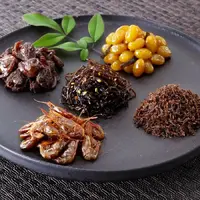
A variety of tsukudani (佃煮)
During the Edo period (1603–1868), the spread of soy sauce helped define tsukudani's signature flavour. Its intense taste meant just a spoonful could transform a bowl of rice. By the late Edo period, tsukudani had spread far beyond Tsukuda Island, becoming a staple in the everyday households of Japan. It was also a natural fit for bento (弁当) and as a side dish (副菜 fukusai), offering a compact way to preserve and enjoy flavour.
Inago tsukudani (いなご佃煮), locusts, a Shinshu speciality
With the expansion of food transport and commerce during the Meiji period (1868–1912), tsukudani began to be mass-produced, and it quickly became a familiar sight in local shops and station kiosks. Despite this commercialisation, many families continued to make it at home—especially in rural areas—relying on the philosophy of mottainai (もったいない), or not letting anything go to waste. Leftover fish scraps, wild mountain vegetables, or seaweed could all be turned into tsukudani.
In contemporary Japan, tsukudani is no longer necessary for preservation, but it remains a staple at the table. For many, it's a food tied to memory—something passed down by grandparents or eaten with a simple meal at home. Artisanal producers on Tsukuda Island and elsewhere continue to craft it by hand, especially for gift-giving or special occasions.
More than just a condiment, tsukudani is a quiet emblem of the Edo-period mindset: practical, resourceful, and intensely flavourful. Even after four centuries, a spoonful still brings warmth and depth to a bowl of rice, just as it did in the days when fishermen simmered their catch by the shore under the rule of the Tokugawa.
Kanji: 佃煮
Kana: つくだに
Romaji: tsukudani