


- 14 Mar 2002
- 21,050
- 18,903
Officials announced on 23 April that an X-ray analysis has definitively identified a specimen long preserved in the Shōsōin Repository (正倉院), a UNESCO World Heritage site, and previously thought to resemble a "dragon" mummy.
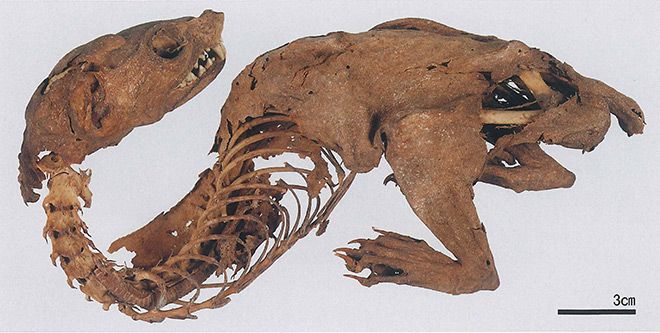
Photo credit: No. 47 Bulletin of Office of the Shōsōin Treasure House
According to the Shōsōin Repository office of the Imperial Household Agency, zoologists and other specialists confirmed that the mummified remains are those of an adult female Japanese marten, a member of the weasel family. Known as "Kōryū" (古龍), the mummy was part of the collection of treasures housed within the repository. Experts examined other ancient objects, including items crafted from animal horns, bones, and fossils preserved for their supposed medicinal properties, to determine their origins. Several items previously believed to be ivory and reindeer antlers were made from materials derived from other animal species.
The Kōryū mummy was first mentioned during Ashikaga Yoshinori 's (足利義教, 1394–1441) visit to Tōdaiji temple (東大寺) in 1429, when he encountered an object resembling a dragon. Recent investigations confirmed through X-ray analysis that the mummy is the remains of an adult female Japanese marten. Radiocarbon dating, applied for the first time to a Shōsōin (正倉院) treasure, determined that the mummy dates from between the mid-11th and mid-12th centuries. Further examinations revealed that associated fragments included parts of a mole, a crow, and a pigeon. Researchers believe the marten likely wandered into the Shōsōin and mummified naturally, although the possibility of deliberate placement cannot be entirely excluded. In the Muromachi period (1336–1573), it was widely believed that the dragon-like mummy would bring rain whenever the repository was opened, a superstition curiously echoed during the recent investigation when heavy rains disrupted plans. The name "Kōryū" (古龍) is thought to have come into regular use during the Edo period (1603–1867).
Photo credit: No. 47 Bulletin of Office of the Shōsōin Treasure House
According to the Shōsōin Repository office of the Imperial Household Agency, zoologists and other specialists confirmed that the mummified remains are those of an adult female Japanese marten, a member of the weasel family. Known as "Kōryū" (古龍), the mummy was part of the collection of treasures housed within the repository. Experts examined other ancient objects, including items crafted from animal horns, bones, and fossils preserved for their supposed medicinal properties, to determine their origins. Several items previously believed to be ivory and reindeer antlers were made from materials derived from other animal species.
The Koryu is a mummified animal resembling a small dragon that was thought to be a mammal. It measures about 40 centimetres in length from the head to the tail. In an investigation in the 1950s, it was tentatively identified as a marten based on the shape of its teeth that can be observed from the outside. Fragments of several other types of mummies have also been handed down as parts of other so-called Koryu.
The Kōryū mummy was first mentioned during Ashikaga Yoshinori 's (足利義教, 1394–1441) visit to Tōdaiji temple (東大寺) in 1429, when he encountered an object resembling a dragon. Recent investigations confirmed through X-ray analysis that the mummy is the remains of an adult female Japanese marten. Radiocarbon dating, applied for the first time to a Shōsōin (正倉院) treasure, determined that the mummy dates from between the mid-11th and mid-12th centuries. Further examinations revealed that associated fragments included parts of a mole, a crow, and a pigeon. Researchers believe the marten likely wandered into the Shōsōin and mummified naturally, although the possibility of deliberate placement cannot be entirely excluded. In the Muromachi period (1336–1573), it was widely believed that the dragon-like mummy would bring rain whenever the repository was opened, a superstition curiously echoed during the recent investigation when heavy rains disrupted plans. The name "Kōryū" (古龍) is thought to have come into regular use during the Edo period (1603–1867).


