Seed planting instructions; how'd I do?

Joined
8 Nov 2003
Messages
92
Reaction score
13
I am hoping to send some Sarracenia seeds to a friend in Japan for her 90th birthday next month. She and her daughter enjoy gardening.

Below are the planting instructions I came up with based on my methods when I used to hybridize them. I think I'm happiest with the first sentence in step three.

I'm certain that none of it's perfect, but is it at least understandable?
Thanks!
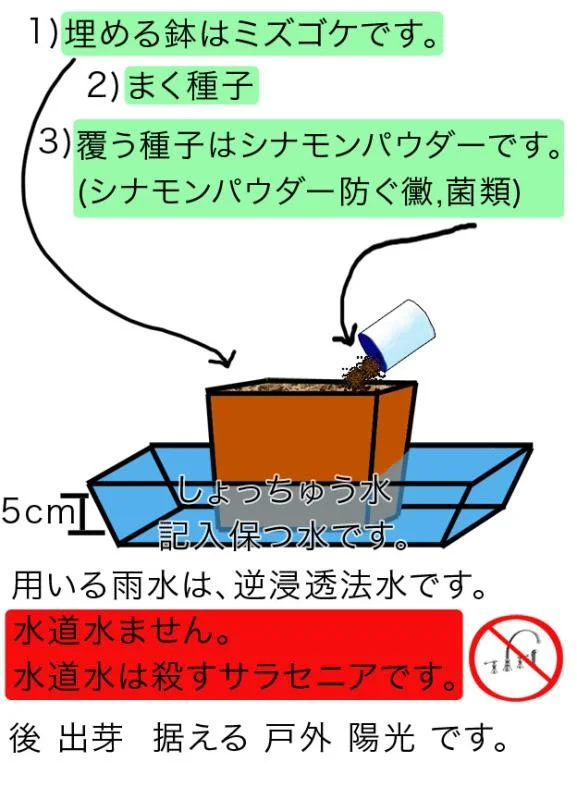
sarraceniagermination-1.webp
 
I can vaguely guess what you might want to say, but to be honest, the instruction does not really make sense.
If you wish to have proper instruction so that your friends will be able to treat the seed in the correct way, why don't you write down what you want to say in English as well? ;)
Then we'll be able to tell you how you should say it in Japanese.
 
I must be even further off than I thought I was. :( Various people could do one sentence so that it's not too much for any one person. Please explain anything you'd like as you go so that I can learn. :-)

Thanks.
----------------------------

1) Fill the pot with sphagnum.

2) Sow the seeds.

3) Cover the seeds with cinnamon powder.
(cinnamon powder prevents mildew and fungi)

Constantly watered.
Keep filled with water.

Use rain water or reverse osmosis water.
No tap water.
Tap water kills Sarracenia.

After germination place outdoors in the sunshine.
 
I must be even further off than I thought I was. :( Various people could do one sentence so that it's not too much for any one person. Please explain anything you'd like as you go so that I can learn. :-)
Thanks.
----------------------------
1) Fill the pot with sphagnum.
2) Sow the seeds.
3) Cover the seeds with cinnamon powder.
(cinnamon powder prevents mildew and fungi)
Constantly watered.
Keep filled with water.
Use rain water or reverse osmosis water.
No tap water.
Tap water kills Sarracenia.
After germination place outdoors in the sunshine.

1) 鉢にミズゴケを詰めます。
2) 種を蒔きます。
3) 種をシナモンパウダーで覆います。
(シナモンパウダーはカビや菌を予防します。)

こまめに水をやり、常に湿っている状態を保って下さい。*
雨水か逆浸透膜浄水器で作った水を使って下さい。
水道水はサラセニアを殺してしまうので使わないで下さい。

発芽したら、屋外の日当たりの良い場所に置きます。

*I was not too sure just how saturated with water you are supposed to keep the pot/sphagnum. I used 湿っている(damp). If you want the pot very well-saturated, I would go with 濡れている(wet).

If you are using this as an excercise to practice Japanese composition, I would suggest you review the basic Japanese sentence construction. As Undrentide has said, what you have in the OP is badly mangled and makes little sense.

Good luck!
 
1) 鉢にミズゴケを詰めます。
Aside from the order of mine being messed up, I had not thought of using 詰め. It conveys a better idea of packing the sphagnum into the pot for a better medium for holding roots down than just "filling."
Is に acting as a topic marker?


2) 種を蒔きます。
How is を used in 種を vs. the use of 種子?


3) 種をシナモンパウダーで覆います。
(シナモンパウダーはカビや菌を予防します。)
What determines if the topic marker は is required vs. に as after 鉢?

Or also ます or さい vs. です?


If you are using this as an excercise to practice Japanese composition, I would suggest you review the basic Japanese sentence construction.
I try to make everything a learning opportunity. I thought I was just getting onto when to use です and は, but unfortunately I still don't have it grasped. :(


As Undrentide has said, what you have in the OP is badly mangled and makes little sense.
So I see. :(


Thanks for all of the help though! :) I'm sorry if I asked too many questions. Please only answer if you have the time. It may be too much. I know there is a lot to it.
 
1) 鉢にミズゴケを詰めます。
Aside from the order of mine being messed up, I had not thought of using 詰め. It conveys a better idea of packing the sphagnum into the pot for a better medium for holding roots down than just "filling."
Is に acting as a topic marker??

詰める (to fill, to pack) would give the better idea to put the moss into the pot with certain compaction.
埋める means "to bury" (i.e. putting something into a hole and cover it up with soil, etc.) or "to fill up (a hole)" , not suitable in this context.

に is a particle to indicate the object.
You'll find some basic idea about the particles including は which is the topic marker here.
Japanese Grammar Guide | Learn Japanese


2) 種を蒔きます。
How is を used in 種を vs. the use of 種子??

種子 (shushi) and 種 (tane) both mean seed(s), but 種子 has more academic sound while 種 is more colloquial. In this context 種子 sounds a bit awkward as if you're writing an academic report.

3) 種をシナモンパウダーで覆います。
(シナモンパウダーはカビや菌を予防します。)
What determines if the topic marker は is

What determines if the topic marker は is required vs. に as after 鉢?

Or also ます or さい vs. です?

Again, please see the articles on "particles" in Tae Kim's Japanese grammar guide.
ます is used to make the verb sound politer.
覆う→覆います
予防する→予防します

です is a predicate verb (polite)
これは家(だ)。→これは家です。 (This is a house)

さい is not a stand-alone word - it's a part of verb conjugation (imperative).
見る→見なさい

I highly recommend to take a look at Tae Kim's Guide to Learning Japanese site, it is simple yet covers basic grammar quite well, I believe it does help you a lot if you're interested in learning Japanese.
 
Thank you a thousand times over for that link! It should help a lot if I can get my head around it. I saved it for study in my bookmarks menu. :-)
 
Back
Top Bottom