Obsolete articles on genetics
A few comments bossel and lexico's quotes from Cavalli-Sforza.
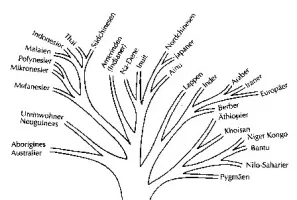
Cavalli-Sforza has an interesting family tree combining
linguistic & genetic features, look at the attachment (it's German, but Ainu & Japanese are easily recognisable). Japanese are closest to Northern Chinese there, while Ainu come next.
Craniometry showed Ainu closest to Maori & Polynesians (but craniometry, well...).
Overall genetic comparison (also done by Cavalli-Sforza, from
The History and Geography of Human Genes; the
Human Races Calculator , where I took it from, is sadly offline) shows as closest related to Ainu:
1 Mongol Tungus 32
2 Japanese 34
3 Korean 57
4 Chuckchi 77
5 Uralic 80
6 Tibetan 83
7 North Turkic 97
The number behind is supposed to show the genetic distance.
Winner of the 1994 R.R. Hawkins Award
One of Princeton University Press's Notable Centenary Titles.
The History and Geography of Human Genes
L. Luca Cavalli-Sforza, Paolo Menozzi, and Alberto Piazza
One thing a reader should notice is the date of publication, i.e., 1994. Most of the results at that time are already dead, or ancient. Now the new study made their works obsolete.
Review of The History and Geography of Human Genes said:
This interdisciplinary approach enables them to address a wide range of issues that continue to incite debate: the timing of the first appearance of our species, the problem of African origins and the significance of work recently done on mitochondrial DNA and the popular notion of an "African Eve," the controversy pertaining to the peopling of the Americas, and the reason for the presence of non-Indo-European languages--Basque, Finnish, and Hungarian--in Europe.
Study methods are not one of the best practices, since the recent experiments published on nature casts doubt on the level of conservation mtDNA can get hold. mtDNA's mutation rate per total sequences is somehow very high. Most recent studies no longer use mtDNA unless there is a need to keep track of maternal lineages.
Another thing is an interpretation mixed with language. Many linguistics studies are unrelated to biological factors. Language is a social science, and its end is the understanding of human culture, not the understanding of biological existence of human.
Review of The History and Geography of Human Genes said:
The authors reconstruct the history of our evolution by focusing on genetic divergence among human groups. Using genetic information accumulated over the last fifty years, they examined over 110 different inherited traits, such as blood types, HLA factors, proteins, and DNA markers, in over eighteen hundred, primarily aboriginal, populations.
HLA factors, proteins, non-Y markers, suffer severe within variations. Although I do give high recognition of Cavalli Sforza on the cell research, these methods are now totally out of date.
I remember one korean guy pointed me out a more recent study done by
Cavalli Sforza's famous pupil, Spencer Wells. I've already cited this a few times, but this could be a useful reminder of differences between the published in 2001 (Spencer Wells), and another in 1994 (Cavalli Sforza).
PNAS | August 28, 2001 | vol. 98 | no. 18 | 10244-10249
The Eurasian Heartland: A continental perspective on Y-chromosome diversity
R. Spencer Wells, Nadira Yuldasheva, Ruslan Ruzibakievc, Peter A. Underhilld, Irina Evseevae, Jason Blue-Smithd, Li Jinf, Bing Suf, Ramasamy Pitchappang, Sadagopal Shanmugalakshmig, Karuppiah Balakrishnang, Mark Readh, Nathaniel M. Pearsoni, Tatiana Zerjalj, Matthew T. Websterk, Irakli Zholoshvilil, Elena Jamarjashvilil, Spartak Gambarovm, Behrouz Nikbinn, Ashur Dostievo, Ogonazar Aknazarovp, Pierre Zallouaq, Igor Tsoyr, Mikhail Kitaevs, Mirsaid Mirrakhimovs, Ashir Charievt, and Walter F. Bodmera,u
ABSTRACT
The nonrecombining portion of the human Y chromosome has proven to be a valuable tool for the study of population history. The maintenance of extended haplotypes characteristic of particular geographic regions, despite extensive admixture, allows complex demographic events to be deconstructed. In this study we report the frequencies of 23 Y-chromosome biallelic polymorphism haplotypes in 1,935 men from 49 Eurasian populations, with a particular focus on Central Asia. These haplotypes reveal traces of historical migrations, and provide an insight into the earliest patterns of settlement of anatomically modern humans on the Eurasian continent. Central Asia is revealed to be an important reservoir of genetic diversity, and the source of at least three major waves of migration leading into Europe, the Americas, and India. The genetic results are interpreted in the context of Eurasian linguistic patterns.
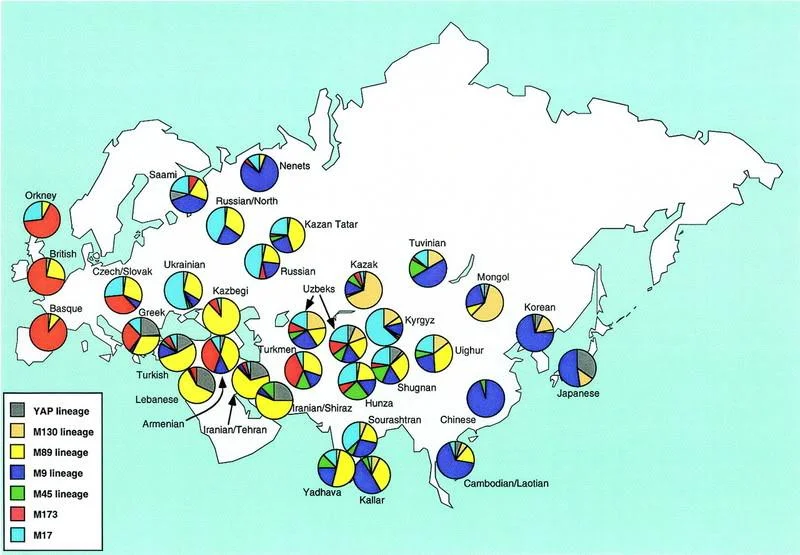
Consensus methods of population geneticist now uses the Y-haplogroup, and this method will be complemented by the complete genome comparisons presently under progress by many researchers of HapMap. But to measure the lineages, Y-haplogroups are just enough, and the only reliable method we can have.
In conclusion, there is a list of items showing that Cavalli Sforza's publication on 1994 is not up to standard in the year of 2006.
(1) Date of Publication (1994) is too old given the advancement of genetics in late 90s usurped by super computational powers and cheaper experiment methods with high quality chips.
(2) HLA is about immune systems, whereby evolutionary pressures, and clocks are high. HLA studies are in general irrelevant to lineage findings.
(3) Mixed results of genetics with linguistics are not appropriate givent that genetics and linguistics do barely agree
(4) mtDNA rich studies, where the mutation rates and recombination factors (see my another thread on this) could bias the results



 ), but I'm pretty sure that by the time of the
 It may mean that science can be affected by the political mindset of the day, which should not be... what was is what was, no more and no less...