

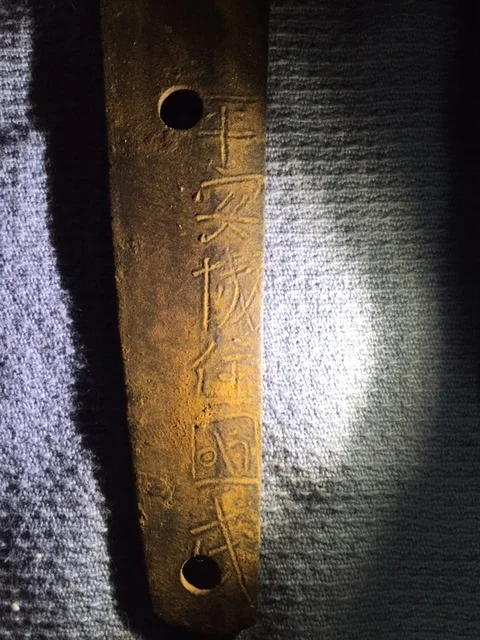
can anyone help me in figuring out what this inscription means on this samurai sword? it has been passed down to me originating from my great great Uncle who was a naval surgeon stationed at US Navy Hospital Yokohama around 1905. He successfully treated a high ranking Japanese official and received this as a gift. I am trying to piece together the story behind its origin. Any help would be much appreciated!!!!
Navigation
Install the app
How to install the app on iOS
Follow along with the video below to see how to install our site as a web app on your home screen.
Note: This feature may not be available in some browsers.
More options
Style variation
System
Light
Dark

You are using an out of date browser. It may not display this or other websites correctly.
You should upgrade or use an alternative browser.
You should upgrade or use an alternative browser.
Samurai Sword inscription
- Thread starter thirdtuck
- Start date

- 22 Feb 2008
- 18,266
- 4,926
Hmm, the third and fifth kanji don't seem to be a real/existing one. How about the reverse side? Is there any inscription?
- Thread starter
- #7
Majestic, thank you so much for your help! It is truly appreciated. Do u know anything about that smith? Should I spend top dollar restoring it? Do you know what year it would have been made? Are u 100% certain of the smith and location of forge?

- 12 Oct 2013
- 4,071
- 5,023
Hello Thridtuck,
There were at least two Kunitakes from Heianjo. The older Kunitake (mid-1600s) has an excellent reputation, but the signature is different from yours in both style and in how the name was written. The more recent Kunitake (late-1600s) had a completely different signature from yours. I'm fairly certain of take (武), but it could also be nari (成) or tatsu (辰) or even toshi (俊), or some other deceptively similar kanji.
So, it could mean a few things. I'll put them in order of likelihood:
1. I'm misreading the final kanji (the one that has been obscured due to the placement of the peg hole.
2. The sword is a forgery.
3. The Kunitake of your sword is completely unknown, or extremely minor.
There is no mistake in Heianjo-ju (平安城住), So if the sword is no fake, it was made in the Kyoto area, or made by someone who came from the Kyoto area.
As above, I am not certain of the last kanji - but I am certain enough that I can rule out other possibilites. Unfortunately it doesn't help much - I will keep looking. The kuni (国) is so distinctive that it should help identify the smith. I guess there was no paperwork with the sword? And (longshot) you don't know the name of the officer who your great great uncle helped? Possible to get a picture of the tip of the sword?
Don't spend top dollar yet. But also don't muck around with it (don't handle the blade, where moisture from your hands could cause rust). Don't try to scrape off rust spots.
There were at least two Kunitakes from Heianjo. The older Kunitake (mid-1600s) has an excellent reputation, but the signature is different from yours in both style and in how the name was written. The more recent Kunitake (late-1600s) had a completely different signature from yours. I'm fairly certain of take (武), but it could also be nari (成) or tatsu (辰) or even toshi (俊), or some other deceptively similar kanji.
So, it could mean a few things. I'll put them in order of likelihood:
1. I'm misreading the final kanji (the one that has been obscured due to the placement of the peg hole.
2. The sword is a forgery.
3. The Kunitake of your sword is completely unknown, or extremely minor.
There is no mistake in Heianjo-ju (平安城住), So if the sword is no fake, it was made in the Kyoto area, or made by someone who came from the Kyoto area.
As above, I am not certain of the last kanji - but I am certain enough that I can rule out other possibilites. Unfortunately it doesn't help much - I will keep looking. The kuni (国) is so distinctive that it should help identify the smith. I guess there was no paperwork with the sword? And (longshot) you don't know the name of the officer who your great great uncle helped? Possible to get a picture of the tip of the sword?
Don't spend top dollar yet. But also don't muck around with it (don't handle the blade, where moisture from your hands could cause rust). Don't try to scrape off rust spots.
- 22 Feb 2008
- 18,266
- 4,926
Ah, the fourth kanji is 住. I thought it was 何 or something, and it's also a cause of my doubts.
- 12 Oct 2013
- 4,071
- 5,023
I would first recommend you post a picture of the signature over at the Nihonto Message Board. The guys there have a lot of experience, and a couple of them are dealers, or are plugged in to the sword collecting circles here in Japan. They might be able to offer more info on the signature or the smith. They will also know about reputable dealers or restorers in your area. If you Google, Nihonto Message Board, it will come up.
I looked through my resource books and could not find any match for that signature/style. It slightly raises the chance of the sword being a forgery. It is very common, I'm afraid. Even old swords that have been in families for generations may be forgeries. Forgery meaning, the sword is a cheap item of no distinction, but someone has added a name to it to make it appear as though it is older or more valuable than it really is. So it could be that the Japanese person who presented it to your great great uncle didn't know what he had. I'm just saying this as one possibility.
Aside from the authenticy, it does look very distressed. The tip is broken, the sharp lines that should be present in the tip area are gone, there is no discernible temper-line. It would take quite a lot of money to get this back into good shape. You would want to be sure of the authenticity before getting it restored.
I looked through my resource books and could not find any match for that signature/style. It slightly raises the chance of the sword being a forgery. It is very common, I'm afraid. Even old swords that have been in families for generations may be forgeries. Forgery meaning, the sword is a cheap item of no distinction, but someone has added a name to it to make it appear as though it is older or more valuable than it really is. So it could be that the Japanese person who presented it to your great great uncle didn't know what he had. I'm just saying this as one possibility.
Aside from the authenticy, it does look very distressed. The tip is broken, the sharp lines that should be present in the tip area are gone, there is no discernible temper-line. It would take quite a lot of money to get this back into good shape. You would want to be sure of the authenticity before getting it restored.
- 12 Oct 2013
- 4,071
- 5,023
Well, look at it this way. Whether the signature is authentic or not, it doesn't change the fact that the sword was given to a distant relative in appreciation, and so it still has great sentimental value as a very interesting heirloom piece. As a historical item, it does seem to be an authentic sword from, let's say the Edo period , and so that in itself is interesting and has value. You have the fittings with it, so those are also interesting antiques.I've got my fingers crossed that it is not a forgery. That would be utterly disappointing!
In the worst case, the signature is fake, and the sword is crappy quality. It's still an antique that's worth a few hundred bucks. In the best case, someone will authenticate the signature. If that happens, you should get a professional to look at the sword to see if there are any fatal flaws in it (cracks, or air pockets). If there are no fatal flaws, its probably worth spending the $2 - $3 thousand dollars on a polish. If you don't have a plain wooden scabbard to store it in, you should get one of those made as well. The polisher should be able to take care of that as well. He will be connected to the craftsmen that can produce these. All in it might cost around $3,500, depends on how long the sword is and the quality of the polish.
Similar threads
- Replies
- 30
- Views
- 11K


- Replies
- 17
- Views
- 9K
- Replies
- 1
- Views
- 2K
