Rikaichan

himeji

先輩
Joined
12 Jul 2008
Messages
37
Reaction score
0
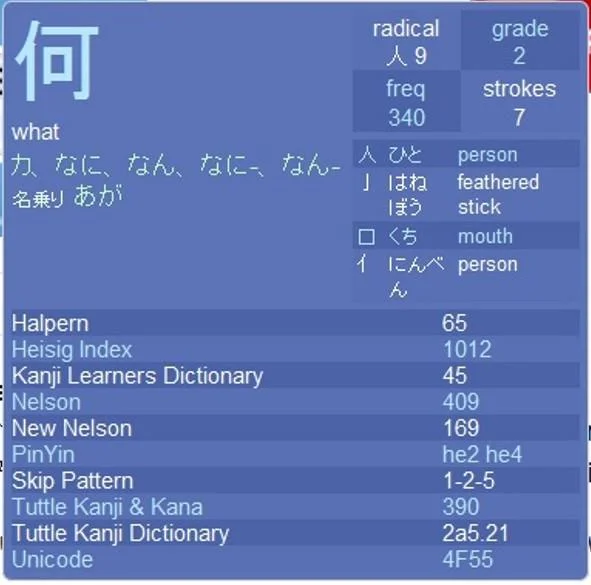
I'm not entirely stupid (although some may disagree ;-) ) and I do understand some of what I'm seeing but could some one please explain the Rikaichan readouts to me blow by blow (line by line)?
rk2-1.webp


rk3-1.webp


The Rikaichan site is not too hot on explanations; The KANJIDIC Pages Have Moved may as well be in Greek as far as I'm concerned at this time; wikipedia is uncharacteristically useless and Googling is just leaving me brain fatigued.
 
it's pretty explicit for me...
Screen 1:

何か can be read as なにか or なんか and then you have the meaning.
何 can be read as なに or なん and then you have the meaning.

Screen 2
The english explanations would be pretty self explanatory, but probably not to someone who's been learning Japanese only a few weeks.

Each kanji is composed of what's called a key.
In this case the key is 人, which is the leftmost part of the kanji. When written as a key, it takes another shape. Furthermore, the kanji 何 can be discomposed into 3 elements: person (人), mouth (口), feather (羽) which are slighly different here.

The rest is just index if you use a specific dictionary/ font set to look the kanji (The number it is given in the dictionary or the specific font table), although I don't see what pinyin is doing here.

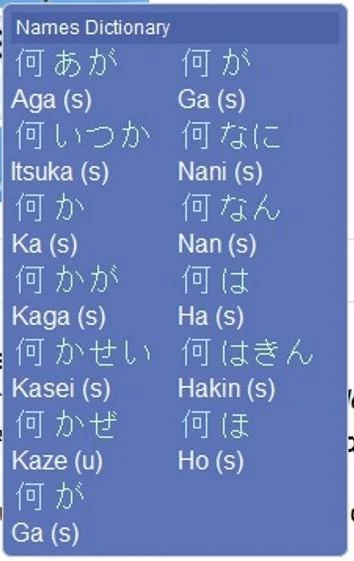
Screen 3 is different reading ways when the kanji is used in a name.
 
I've never actually seen Rikaichan until today and I also have a question. When I search for a word, it lists like the first four kanji in the search results. How do I see the kanji in the lower results? Is there a way to scroll through them or click on a result to show just those?
 
How do I see the kanji in the lower results?

With whatever you want selected keep pressing the Enter Key and it'll cycle through the screens. This is on an untouched XP install (you can change things in the configuration).

You need to have installed the Names dictionary in addition to the main dictionary to get the 3rd readout.
 
it's pretty explicit for me...

No doubt.

Screen 1:

Can you decipher all the shorthand within the () shown in white for me?

probably not to someone who's been learning Japanese only a few weeks.

Perversely that readout I understand; it has an explantion on Rikaichan's site.

Screen 3 is different reading ways when the kanji is used in a name.

Well yes...

... but I don't see how you get Aga (s) out of it or any of the others except Nani (s) and Nan (s). And what's with the (s)?
 
No doubt.
Can you decipher all the shorthand within the () shown in white for me?
Perversely that readout I understand; it has an explantion on Rikaichan's site.
Well yes...
... but I don't see how you get Aga (s) out of it or any of the others except Nani (s) and Nan (s). And what's with the (s)?

Sorry if I might have sounded offending.

These things between parenthesis are from the edict abreviations, and from memory I think:

int: interjection
pn: pre-noun
adj-no: may take the particle の
pref: prefix
n: noun
col: forgot...but should be easy to find out

as for screen 3, the S could mean surname or Scarce in my opinion since P means it's from the most commonly used kanjis list.

Hope it was helpful, although I don't think you're gonna use these abreviations so often.
 
> Hope it was helpful,

It is, thanks.

> ... but should be easy to find out

IME it's not. I've already done a lot of searching prior to asking here; no doubt if I knew more Japanese (I'm working on it) language it would be crystal clear. Kana was a bunch of unrelated hieroglyphics, total madness, to me a short time ago but now it's as clear as day.
 
Just the job, thank you.

Should keep me quiet for a while.
 
Back
Top Bottom