I must respectfully disagree with undrentide.
In Japanese, the noun marked by は is not the subject, it is the topic. This means that
"うちは sentence head (subject)
家内と子供二人の四人家族だ。 predicate"
is not correct. The reason you always hear people saying that japanese is a topic-based language and not a subject based one is exactly because of this. That is why people always translate は as "as for" not "is".
As for the sentence
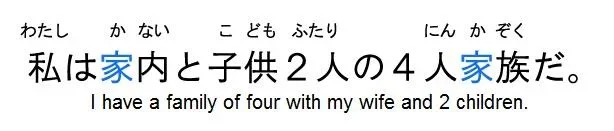
私は家内と子供二人の四人家族だ。
Normally you would cut out the 私は, except here it emphasizes that "as for me" the following is true. The context this sentence would occur in is if someone just told you the size of their family, and then you said "as for me, I have..."
For the rest of the sentence:
家内と子供二人 - wife and two kids
四人家族 - four person family
so if you were to translate the sentence, you could say:
"As for me, [it is] a four person family of a wife and two kids."
The [it is] is not directly in the sentence, but it is assumed.
If you want to confirm this (about は being topic, not subject), you can check wikipedia article on topic-prominent language, or the "wa" section of Tae Kim's guide.
-
Here is the relevant part of Tae Kim's:
-
"アリス) 今日は試験だ。- Today is exam.
ボブ) ジムは? - What about Jim?
アリス) ジムは明日。 - Jim is tomorrow. (As for Jim, the exam is tomorrow.)
We need to realize how generic the topic can really be. A topic can be referring to any action or object from anywhere even including other sentences. For example, in the last sentence of the conversation above, even though the sentence is about when the exam is for Jim, the word "exam" doesn't appear anywhere in the sentence! "
-
EDIT: to make this even longer, I'm gonna also say that just so you know there are lots of mistakes in those smart.fm sentences, but this just isn't one of them, if you assume the context.
RE-EDIT: oops you said KO2001 not smart.fm, ah well. The point is there are lots of errors in English-made works (Not sure if KO2001 is made by English people?)