Question Please read a handwritten haiku

Ger

後輩
Joined
17 Jan 2018
Messages
190
Reaction score
95
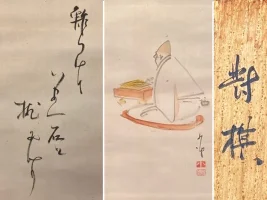
Please read the handwritten haiku attached.
The box has two charaters ?棋, what does the first say?

The author is Sazanami Iwaya (巖谷小波) 1870-1933
Japanese novelist, editor, playwright, critic, and storyteller, a pioneer of Japanese children's literature in the Meiji era . Iwaya, whose real name was Iwaya Sueo, achieved popular success with Koganemaru.
 

Attachments

  • haiku 3.webp
    haiku 3.webp
    114.3 KB · Views: 147
A partial solution would be welcome too.
In the haiku I only recognize 石. What is e.g. the first character like?

On the box I wonder what the first character might be in ?棋.
Is there a game with a somewhat similar character?
 
I'm almost certain the box simply says 将棋 (shōgi) using some variant of 将.
The poem is indecipherable to me. You might try to put it on Reddit in the translation subreddit to see if anyone can crack it.
 
I'm almost certain the box simply says 将棋 (shōgi)
Thanks very much for your reaction.

On reddit I got two reactions. Would you be able to combine them into a possible explanation?

Kafatat:
對棋. Modern character (shinjitai) is 対. Play the game of go together.
I can read only one character in the haiku: 石, meaning stone (rock) or more likely, a piece in the game of go.

kakubinn:
I am not sure at all
将棋 [shougi] or something, though I am not sure
𨋘らに いざ一石と 挑みけり [sanagara ni iza isseki to idomi keri] Just like (a battle), "Let's fight! (Starting with, or Putting) one (or the first) stone", I have challenged.

nomfood added:
中文(吳語)
I'm not sure how you got 𨋘ら or if it's a real word. Isn't it closer to 鮓?
I think it's いま
 
OK - I see it on Reddit. I agree with Kafatat. The writing on the box should be 對棋 ("Playing Shōgi"). It's a better match than 将棋.

The poster named Nomfood is a very good translator, so I would normally agree with him. What he says about Kakubinn's translation is correct. I feel Kakubinn is grasping at straws (but normally he/she is also a competent translator). Nomfood is probably one of the top three or four Japanese translators on reddit. The fact that Nomfood hasn't offered his own interpretation tells me that the writing is a bit too enigmatic for any of us to pin down. I don't really understand his comment about いま.
 
Considering 對 in 對棋 seems not to be related to 将,
Considering the haiku mentions 石.
Considering 棋 is also often used for "go" [e.g. Nihon Kiin (日本棋院), Kido (棋道),... ],
Would this haiku rather refer to igo?

As to 對棋, "play together": what about the illustration showing a man alone (studying?)
 
I really don't know too much about igo and shōgi, but yes the image and poem could both be igo.
Regarding 對棋, its hard to say if this is a significant choice of words or not, without understanding the poem. I think I would just translate 對棋 (対棋 in modern Japanese) as "playing shōgi" or "playing go". I don't think I would put emphasis on "playing with a partner", as the game itself implies that you are playing against an opponent. So my gut feeling is that there is no particular significance in the choice of words and the box versus the solitary figure in the picture.

Is the person in the picture really playing by himself? Is he just studying the board? Is it a philosophical treatise on solitude? I'm afraid I can't answer any of those questions.
 
Back
Top Bottom