


- 14 Mar 2002
- 21,050
- 18,903
Mitsubishi Electric has developed artificial intelligence that can determine whether a driver is intoxicated, using facial images and other signs captured by an in-vehicle camera. The system looks at a driver's face and behaviour from camera footage and then decides. The company said it plans to work with automakers to bring the technology into vehicles, with functions such as issuing warnings or even stopping the car if the AI judges the driver to be drunk. The aim, it said, is to move towards early commercial use. NPA data shows there were 125 fatal accidents caused by drunken driving in 2025, down 15 from a year earlier. Even so, the fatal accident rate in such cases was about 7.1 times higher than for sober drivers.
Courtesy of Mainichi.
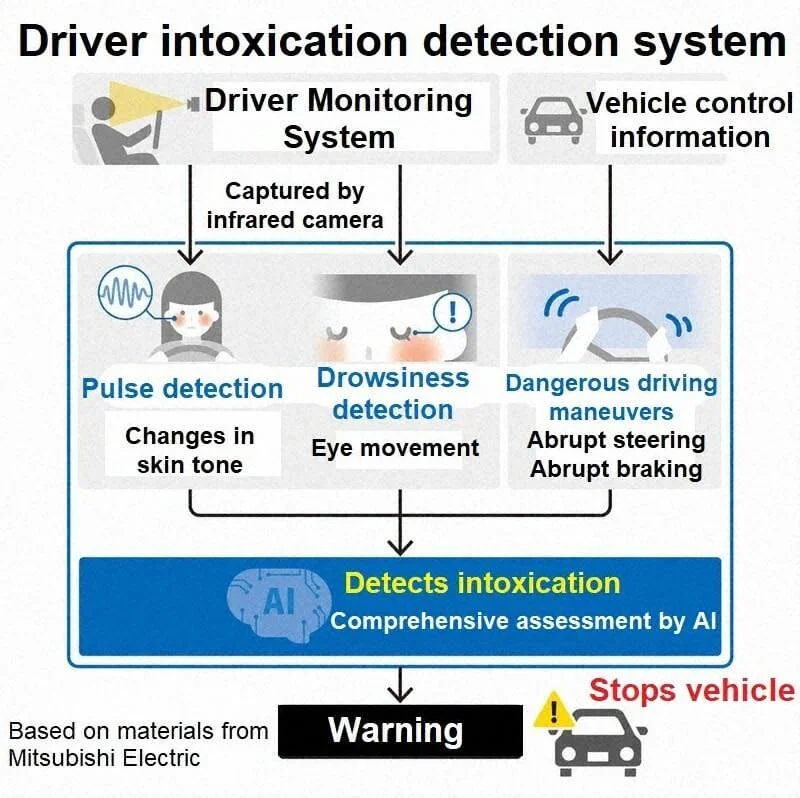
The system employs infrared cameras capable of nighttime use to capture changes in skin complexion due to blood vessel dilation, while the AI accurately measures an increase in pulse rates. It estimates drowsiness from eye movements and other indicators. Additionally, the AI determines intoxication by combining vehicle control information, such as abrupt steering or braking, with other data.

 mainichi.jp
Courtesy of Mainichi.
According to Japan's National Police Agency, there were 125 fatal accidents caused by drunken driving in 2025, a decrease of 15 from the previous year. However, the fatal accident rate for drunken driving was about 7.1 times higher than for sober driving. In the United States, the National Highway Traffic Safety Administration reported that more than 12,000 people died in drunk driving accidents in 2023. Getting behind the wheel after drinking has become a social issue both domestically and internationally, and discussions in Europe and the U.S. are progressing toward mandating the implementation of drunken driving prevention technology in new vehicles. Mitsubishi Electric's Advanced Applied Development Centre in Hyogo Prefecture commercialised a "Driver Monitoring System (DMS)" that uses in-car cameras to recognise a driver's face and detect inattentive or drowsy driving, triggering a warning sound. This DMS was adapted to detect intoxication in 2018.
The system employs infrared cameras capable of nighttime use to capture changes in skin complexion due to blood vessel dilation, while the AI accurately measures an increase in pulse rates. It estimates drowsiness from eye movements and other indicators. Additionally, the AI determines intoxication by combining vehicle control information, such as abrupt steering or braking, with other data.
Japan's Mitsubishi Electric develops AI to detect drunken driving from drivers' faces - The Mainichi
OSAKA -- Major Japanese electronics maker Mitsubishi Electric Corp. has developed artificial intelligence (AI) that determines whether a driver is int


