News M5.6 quake hits Kanto region

thomas

Unswerving cyclist
Admin
Joined
14 Mar 2002
Messages
21,050
Reaction score
18,903
Quite a bummer (shindo 4 in our area), though the blaring earthquake early warning was actually scarier than the tremor itself.
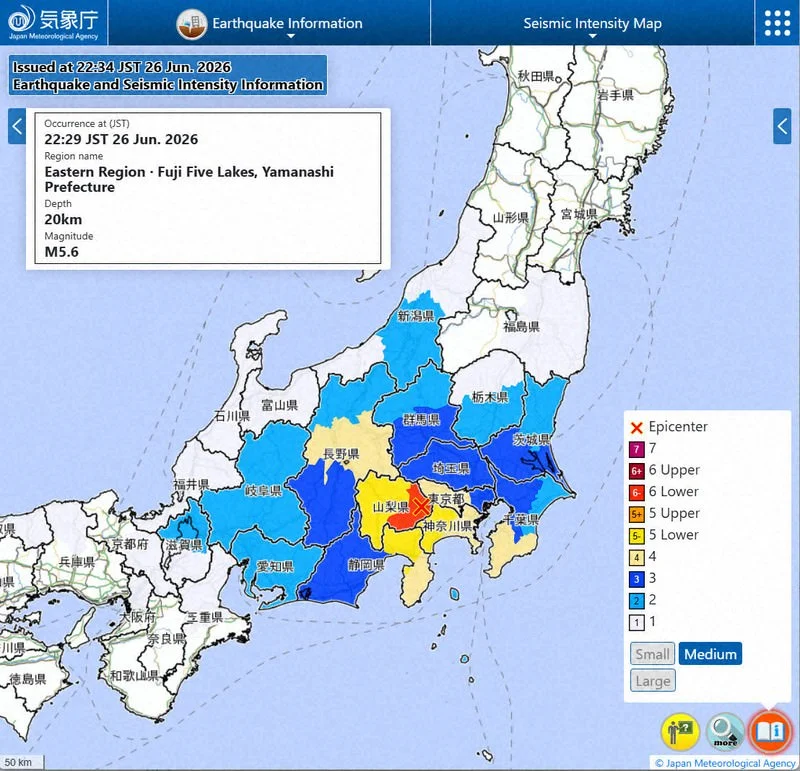
M5.6-26062025.webp

Day and Time: June 26, 2026, 10:29 p.m.
Epicenter: Yamanashi Prefecture. N 35.6 , E 139.0
Depth: 20 kilometers
Preliminary magnitude: 5.6
Seismic intensity scale: Lower 6 out of maximum 7
Note: No tsunami warning issued.
Note: An earthquake early warning was issued for this quake.


It seems that a major earthquake has just occurred in Yamanashi Prefecture, in the Kanto region.

Footage from the Moment the Earthquake Struck: Scenes from Odawara [Magnitude 6 Lower Recorded in Fujikawaguchiko Town, Yamanashi Prefecture] | TBS NEWS DIG

At around 10:29 p.m. on June 26, a strong earthquake struck Yamanashi Prefecture, registering a maximum seismic intensity of Lower 6 on the Japanese scale. According to the Japan Meteorological Agency (JMA), the epicenter was located in the eastern Yamanashi Prefecture/Fuji Five Lakes area. The earthquake occurred at a depth of approximately 20 kilometers (12 miles) and had an estimated magnitude of 5.6. There is no risk of a tsunami from this earthquake. The JMA issued an Earthquake Early Warning following the quake. The strongest shaking, measuring Lower 6 on the Japanese seismic intensity scale, was observed in Fujikawaguchiko Town, Yamanashi Prefecture.

 
I was concerned about the earthquake doing the seismic equivalent of poking the bear and hastening the next eruption. Excuse my non-technical language!
 
ome people worry that a large earthquake could trigger an eruption of Mount Fuji because there are historical examples suggesting a possible connection. However, the relationship is complex.

One well-known example is the 1707 Hōei earthquake, which was estimated to have a magnitude of about 8.6. About 49 days later, 1707 Hōei eruption occurred. Many volcanologists believe the massive earthquake may have changed the stress underground, helping trigger an eruption that was already close to happening.

Another historical event is the 1633 Kan'ei earthquake. Researchers have studied whether it influenced nearby volcanic activity, but there is no conclusive evidence that it directly caused an eruption.

It is important to understand that earthquakes do not automatically cause volcanoes to erupt. For an eruption to occur, magma must already be accumulating beneath the volcano, and several conditions must be met. A large earthquake may sometimes act as the final trigger, but only if the volcano is already in a critical state.

For example, 1923 Great Kantō earthquake and the 2011 Tōhoku earthquake and tsunami did not lead to an eruption of Mount Fuji, even though they were extremely powerful earthquakes.

Therefore, scientists monitor Mount Fuji using seismic activity, ground deformation, volcanic gas emissions, and other observations. A large earthquake alone is not considered sufficient evidence that an eruption is imminent. Instead, experts evaluate all available monitoring data before assessing volcanic risk.
 
Given the penchant of Japanese news for instilling fear and anxiety into the population, such as the over-reporting of even slightly bad weather, we'd soon know about it if Fuji was showing warning signs, so I think we can assume that the volcano is not going to erupt for a while.
 
Back
Top Bottom