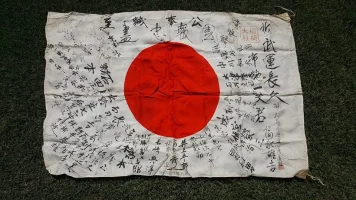
Japanese flag (Yosegaki Hinomaru w/kanji) Translation request

FrancisBeaty

後輩
Joined
23 Jun 2016
Messages
26
Reaction score
0
Japanese flag (Yosegaki Hinomaru w/kanji)

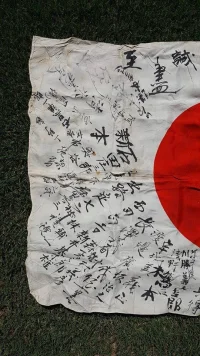
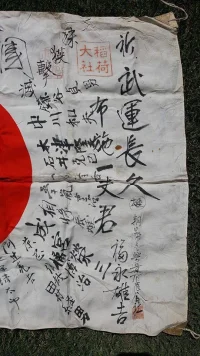
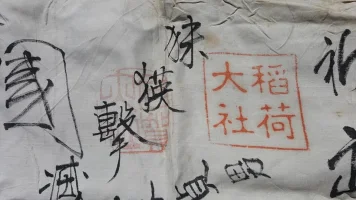
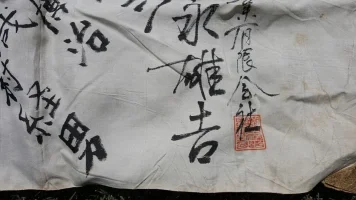
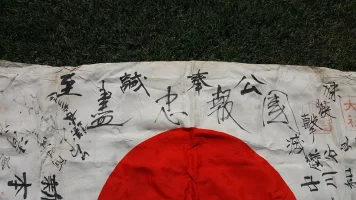
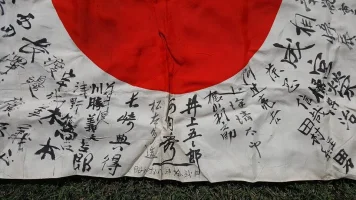
I have tried translating the the flag, some I can find...but struggling on it. It has 3 possible shrine stamps, a soldiers name and maybe even a date or location. I have only researched online...I am completely unfamiliar with kanji. Also other than a soldiers name, who signed around the red circle? Fellow soldiers or friends from home?
What I think I found so far is this;

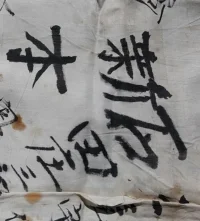
On the far right side...it states a common slogan 祈武運長久, Ki "Prayers" Buun "Fortunes of war" Choukyuu "Forever/perpetually". or Ki Buun Choukyuu--> "Prayers for Eternal Good Fortune in Battle"?
Also on the top I see 奉公 hōkō for "loyalty and courage"?
Thanks for any help...I love history no matter where from.
 

Attachments

  • 13487506_10154884588323492_256066209_n.webp
    13487506_10154884588323492_256066209_n.webp
    167.1 KB · Views: 593
  • 13511588_10154884588303492_324562615_n.webp
    13511588_10154884588303492_324562615_n.webp
    175 KB · Views: 371
  • 13514489_10154884588278492_14192273_n.webp
    13514489_10154884588278492_14192273_n.webp
    141.3 KB · Views: 462
  • 13487754_10154884588348492_1926584702_n.webp
    13487754_10154884588348492_1926584702_n.webp
    149.8 KB · Views: 353
  • 13479442_10154884588338492_158153076_n.webp
    13479442_10154884588338492_158153076_n.webp
    151.3 KB · Views: 350
  • 13479428_10154884588308492_736614757_n.webp
    13479428_10154884588308492_736614757_n.webp
    127 KB · Views: 352
  • 13480148_10154884588318492_281632680_n.webp
    13480148_10154884588318492_281632680_n.webp
    105.5 KB · Views: 402
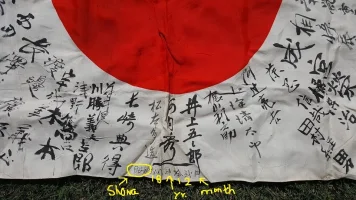
Date found...So this would be from the The Shōwa period (1926 – 1989) Shōwa 18 (1943) Month 12 for Dec?
 

Attachments

  • 13480148_10154884588318492_281632680_n (1).webp
    13480148_10154884588318492_281632680_n (1).webp
    108.5 KB · Views: 318
I found the flag owners name, I think... but I don't know his actual name yet.

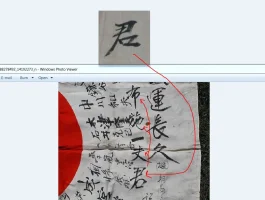
" kanji 君 is "kun" which is used when addressing young males (it can also be "kimi" an informal form of "you", but that's not the context you will normally see on WW2 flags, Japanese normally address someone by their name rather than as "you".). Look for this kanji, and there will probably be 4 other kanji before it (above it or to the right, most old Japanese writing goes top to bottom or right to left). That will be the name of the person the flag was given to."
 

Attachments

  • Name.webp
    Name.webp
    80.4 KB · Views: 383
So at this time I am not sure of soldiers name...but know where it is. Need help with that. There are 2 other areas I need help on...far right bottom and left center.
 

Attachments

  • Need help right side bottom.webp
    Need help right side bottom.webp
    15.2 KB · Views: 361
  • need help  left side middle.webp
    need help left side middle.webp
    57.7 KB · Views: 361
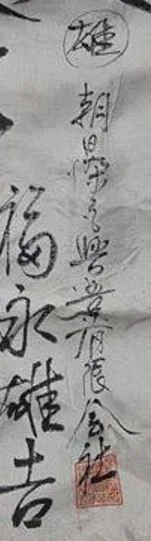
Looks like it was presented to Fuse Kazuo 布施一夫 (family name Fuse)

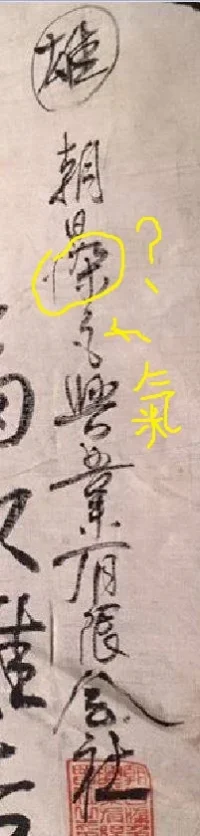
It was sent on behalf of the people working in a company Asahi (something) Kōgyō Corporation
朝日囗囗興業有限会社 (can't read the kanji after Asahi).
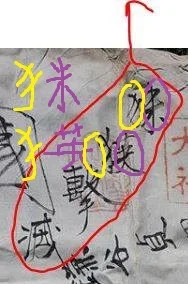
The kanji in left center are part of names; Ishida and Niimoto.
 
Looks like it was presented to Fuse Kazuo 布施一夫 (family name Fuse)

It was sent on behalf of the people working in a company Asahi (something) Kōgyō Corporation
朝日囗囗興業有限会社 (can't read the kanji after Asahi).
The kanji in left center are part of names; Ishida and Niimoto.
Thank you very much for the additional information on the young man and the Company... is there anything special or significant about the 3 possible stamps for shrines or temples?
 
Someone said..."the first word but looks like the abb. for second word."
 

Attachments

  • 12.webp
    12.webp
    34.2 KB · Views: 311
I don't think there is anything special about the seals. One is from Inari Taisha (I presume this refers to Fushimi Inari Taisha, in Kyoto - a famous shrine). I can't see the one next to it. The one at the bottom would be the company seal for Asahi something Corporation. I still can't make out the two characters - and the advice given by the other person doesn't help me much. He/she suggests the fourth character is 氣 (or 気 in modern Japanese), so that would point to some sort of gas or compressed air or steam or something. When I put those elements into a search engine, I get nothing. I'm not entirely convinced that he/she has correctly identified 気 (but its as good a guess as any).
 
The slogans written on the flag are just four. The rest are all signatures.

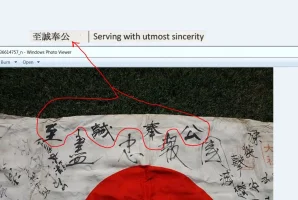
slogan at the top
至誠奉公
Shiseihōkō
sincere loyalty

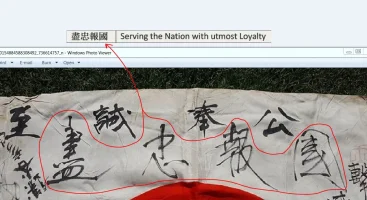
盡忠報國
Jinchūhōkoku
Give all for the country

the upper right
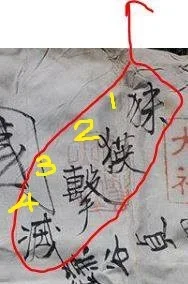
擊滅
Beieigekimetsu
Destroy America and Britain
(The first two characters can't be displayed in this forum. See the following pages.
的解释|的意思|汉典""字的基本解释
的解释|的意思|汉典""字的基本解释
米 and 英 are usually used to refer to America and Britain, respectively. There is a well-known slogan 鬼畜米英 Kichikubeiei Satanic America and Britain in this era, and the radical 犭 kemonohen means "beast", so these two characters would be used to represent 鬼畜米英 here, I suppose.)

You can find these common slogans in the following thread.
Help With Japanese World War 2 Flag Souvenirs | Japan Forum
As is the thread, the correct reading of 祈武運長久 is "Inoru Buunchōkyū" or "Buunchōkyū wo inoru", not "Ki Buunchōkyū".
 
The slogans written on the flag are just four. The rest are all signatures.

slogan at the top
至誠奉公
Shiseihōkō
sincere loyalty

盡忠報國
Jinchūhōkoku
Give all for the country

the upper right
擊滅
Beieigekimetsu
Destroy America and Britain
(The first two characters can't be displayed in this forum. See the following pages.
的解释|的意思|汉典""字的基本解释
的解释|的意思|汉典""字的基本解释
米 and 英 are usually used to refer to America and Britain, respectively. There is a well-known slogan 鬼畜米英 Kichikubeiei Satanic America and Britain in this era, and the radical 犭 kemonohen means "beast", so these two characters would be used to represent 鬼畜米英 here, I suppose.)

You can find these common slogans in the following thread.
Help With Japanese World War 2 Flag Souvenirs | Japan Forum
As is the thread, the correct reading of 祈武運長久 is "Inoru Buunchōkyū" or "Buunchōkyū wo inoru", not "Ki Buunchōkyū".
Just wanted tell you guys ...Thanks. This has been very fun learning about this...and you both have been very helpful at figuring it out. Frank

So maybe it says...this? Because 犭 kemonohen means "beast"

British/ Beast
American/Beast
Shoot/knock
Destroy?

In ref. to this....
 

Attachments

  • beast.webp
    beast.webp
    15.6 KB · Views: 313
  • beast1.webp
    beast1.webp
    14.4 KB · Views: 328
擊滅 means "to destroy" or "destruction" as a compound word, not just simply "shoot + destroy/exterminate". The same goes to 奉公, 至誠 or 鬼畜. Thus, 鬼畜米英 means "Satanic America and Britain" as a four-characters idiom.
 
擊滅 means "to destroy" or "destruction" as a compound word, not just simply "shoot + destroy/exterminate". The same goes to 奉公, 至誠 or 鬼畜. Thus, 鬼畜米英 means "Satanic America and Britain" as a four-characters idiom.
Thanks, So if 犭is in front of 米 and 英, then it means British/ Beast and American/Beast?
 
Kemonohen is a radical, not a kanji. Those two Chinese characters "犭+米" and "犭+英" do exist, but they are very uncommon even in Chinese, and have nothing to do with America and Britain. I said my guess is that the writer would use them to represent 鬼畜米英 as a kind of wordplay.
 
Kemonohen is a radical, not a kanji. Those two Chinese characters "犭+米" and "犭+英" do exist, but they are very uncommon even in Chinese, and have nothing to do with America and Britain. I said my guess is that the writer would use them to represent 鬼畜米英 as a kind of wordplay.
I just wanted to thank everyone's help with this translation...it has been fun learning something new in historical purposes. Is there anyway possible to research the young man Fuse Kazuo 布施一夫 (family name Fuse) military records or otherwise?
 
If he was in the Imperial Army, prefecture governments have the record, but you need to investigate where he was from. If he was in the Imperial Navy, Ministry of Health, Labour and Welfare has the record.
 
Back
Top Bottom