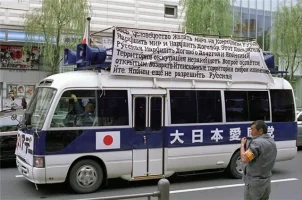
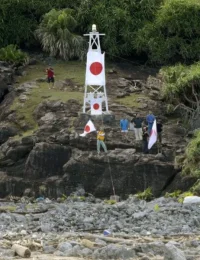
I wonder, what do people think about the Japanese Gov, behavior regarding the Kuril Islands (Rightfully owned by Russia)
and the Senkakus Islands which it is contesting with China?
As those with knowledge know the Kuril Islands belong to Russia, and Tokyo has no claim to these Islands what so ever.
Japan is incapable of striking against Russia on it's own, and the US will certainly not support any action which would go against the mighty bear.
This can be evidenced with the recent Georgia conflict.
The US is also not prepared to go to war with China over these islands, and have stated so many times.
The US, upon which Japan is completely dependent for it's security, is in the process of changing up it's role and alliances in Asia.
Should Japan let go of these claims and concentrate instead on fostering good relations with it's neighbors instead.
Both Japanese claims to both Islands are different and have different levels of validity.
However what about the attitude of the Government in general.
They are obviously taking these actions to gain the nationalist vote. but at what cost?
Japan is clearly not going to be able to use force to claim these Islands, so is entirely reliant on political means.
And the political means are not getting anywhere, and are actually doing harm to Japan.
I wonder, what do people think about the Japanese Gov, behavior regarding the Kuril Islands (Rightfully owned by Russia) and the Senkakus Islands which it is contesting with China?
AFAIK, Japan only claims the South Kuril Islands. Taken from Wikipedia:
The San Francisco Peace Treaty between the Allied Powers and Japan from 1951 states that Japan must give up all claims to the Kuril islands, but it also does not recognize the Soviet Union's sovereignty over the Kuril Islands. Furthermore, Japan currently claims that at least some of the disputed islands are not a part of the Kuril Islands, and thus are not covered by the treaty. Russia maintains that the Soviet Union's sovereignty over the islands was recognized following agreements at the end of the Second World War. However, Japan has disputed this claim.
I don't think the status quo will ever change. Really not a big topic in the news apart from a few indignant reports whenever Putin or Medvedev happen to visit those impoverished islands, curiously gazing at Hokkaido through binoculars.
Yalta and Potsdam gave the Kuril Islands to Russia. The treaty refers to the Kuril Islands being given to Russia. This agreement was between the allies. and on all allied maps the entire island group was referred to as the Kuril islands.
Either way that is not really the issue. Russia owns them and they are not going to give them back.
There is nothing the Japanese can do about it.
So why carry on making waves?
not sure why you're trying to elicit this response. I don't know too much about the island claims, but despite being a miserable hunk of rock, Dokdo has great value as a territory politically and militarily, and it does have some natural resources as well. If the Kuril islands are anything like that, why would Japan suddenly decide to relinquish their claims, unfounded or not?
There is no agenda, It's not about should the islands be japanese or should they be russian etc.
The point is. They are in all likely hood not going to get any of them.
So how far do you throw good money after bad.
Each move to get one of these islands pushes Japan further away.
There is a very real political and eventually economic cost to this behavior.
At what point do the Japanese change tactics,
"why would Japan suddenly decide to relinquish their claims, unfounded or not?"
Because it is damaging relations with all 3 of it's neighbors.
Is it not time for Japan to give up and perhaps make friends?
If they carry on as they do, are they not in danger of becoming isolated in their own region, with a USA that isn't willing or able to get involved any more and still without any new islands?
(and as FYI Falkands are British, discovered by the British, Colonised by the British (and French to a degree) - the argies tried to make a claim for them about 100 years later, this claim was not recognized by anyone. More to the point, Everyone that lives there wants to remain British and Britain has the strength to single handedly kick Argentina's arse if they ever try to take them again. The new type 45 destroyer (most advanced warship on the seas at the moment) could destroy the entire Argentine airforce in an hour. And is currently stationed in the Falklands)
The new type 45 destroyer (most advanced warship on the seas at the moment) could destroy the entire Argentine airforce in an hour. And is currently stationed in the Falklands)
they will sell it to china as scrap metall next year, as they did with bombers, interceptors, helicopters and tanks, just because finansial crisis does not allow to maintain it working condition. Why britain need that crap, if we know exactly that God will save Queen.
That we don't care about the topic and are unimpressed by your observations on it isn't necessarily attributable to our ignorance, gratuitous dismissive insulting remarks from you to the contrary notwithstanding.
I don't understand the Japanese Government.. Yes, I think they should give up and let go of these claims and concentrate instead on fostering good relations with their neighbours.
I'd say if you don't care about a topic that discusses an issue that will have a significant impact on the future prosperity of the country you live in -
Then that is the very definition of ignorance.
Also I have yet to make any observations on the topic, I have only raised it.
However as it appears to be beyond the grasp, there is little point.
Like I said, Don't be offended. I chose to focus on international politics as my area of interest some people prefer AKB48.
One is not necessarily better than the other.
And I could understand why someone from Japan would find it easier to ignore this subject, as the J gov manages to make such an awful hash of it.
I'm hearing a lot of vague assertions. Your posts are clearly intended to elicit a response of "yes, Japan should just give up on these islands." When you didn't get that response, you claim it's going to cost Japan politically and economically, mentioning "significant impact," but go no further than that.
Then claim it's simply over our heads. You're trying to write persuasively without any data to make yourself sound credible, then insult us when we aren't persuaded. Well alright then.
If you just want people to pander to you, put us all on ignore and just respond to yourself.
Actually as there appear to be quite a few people who live in Japan here, and thus statistically a good few people who support the Government in it's island claims. I would hope that some one could put together a measured and reasoned argument as to why the Japanese Government Should pursue it's claims.
It would be interesting to see how people in Japan actually see this situation.
Of course there is a political cost.
Of course this results in an economic cost.
Russia is an energy giant.
China is Japans biggest trading partner, and supplies much of the raw materials required for Japanese Industry.
China is also in the process of asserting itself in the region, and will be the first Asian country to actually have a blue water navy.
I made a point of making it clear that it was not about if Japan has a right to the islands or not (that is another debate)
The point is the politics costs involved.
But this is obviously a topic that holds no interest for people here, and that would be statistically in line with the Japanese populous as a whole,
Which is why the Government is able to get away with such poor foreign policy.
You yourself have stated that Japan should carry on trying to get the islands.
Do you care to back that assertion up with some foundation?
It's politics, so there is no right or wrong answer, which is why it normally makes for good debates
Exactly , it is politics and if you can't understand that then you need to do more research. Or learn more on the topic of politics.
As with anything that involves politics, it is as much about the process as it is with the outcome. If Japan was to lay down and just give in, what message would they be sending to the rest of the world? Every country and his/her dog would then see them as an easy target and it would be a free for all. So what would the costs be towards Japan if they did lay down? It would be a lot higher than the monetary costs of keeping the claim alive.
So , in short, there is nothing to debate. These types of issues will unlikely be solved in the near future and if the truth be told I doubt governments of both sides even really care if they are or not. If either side was really serious, we would have a war on our hands.
I am not defending any one government BTW, as they are all pretty much the same anywhere you go.(Democratic ones)
Has Japan's stance on these islands cost it much so far?
I would even venture to say that Japan's island claims serve to benefit the other countries, as it gives their government a galvanizing force to bring people together, overlook their domestic problems and focus on a foreign nemesis.
You yourself have stated that Japan should carry on trying to get the islands.
Do you care to back that assertion up with some foundation?
Where did I say that? I asked why would Japan suddenly relinquish their claims, not that I had an opinion on whether they should continue to claim the islands. Please reread my post lest you put words in my mouth.
If you are looking for dubitable territorial claims, you should look no further than China, currently at odds with seven neighbouring countries over rocks, shoals and sandbanks, based on claims not even remotely justified by history and/or international law.
In order to further educate yourself on Japan's stance on what they call the Northern Territories issue, please read the following MOFA pamphlet
This paper, written by a Russian research intern, expands on the history and the legal background of the Russo-Japanese territorial disputes in a very level-headed and objective fashion
If you are looking for dubitable territorial claims, you should look no further than China, currently at odds with seven neighbouring countries over rocks, shoals and sandbanks, based on claims not even remotely justified by history and/or international law.
One reason might be related to the inclination of the Japanese to maintaining the status quo. If the status quo is not really hurting anything serious, why not just leave it as it is. It is the same mentality as letting nuclear power plants running despite the fact that many have criticized the dangers of having nuclear power plants in the earthquake stricken country.
I'm sure there are tons of Japanese who care much less about those territorial disputes.
I am not sure about the Northern Territories, but for the Senkaku islands, many must feel like even if we let go of the claim to the islands and try to become friendly to Chinese, they would most likely bring up another issue, perhaps something related to what took place in WWII.
Well politically foreign policy often takes a back seat to domestic policy.
You can get as friendly with your neighbours as you like, or get as much respect from the international community as is possible, but it's still the home voters who decide whether or not you have a job.
Of course it's not just Politician and Voter. Between them stand the sensationalist media. Who will of course do everything it can to get people fired up.
Ultimately it comes down to who is the "average" voter in Japan?
Japanese voters tend to be quite conservative/republican.
There is a strong under current of Nationalism in Japan.
The mind set in Japan is of course not static either. Niether is the relationship between Citizen voter and Political Government.
A lot changed in the 80's. " A time when Money was like water".
However I don't want to get too in depth with domestic politics in Japan.
the nationalists in Japan have a loud voice, and with post-nationalism not in any way present in Japan this is not surprising,
So a government must placate these nationalists in order to stay in power.
The nationalists are also the most likely demographic to take to the streets,
Certainly in the post bubble society.
So I can understand why the politicians would not want to change the status quo.
Or why they pander to the nationalists.
But I still don't understand, what Japan, as a nation or as a leading political party actually has to gain from the claims.
I could genuinely understand keeping it up, if at some point down the line you were actually going to have a chance of getting the islands, and they were filled with natural resources. There is no hope of that.
Would the Japanese Government have the political nous to negotiate a trade deal with china over the islands?
This would boost a stagnating Japanese economy, by forging better trade relations on more favourable terms for Japan, with it's biggest trading partner.
And lets be realistic, those islands are going to end up as Chinese anyway.
Or perhaps I have it wrong, perhaps there is a genuine advantage to Japan maintaining it's island claims that is more than some free nationalist votes for the ruling party come election time.
I think most of Japanese know that China is going to make other claims to various things anyway even after giving up the Islands, so when it comes to the relationship with mainland China, probably it does not make any difference whether giving the islands or not. The Chinese communist party probably needs anti-Japanese sentiment to maintain their authority.
In any case, solving territorial disputes is probably not the most urgent issue people want to focus on in electing politicians.
Yalta and Potsdam gave the Kuril Islands to Russia. The treaty refers to the Kuril Islands being given to Russia. This agreement was between the allies. and on all allied maps the entire island group was referred to as the Kuril islands.
Either way that is not really the issue. Russia owns them and they are not going to give them back.
"Japanese sovereignty shall be limited to the islands of Honshū, Hokkaidō , Kyūshū , Shikoku and such minor islands as we determine."
There was no agreement on what minor islands this consisted of. Okinawa , the Ryukyus, and a whole host of other islands were returned to Japan without any sort of allied "agreement." They were certainly less significant than the three lower Kuril islands. So there is no certainty on international law who actually owns the islands. Certainly the EU Parliament and the US congress believe that the lower islands should be returned.
Really? considering that the Russians concede that there is issues to be discussed surrounding their final disposition and have invited several Japanese prime ministers to discuss the issue, it suggests that there might be something they can do something about it.
There is no agenda, It's not about should the islands be japanese or should they be russian etc.
The point is. They are in all likely hood not going to get any of them.
So how far do you throw good money after bad.
Each move to get one of these islands pushes Japan further away.
There is a very real political and eventually economic cost to this behavior.
At what point do the Japanese change tactics,
"why would Japan suddenly decide to relinquish their claims, unfounded or not?"
Because it is damaging relations with all 3 of it's neighbors.
Is it not time for Japan to give up and perhaps make friends?
If they carry on as they do, are they not in danger of becoming isolated in their own region, with a USA that isn't willing or able to get involved any more and still without any new islands?
Considering = that Japan might become part of the TPP, has expanded its military and diplomatic relations with South Korea, The Philippines, India, Vietnam, among others, and has increased its foreign trade over the past twenty years, this is a ridiculous assumption.
(and as FYI Falkands are British, discovered by the British, Colonised by the British (and French to a degree) - the argies tried to make a claim for them about 100 years later, this claim was not recognized by anyone. More to the point, Everyone that lives there wants to remain British and Britain has the strength to single handedly kick Argentina's arse if they ever try to take them again. The new type 45 destroyer (most advanced warship on the seas at the moment) could destroy the entire Argentine airforce in an hour. And is currently stationed in the Falklands)
The type 45 is the most advanced? Praytell, what exo-atmospheric or TMD capability does it have? What Anti-ship or long distance capability does it have? How effective is its network capability compared to the Aegis system?
The type 45 is a very nice ship, however its not the most advanced.
Its also a fading power, with a horrible demographic profile, increasingly failing social system, and rapidly declining military power. Its an energy giant when the Japanese state is becoming more efficient with its energy needs and can draw its resources from North America, Asia and the Middle East. Rather it is Russia that needs Japan more than the other way around... in order to help it exploit its wealth in the east and as a market for its goods. Japan does not.
and domestic policy often takes a back seat to foreign policy. That's a bunch of euphemisms that illustrate no understanding about the dynamics of foreign policy.
You can get as friendly with your neighbours as you like, or get as much respect from the international community as is possible, but it's still the home voters who decide whether or not you have a job.
Of course it's not just Politician and Voter. Between them stand the sensationalist media. Who will of course do everything it can to get people fired up.
Ultimately it comes down to who is the "average" voter in Japan?
Japanese voters tend to be quite conservative/republican.
There is a strong under current of Nationalism in Japan.
Wrong, which illustrates the shallowness of analysis you bring to this topic. Any number of polls or even anecdotal evidence would indicate that pacifism commands significantly greater support among the Japanese public, even today. An 2010 Asashi Shinbun poll suggested that 67% of Japanese think altering Article 9 would be to the detriment of the country. I'd place nationalist groups at less than 25%, if notless than 20% of the general populace support.
Or perhaps I have it wrong, perhaps there is a genuine advantage to Japan maintaining it's island claims that is more than some free nationalist votes for the ruling party come election time.
This site uses cookies to help personalise content, tailor your experience and to keep you logged in if you register.
By continuing to use this site, you are consenting to our use of cookies.


 they will sell it to china as scrap metall next year, as they did with bombers, interceptors, helicopters and tanks, just because finansial crisis does not allow to maintain it working condition. Why britain need that crap, if we know exactly that God will save Queen.