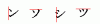
How in the hell do you guys tell ソ ンand シ ツ apart?

-悪魔-

先輩
Joined
13 Jun 2004
Messages
64
Reaction score
1
Both handwritten and typed on the computer. How in the hell do you guys differentiate the those apart? This is the most feared thing that I hate about katakana. Why in the hell they have to make them virtually identical? 😡
 
-悪魔- said:
Both handwritten and typed on the computer. How in the hell do you guys differentiate the those apart?
Context, practise, context and context.
 
Shi and n are written with the strokes starting on an imaginary vertical line, and the stroke are pulled "to the right", away from that imaginary line. So and tsu are written the opposite way, strokes starting on an imaginary horizontal line. with the strokes pulled "down".
 

Attachments

  • kana.gif
    kana.gif
    436 bytes · Views: 197
Toss in stroke order and they're impossible to miss.
ン -dot is angled to the right, stroke starts at the bottom and ends at the top
ソ - dot is angled down, stroke starts at the top and ends at the bottom
シ - dots are angled to the right, stroke starts at the bottom and ends at the top
ツ - dots are angled down, stroke starts at the top and ends at the bottom

When I write, then, my ソs and ツs usually come out narrower than my ンs and シs. Their differences are fairly pronounced...at least as much as the difference between I and l in the English alphabet.
 
jonny-mt said:
Toss in stroke order and they're impossible to miss.
Ah, but what happens when you throw in half-width katakana? :D
ん or そ? ン
 
PaulTB said:
Ah, but what happens when you throw in half-width katakana? :D
ん or そ? ン

I was actually writing my post at the same time as Buntaro (hence the identical post times)...seems his system is more complete than mine, so going by that I'm going to wager that's an ん :D
 
jonny-mt said:
I was actually writing my post at the same time as Buntaro (hence the identical post times)...seems his system is more complete than mine, so going by that I'm going to wager that's an ん
Congratulations!

Actually there's an easy (and total cheat) way to tell with electronic text.

1. Take the character and paste it into an edit box or similar.


2. Select it and use the reconv shortcut key from the Japanese IME.
[IMPORTANT! The standard key is generally available on a Japanese keyboard only. Manually alter the setting to something you can use (I chose F12). This can be done from
IME Language Bar -> Tools -> Properties -> General -> Advanced Button]

You will find ん but not そ in the option list :cool:


More generally if you have something like 追随 you can see how it is (probably) read by the same method.
 
I just use a simplemnemonic trick. The best way is to learn an order, any order , even if it makes no sense, but the order you put them in must get a meaning

Mine is no - so - tsu - n - shi.
Strokes : 0 -1 - 2 - 1 - 2. 0-1-2-1-2 is really fast to say on your mind. Then just remember which way were the strokes , Horz, then vert ? or Vert than Horz....
Up, Up, down, down, left, right, left, right, B, A, Start. Now you know which is which :P
 
Kintaro said:
I just use a simplemnemonic trick. The best way is to learn an order, any order , even if it makes no sense, but the order you put them in must get a meaning

Mine is no - so - tsu - n - shi.
Strokes : 0 -1 - 2 - 1 - 2. 0-1-2-1-2 is really fast to say on your mind. Then just remember which way were the strokes , Horz, then vert ? or Vert than Horz....
Up, Up, down, down, left, right, left, right, B, A, Start. Now you know which is which :P

LOL. It's amazing how the Contra code left such a lasting impression on those who played the game. :D :D

I must say that I've never quite seen someone break these down like that. It's quite impressive, really. Although I'm not so sure that it's a simple mnemonic trick. :p 😌
 
Back
Top Bottom