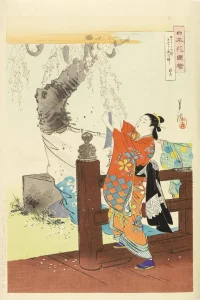
Caption on Gekko print

Ger

後輩
Joined
17 Jan 2018
Messages
190
Reaction score
95
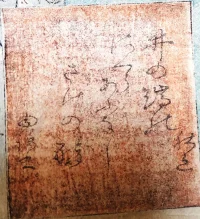
Please read the caption on this print by Gekko.
A partial result would be welcome too.
Is it a known haiku?
The red box seems to start with 井 (well) and indeed the lady is next to a well.
Any ideas as to what scene is depicted? She seems to (un)tie a ribbon to a branch.
I have added a enhanced image of the red box.
 

Attachments

  • IMG_3025.webp
    IMG_3025.webp
    259.1 KB · Views: 99
  • IMG_3024+.webp
    IMG_3024+.webp
    342.4 KB · Views: 96
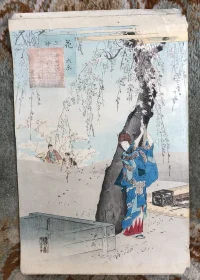
Compare with these prints I just found:

渓斎英泉「花見」
Eisen Keisai "Hanami"

尾形月耕「秋色桜・井の端の桜あぶなし酒の酔ひ」
Google: Gekkou Ogata "Autumn Colored Cherry Blossoms / Cherry Blossoms at the End of the Well"


Who are the men approaching in the first print?
 
You've got it right. The blue square behind the poem reads
上野 花 台東 Ueno, hana, Taitō
The reddish square reads
井の端 くらあふなし さけの酔 The ones in red use hentaigana

Also 秋色 (Shūshiki) which is the name of the poet.

The seal is 華暁樓 (Kagyōryō) , one of Gekkō's art names. The poem warns against hanging out around the well during cherry-blossom-viewing season, as there will be drunkards around. The girl composed the poem, and the priest of Kaneiji Temple (near Ueno) heard it, and was charmed by it, and I think he promoted the poem as a slogan against drunkards in this season. Maybe one of the two guys approaching represents the priest of Kaneiji Temple. I don't know why she is tying something to the branch. Maybe she is tying that poem to the tree branch?

This site below helped me immensely.
 
The poem reads something like

At the well-side
The cherry-blossoms are dangerous
Drunk on sake

As you can see, by itself its not a fascinating or lovely poem, but I think what resonated with the priest was the fact that it was written by a young girl (13 years old), and that its a fairly catchy slogan for the dangers of booze. And maybe the juxtaposition of cherry-blossoms with danger has an unusual quality to it.
 
That's great! Far more than I had even hoped for...
The site you mention indeed describes the actual Gekko print!

明治・大正期の人気絵師・尾形月耕の錦絵で、秋色桜の故事を描いています。日本橋小網町の菓子屋の娘、おあきが十三歳の年に上野の花見で詠んだ句「井戸端の桜あふなし酒の酔」が、寛永寺の法親王の耳に入り、いたくお気に召された。後に、少女は俳諧点者・秋色として名を成した云々。『江戸遊覧花暦』の「桜 東叡山」の項にも、この故事が紹介されています。句の初出は享保17(1732)年刊の地誌、菊岡沾涼『江戸砂子』(巻三)(菊岡沾涼著 ; 丹治庶智補 : 明和9(1772)【840-1】)です(該当箇所)。

google translates as:

Hana Ueno


41.webp

A nishiki-e by Gekkou Ogata, a popular painter in the Meiji and Taisho periods, depicting the historical events of autumn-colored cherry blossoms. When Oaki, the daughter of a confectionery shop owner in Koamicho, Nihonbashi, wrote a poem when she was thirteen years old at a cherry blossom viewing party in Ueno, "Idobata no Sakura Afunashi Sake no Sui" was heard by the Cloistered Prince of Kan'eiji Temple, and he loved it. summoned. Later, the girl made a name for herself as a haiku poet Akiiro. This story is also introduced in the " Sakura Toeizan " section of " Edo Yuran Kakoyomi ". The first appearance of the phrase is in Kikuoka Senryo's "Edo Sunago" (vol. 3), a topography published in 1732 ( Kikuoka Senryo; place ).
 
A mystery remains about the presence of the well.
And the strip of paper is tied to a branch by a woman in the next print as well, while no poem seems to be mentioned.

The poem reads something like

At the well-side
The cherry-blossoms are dangerous
Drunk on sake

As you can see, by itself its not a fascinating or lovely poem, but I think what resonated with the priest was the fact that it was written by a young girl (13 years old), and that its a fairly catchy slogan for the dangers of booze. And maybe the juxtaposition of cherry-blossoms with danger has an unusual quality to it.

Maybe it is dangerous to sit on the side of a well admiring tha blosoms while drinking sake... One could fall back in.
.
 
Your link also has a chapter on Hanami Sake.
Google translate: "One of the pleasures of cherry blossom viewing is alcohol. The Edokko played the shamisen and enjoyed a comical farce as a side dish. Among them, there are some who get frustrated by exposing their drunkenness . According to Tobi Mitamura's "Edo of Entertainment" (Taisho 14 (1925) [546-37]), police power was exercised in a restrained manner during cherry blossom viewing, and the shogunate seemed to tolerate the common people's relaxation ."
 
Well I think the episode would have been famous in those days, so any educated person in Edo seeing this print will know the story and who it depicts.

The well is mentioned in the first line in the poem
Idobata no
Sakura Afunashi
Sake no Sui

Idobata (or "Inobata" in the poem) means "by the side of the well".

As you might know, hanami is a traditional pastime that often (usually?) involves drinking under the cherry trees with colleagues, friends, classmates, and even today the police are probably more lenient towards drunks during hanami season.

The translation above got the poet's name wrong. Should be Shūshiki instead of "Akiiro".
(She is both the poet, as well as the girl depicted in the ukiyoe). Shūshiki is her art name.
 
And yes, you may be right - she may be tying the poem to a tree to warn drunkards against falling in the well at hanami time.
 
Still it is strange - the well is mentioned as well in the third print from the left in the earlier mentioned page:

尾形月耕「秋色桜・井の端の桜あぶなし酒の酔ひ」
And that is in autumn? Or what does it say precisely?
The tying of a ribbon seems to be not connected to hanami.

Here is the print enlarged so that a poem(?) can be read there too starting with 井.

Can it be read? Also attached here
 

Attachments

  • 20a9d3ad-03c5-4ace-8d72-7ef49ebc6163.webp
    20a9d3ad-03c5-4ace-8d72-7ef49ebc6163.webp
    163.7 KB · Views: 90
Apparantly this is clear about the poem:
"Artist Gekko Title Hana (flower) - Woman attaching a poem strip to a blossoming cherry tree Signed Gekko Date 1891 Publisher Takegawa Risaburo Format Oban (10" X 14 5/8") Impression Fine; metallic pigments Condition Excellent color
 
尾形月耕「秋色桜・井の端の桜あぶなし酒の酔ひ」
And that is in autumn?
As Majestic-san already pointed out, 秋色 Shūshiki is the name of the poet/girl. Thus, it doesn't mean "autumn", and the AI's translation of 秋色桜の故事を描いています "depicting the historical events of autumn-colored cherry blossoms" is clearly wrong. It actually means "depicting a historical episode of Shūshiki's cherry blossoms".

Here is the print enlarged so that a poem(?) can be read there too starting with 井.

Can it be read?
Yes, it's the same poem.
 
Back
Top Bottom