

Navigation
Install the app
How to install the app on iOS
Follow along with the video below to see how to install our site as a web app on your home screen.
Note: This feature may not be available in some browsers.
More options
Style variation
System
Light
Dark
You are using an out of date browser. It may not display this or other websites correctly.
You should upgrade or use an alternative browser.
You should upgrade or use an alternative browser.
Accounts of Enola Gay Crew
- Thread starter lonesoullost3
- Start date
cicatriz esp
後輩
- 21 Aug 2004
- 225
- 6
senseiman said:If you were to detonate a Hirsohima sized bomb on downtown LA, the number of people killed would almost definitely be greater.
Percentages like that mean nothing. Hiroshima is a very compact city which had a population of 350,000 at the time. LA is a sprawling metropolis with suburbs extending over hundreds of square miles.
And yet, if you removed every single person from LA and detonated the bomb, that percentage would still stand. I was only refering to blast radius and maybe psi as a function of that radius, sorry for the confusion.

lexico
後輩
- 22 Dec 2004
- 2,584
- 155
To be human is to realise he has a choice -- at all times.
To blame others, the opponent, the soviets, the Nazis, Pearl Harbor, the public outrage, need to save lives, is to close eyes to this human condition and to seek refuge in an easy defense -- like an animal that has no choice.
There was a choice, many choices, and many, many more.
Those are for murder-in-self-defense case arguments -- not for the leading country of the free world.
So let us not put the words in the mouths of respondents by asking should -- this is no catholic mass.
My answer is: no. Using the atomic bombs was not necessary because there were at least several choices laid before the US, but the choices were neglected out of choice, blinded by fear, greed, haste, and expediency.
To blame others, the opponent, the soviets, the Nazis, Pearl Harbor, the public outrage, need to save lives, is to close eyes to this human condition and to seek refuge in an easy defense -- like an animal that has no choice.
There was a choice, many choices, and many, many more.
Those are for murder-in-self-defense case arguments -- not for the leading country of the free world.
So let us not put the words in the mouths of respondents by asking should -- this is no catholic mass.
My answer is: no. Using the atomic bombs was not necessary because there were at least several choices laid before the US, but the choices were neglected out of choice, blinded by fear, greed, haste, and expediency.

- 8 Aug 2005
- 7,316
- 3,727
I'm not a historian, but my thoughts are thus:
to the American leadership, in order to end the war a devastating attack was necessary; something to crush the Japanese morale and make victory seem impossible... dropping the second bomb on Nagasaki was to reinforce that sense of hopelessness, and to give the impression that we had more than just one of these bombs, and that we were willing to continue dropping them until there was no one left to fight...
nevertheless, I never liked the idea of targetting civilians. The major arguments for the decision I can remember are that the Japanese would have continued fighting to the last man and dragged the war on for as long as possible; there couldn't have been the same psychological impact if a different target was picked, and that the Japanese had no qualms about targetting civilians, both in Asia and America. I recognize these arguments and the fact that the war did end very quickly after the bombs dropped, but I don't find any of it real justification or vindication for all thse civilian casualties that week (and all the repercussions thereafter). I've read several accounts of what happened in Hiroshima, the first of which was Sadako's thousand paper cranes, one of the first books I read... I find the first-person accounts of how devastating the bombs were to be the most compelling arguments against ever dropping them again.
to sum up my own feelings, America needed to show it had the power to end the war as quickly as possible, and that's what they did, but I would prefer to think that all those civilian casualties were not necessary as collateral damage.
to the American leadership, in order to end the war a devastating attack was necessary; something to crush the Japanese morale and make victory seem impossible... dropping the second bomb on Nagasaki was to reinforce that sense of hopelessness, and to give the impression that we had more than just one of these bombs, and that we were willing to continue dropping them until there was no one left to fight...
nevertheless, I never liked the idea of targetting civilians. The major arguments for the decision I can remember are that the Japanese would have continued fighting to the last man and dragged the war on for as long as possible; there couldn't have been the same psychological impact if a different target was picked, and that the Japanese had no qualms about targetting civilians, both in Asia and America. I recognize these arguments and the fact that the war did end very quickly after the bombs dropped, but I don't find any of it real justification or vindication for all thse civilian casualties that week (and all the repercussions thereafter). I've read several accounts of what happened in Hiroshima, the first of which was Sadako's thousand paper cranes, one of the first books I read... I find the first-person accounts of how devastating the bombs were to be the most compelling arguments against ever dropping them again.
to sum up my own feelings, America needed to show it had the power to end the war as quickly as possible, and that's what they did, but I would prefer to think that all those civilian casualties were not necessary as collateral damage.
Silverpoint
後輩
- 17 Jul 2005
- 483
- 44
With the greatest of respect to the original poster, there's a considerably longer and more detailed current thread on this topic entitled "Accounts of Enola Gay Crew" which is (at the moment) sitting near the top of the first page of the forum. Maybe a moderator could join the two or something?
Edit: This post got merged from another thread (in case you're wondering what I'm talking about)
Edit: This post got merged from another thread (in case you're wondering what I'm talking about)
Last edited:

"She said that if Truman had waited even one week longer, there may never have been a need to drop the bombs."
This is demonstrably untrue. 3 days before that week was up, the Japanese had successfully tested their own atomic bomb. It was planned to be used on the nearly 1 million person strong invasion of Kyushu .
In hindsight, the bombings turned out to stop the war immediately, but I don't know that I can justify them with the knowledge that they had at the time.
This is demonstrably untrue. 3 days before that week was up, the Japanese had successfully tested their own atomic bomb. It was planned to be used on the nearly 1 million person strong invasion of Kyushu .
In hindsight, the bombings turned out to stop the war immediately, but I don't know that I can justify them with the knowledge that they had at the time.
lexico
後輩
- 22 Dec 2004
- 2,584
- 155
Do you have proof of this ? Even 2ndary that might point to the primary proof ? Anything ?vorpar said:This is demonstrably untrue. 3 days before that week was up, the Japanese had successfully tested their own atomic bomb. It was planned to be used on the nearly 1 million person strong invasion of Kyushu.Silverpoint referring to a lady historian on BBC Hiroshima debate said:"She said that if Truman had waited even one week longer, there may never have been a need to drop the bombs."
Wilcox, Rober K. Japan's Secret War. New York: Marlowe & Co., 1995
Pictorial History of the Second World War, vol. 5. New York: Wm. H. Wise & Co., 1970
Parrott, Lindsay. "Five Cyclotrons Wrecked in Japan." New York Times, Novermber 24, 1945. (additional stories on Nov 26, 29 and Dec 5, 6, 14, and 15.)
The book I'm reading has a photo of one of the cyclotrons being disposed of by the US military. Jack Seward's Strange But True Stories from Japan.
I misquoted also, the invasion force was numbered at 3.5 million.
Pictorial History of the Second World War, vol. 5. New York: Wm. H. Wise & Co., 1970
Parrott, Lindsay. "Five Cyclotrons Wrecked in Japan." New York Times, Novermber 24, 1945. (additional stories on Nov 26, 29 and Dec 5, 6, 14, and 15.)
The book I'm reading has a photo of one of the cyclotrons being disposed of by the US military. Jack Seward's Strange But True Stories from Japan.
I misquoted also, the invasion force was numbered at 3.5 million.
Silverpoint
後輩
- 17 Jul 2005
- 483
- 44
vorpar said:This is demonstrably untrue. 3 days before that week was up, the Japanese had successfully tested their own atomic bomb. It was planned to be used on the nearly 1 million person strong invasion of Kyushu.
And where exactly was this bomb tested? You need an extremely large amount of space to test a bomb. Testing one in Japan would be nearly impossible due to the densely populated environment. The Japanese were being pinned back on every front, so it's unlikely they could have taken it overseas for testing. I'm curious as to where exactly this device went off and why there is no mention of it in any official records.
The original argument for creating the bomb was because Germany was considered to be close to developing one, so the Allies knew they had to develop the technology first. If there was any real knowledge that the Japanese had a bomb, this would have been a propaganda gift for Truman in his argument for ending the war quickly. Yet, no one at the time, or since in an official capacity has ever used this argument that I'm aware of.
lexico
後輩
- 22 Dec 2004
- 2,584
- 155
RE: Japan's Nuclear Arms as of August 1945 & Plan to Bomb Kyushu
Vorpar:
Thank you for the references. I shall be back to post an argument against what you presented;
Vorpar:
Thank you for the references. I shall be back to post an argument against what you presented;
vorpar said:3 days before that week was up, the Japanese had successfully tested their own atomic bomb.
It was planned to be used on the nearly 1 million [sic. > 3.5 million] person strong invasion of Kyushu.
If there was any real knowledge that the Japanese had a bomb, this would have been a propaganda gift for Truman in his argument for ending the war quickly.
I didn't quite say it clearly enough, but they didn't know until after it was tested that Japan had the bomb. It wasn't tested until after the Nagasaki bombing.
It was tested at a research facility in Korea. You're right, they sent the scientists away since nothing could get done during the American bombing.
Debate all that you wish. I myself haven't checked the primary sources, so I don't know the complete accuracy of what I have presented here. I don't mean to offend, I just thought this was an interesting little known tidbit.
I personally think that the use of nuclear weapons was a tragedy, especially against a mostly civilian population. Nobody can accurately predict what Japan would have done with their bomb either, so I'm not saying that it justifies the American bombings.
In any case, it isn't really that far-fetched an idea, considering that Japan was researching fission in the '20s, at the same time numerous other countries were.
lexico
後輩
- 22 Dec 2004
- 2,584
- 155
A Different Account by Enola Gay Commander, Robert Lewis
While Theodore Van Kirk, Navigator, Morris Jepson, Weapons Test Officer, and Dr Harold Agnew reaffirms the bombimg of Hiroshima on August 6, 1945, the Commandar of Enola Gay, Robert Lewis, chooses to differ from their view, as do J Robert Oppenheimer and Dwight Eisenhower.
The Independent Online Edition
Independent Media TV
While Theodore Van Kirk, Navigator, Morris Jepson, Weapons Test Officer, and Dr Harold Agnew reaffirms the bombimg of Hiroshima on August 6, 1945, the Commandar of Enola Gay, Robert Lewis, chooses to differ from their view, as do J Robert Oppenheimer and Dwight Eisenhower.
The Independent Online Edition
Independent Media TV
(c) 2005 Independent News & Media (UK) Ltd.By David McNeill in Hiroshima said:'My God, what have we done?' - the commander of the 'Enola Gay'
Sixty years ago tomorrow, the crew of the Enola Gay watched in awe as their payload detonated over the city of Hiroshima. "As the bomb exploded, we saw the entire city disappear," said Commander Robert Lewis. "I wrote in my log, 'My God, what have we done?'"
Below, thousands of people were instantly carbonised in a blast that was thousands of times hotter than the sun's surface; further from the epicentre, birds ignited in mid-flight, eyeballs popped and internal organs were sucked from bodies of victims.
By the end of the day an estimated 160,000 were dead or injured and the bomb's "ghosts" walked the city - thousands of initial survivors who would die within days, often with the word mizu -water - on their lips. Many more subsequently died - and are still dying - from various cancers.
Harry Truman, the then President of the Unites States who had ordered Hiroshima destroyed, later said: "We have discovered the most terrible weapon in the history of the world," but steadfastly defended its use and said it had ultimately saved lives.
In March this year, Paul Tibbets, the pilot of the Enola Gay, also said the bomb had saved lives. Asked whether he had any regrets, he said: "Hell no, no second thoughts. If you give me the same circumstances, hell yeah, I'd do it again."
J Robert Oppenheimer, the brilliant scientist who oversaw the building of the bomb, was more ambiguous about his creation. He famously said after the first test detonation: "Now I am become death, the destroyer of worlds."
Truman's successor, President Dwight Eisenhower, also had reservations. In a 1963 interview with Newsweek magazine, he said: "The Japanese were ready to surrender and it wasn't necessary to hit them with that awful thing." Some thought that Imperial Japan, like Nazi Germany, deserved what it got for the brutal, relentless bombing of Shanghai and Chongqing, the Rape of Nanjing and other war atrocities across Asia. But others asked where had the moral high ground of the Allies gone since President Franklin D Roosevelt described the 1940 Nazi blitzkrieg of British cities as "inhuman barbarism"?
"No one seemed conscious of the irony," wrote the US historian Howard Zinn. "One of the reasons for the general indignation against the fascist powers was their history of indiscriminate bombing of civilian populations."
Tomorrow morning, Hiroshima will sidestep the endless debates over whether the bombing was justified and concentrate on commemorating the victims, in a ceremony swelled by thousands of foreign visitors and dominated by fresh concerns that the world is forgetting the lessons learnt here.
"I'm less resentful about what happened in Hiroshima than I am about America's wars today," says Kazuko Kojima, who was born two days after the bomb fell, in a cellar filled with the dead and dying victims. "Why don't they stop? Aren't there better ways to solve problems? The reason people go to war is because they don't understand the feelings of others."
Article Length: 448 words (approx.)
Last edited:
Silverpoint
後輩
- 17 Jul 2005
- 483
- 44
vorpar said:It was tested at a research facility in Korea. You're right, they sent the scientists away since nothing could get done during the American bombing.
I'm not saying you're completely wrong, but the balance of probability would lead me to believe that this isn't a true account. Recently a "historian" in the UK published a book claiming that Germany had also developed a bomb, but his arguments were widely discredited. He put up what seemed like a reasonably sound argument to someone reading his book. But when you looked at the bigger picture, he had been incredibly selective with the truth in order to build a case.
Korea, China et. al. need no excuses to criticize Japan's wartime atrocities. If there had been any testing of nuclear weapons on Korean soil, I'm pretty sure it would be at the forefront of any debate and other countries would never let Japan forget about it, yet I've never heard a word come out of Korea about this.
lexico
後輩
- 22 Dec 2004
- 2,584
- 155
The Japanese Nuclear Project: How Was It ? How Is It ?
Was there a Japanese A-Bomb, genzai bakudan ナ陳エナスq窶敘。ナ甜, in 1945 ?
The Snell Report on an Interrogation of a Japanese Intelligence Officer
Japan Developed Atom Bomb; Russia Grabbed Scientists by David Snell
Atlanta Constitution Oct. 3 1946.
(C) The Atlanta Constitution and David Snell 1946
The controversy regarding the Japanese Nuclear Program began with a US Army officer David Snell (an agent of the Twenty-Fourth Criminal Investigation Detachment) who interviewed a certain Japanese Captain Tsetusuo Wakabayashi ( "pseudonym" ) who had been "in charge of counter-espionage at the atomic developing project in Korea.ツ" ツ"Wakabayashiツ" told Snell in Seoul 1945 that;
William J. Pellas (http://www.williamjpellas.com/)
in Cold War Times May/June 2004 pp. 19-20
(C) US Library of Congress 2003
Obviously there would be thousands of pages to be written on the Japanese nuclear program, and at least dozens of questions raised. These are some that I believe are essential :
1) How much of Wakabayashi's account of Japan's nuclear program and bomb testing relayed in Snell's report can be supported by evidence ?
If the answer is preeminently positive, follows the question;
2) How much was the US aware of the Japanese nuclear program ? Is there evidence ?
If the answer is preeminently positive, follows the question;
3) Did that knowledge influence the US bombing of Hiroshima ? Is there evidence ?
If the answer is preeminently positive, follows the question;
4) How much can Japan be blamed for its hypocricy of crying murder when they themselves were contemplating nuclear bombing US mainland indiscriminately with 9,000 nuclear weapons dropped from balloons as it had done with conventional bombs ? Is there evidence ?
If the answer is preeminently positive, follows the question;
5) How much has Japan been preparing for a nuclear re-armament after 1952 ? Is there evidence ?
If the answer is preeminently positive, follows the questions;
6) Where does Japan's nuclear offensive preparedness stand right now ?
What evidence do we have of Japan walking the double ropes of "victim" and "villain" ?
What has been its main means of information manipulation ?
7) What interest lies in a "possible" nuclear re-armament of Japan for the US ?
It is obvious that a nuclear re-armament amounts to independence from the US nuclear shield, politically and militarily.
What's in it for the US to let Japan slip out of its rein ?
Or is it just another "conspiration cooked up by idle day-dreamers and Japan bashers" ?
--------------------------------------------------------------------------
Useful links On the (Japanese) Nuclear Program(s):
Japanese atomic program
Nuclear Weapons Program FAS: The Federation of American Scientists
Japan and Atomic Bombs Links to Japan Incorporated articles
CHRONOLOGICAL TABLE OF NUCLEAR WEAPON Masaaki Koarashi
Japanese development of nuclear energy several possible Japanese nuclear testings before August 15, 1945
Japan's A-Bomb 39th Bomb Group (VH), 20th Air Force, claims Japan detonated an atomic bomb
Japan's Atomic Bomb Michael Trossman favors Imperial Japan's motivation, suggests nuclear rearmament of modern Japan
Wiki Talk: Japanese atomic program discussion on IJ nuclear program
German nuclear energy project
Soviet atomic bomb project
Manhattan Project
Links: japan nuclear weapons program Links to FAS articles, nuclear programs of the world
List of countries with nuclear weapons
History of nuclear weapons
Nuclear weapon
Nuclear weapon design
Critical mass
Uranium Maps Worldwide distribution of Uranium Ores (requires Java)
Uraninite
Yellowcake
Uranium hexafluoride
Uranium
Uranium-235
Uranium-238
Plutonium
Uranium Production FAS page
Heavy water
Enriched uranium
Uranium Enrichment
Uranium Enrichment (pdf)
Isotope separation for uranium enrichment
Gaseous diffusion
Gas centrifuge
Zippe-type centrifuge
Cyclotron a kind of particle accelerator
Particle accelerator
Particle Accelerators Around the World
Nuclear testing
Nuclear explosion (detonation, blast)
Nuclear Weapon Effects Calculator
Electromagnetic pulse
Gamma radiation
Firestorm
Shock wave
Mushroom cloud
Radioactive contamination
Nuclear fallout
Trinity test
Castle Bravo
Tsar Bomba
Table of Known Nuclear Tests Worldwide: 1945-69 | 1970-96 National Resources Defense Council
Category: Nuclear test sites
--------------------------------------------------------------------------
Vorpar:
What are required for Wakabayashi-Snell-Wilcox's claim to Japan's Nuclear Bomb Testing of August 12, 1945 ?
These are the bare minimum number of conditions that would have to be met
1) for a Japanese atomic bomb to have existed at that time
2) for the nuclear bomb to have detonated off shore of Hungnam 窶ケツサ窶愿ャ (Jap. Konan) Korea, August 12, 1945.
First there would have had to be uranium ore(s) to supply the raw, naturally occurring uranium within Japanese access.
Second there would have had to be a facility with a certain throughput, processing the raw uranium to a higher concentration of uranium.
Third there would have had to be an established enrichment technology.
Fourth there would have had to be a facility employing the enrichment technolgy to separate U-235 from U-238 via enrichment.
Fifth the enrichment process would have had to last long enough to have accumulated U-235 above critical mass.
Six there would have had to be an explosion mechanism deveoped. The enriched U-235 of a quantity above critical mass would have had to be assembled in sub-critical mass parts that would reach above critical mass at time of desired detonation.
Seventh if the bomb was tested, there would have had to be telltale signs of the testing if the test was performed above ground or waters.
Does the August 12, 1945 Japanese a-bomb have enough evidence (records, witness accounts, orders, plans, reports, books) to satisfy these criteria ?
What does Robert K. Wilcox have to offer in terms of concrete evidence supporting the existence of a working atomic bomb in Imperial Japan before the surrender ?
Was there a Japanese A-Bomb, genzai bakudan ナ陳エナスq窶敘。ナ甜, in 1945 ?
The Snell Report on an Interrogation of a Japanese Intelligence Officer
Japan Developed Atom Bomb; Russia Grabbed Scientists by David Snell
Atlanta Constitution Oct. 3 1946.
(C) The Atlanta Constitution and David Snell 1946
The controversy regarding the Japanese Nuclear Program began with a US Army officer David Snell (an agent of the Twenty-Fourth Criminal Investigation Detachment) who interviewed a certain Japanese Captain Tsetusuo Wakabayashi ( "pseudonym" ) who had been "in charge of counter-espionage at the atomic developing project in Korea.ツ" ツ"Wakabayashiツ" told Snell in Seoul 1945 that;
The Japanese Bomb And Why It Matters (pdf)Japan had been trying to build its own nuclear bombs since at least as far back as 1938, upon hearing of German success in splitting the atom.
He recounted the appointment by the Imperial Japanese Army of Dr. Nishina Yoshio ツ仁窶ーテ遺?擢窶悩 ---one of the world's foremost nuclear physicists and a former student of Neils Bohr---to head the bomb assembly effort at the national science academy, Tokyo's Riken Institute.
Research proceeded at a relatively leisurely pace until the tide of war turned against Japan, after which the Army and, later, the Navy began pouring more and more resources into building a working device and turning it into a practical weapon.
When American B-29s arrived to firebomb mainland cities, the program was disrupted and had to be largely evacuated and reconstituted in Korea, at Hungnam 窶ケツサ窶愿ャ (Jap. Konan), where Japanese zaibatsu colonial entrepreneurs (such as Noguchi Shitagau 窶禿ャナ津サ ツ鞘?ヲ, 1873-1944) had built a gigantic military industrial complex after taking control of the area in the 1904-5 Russo-Japanese War.
It was here, Wakabayashi claimed, that the Japanese atomic bomb, the genzai bakudan ナ陳エナスq窶敘。ナ甜 (ツ"greatest fighterツ" [sic. > "element bomb"]) was completed and test-fired on August 12, just after Nagasaki. He said it would have been finished three months earlier had it not been for the B-29s, which he considered to have been the decisive weapon in the war.
Alas for Japan, there was only enough uranium fuel to power the test detonation, and with the Soviets bearing down on Hungnam 窶ケツサ窶愿ャ (Jap. Konan)---the largest industrial installation in all of Asia at that time---the decision was made to abandon the project and destroy as much of it as possible.
Much documentation accordingly vanished, along with several bomb casings for additional, not yet completed genzai bakudan ナ陳エナスq窶敘。ナ甜, but the Soviet advance was so fast and overwhelming that most of the complex fell into Russian hands intact, and a number of prominent Japanese atomic scientists were captured---and, later, ruthlessly tortured."
William J. Pellas (http://www.williamjpellas.com/)
in Cold War Times May/June 2004 pp. 19-20
(C) US Library of Congress 2003
Obviously there would be thousands of pages to be written on the Japanese nuclear program, and at least dozens of questions raised. These are some that I believe are essential :
1) How much of Wakabayashi's account of Japan's nuclear program and bomb testing relayed in Snell's report can be supported by evidence ?
If the answer is preeminently positive, follows the question;
2) How much was the US aware of the Japanese nuclear program ? Is there evidence ?
If the answer is preeminently positive, follows the question;
3) Did that knowledge influence the US bombing of Hiroshima ? Is there evidence ?
If the answer is preeminently positive, follows the question;
4) How much can Japan be blamed for its hypocricy of crying murder when they themselves were contemplating nuclear bombing US mainland indiscriminately with 9,000 nuclear weapons dropped from balloons as it had done with conventional bombs ? Is there evidence ?
If the answer is preeminently positive, follows the question;
5) How much has Japan been preparing for a nuclear re-armament after 1952 ? Is there evidence ?
If the answer is preeminently positive, follows the questions;
6) Where does Japan's nuclear offensive preparedness stand right now ?
What evidence do we have of Japan walking the double ropes of "victim" and "villain" ?
What has been its main means of information manipulation ?
7) What interest lies in a "possible" nuclear re-armament of Japan for the US ?
It is obvious that a nuclear re-armament amounts to independence from the US nuclear shield, politically and militarily.
What's in it for the US to let Japan slip out of its rein ?
Or is it just another "conspiration cooked up by idle day-dreamers and Japan bashers" ?
--------------------------------------------------------------------------
Useful links On the (Japanese) Nuclear Program(s):
Japanese atomic program
Nuclear Weapons Program FAS: The Federation of American Scientists
Japan and Atomic Bombs Links to Japan Incorporated articles
CHRONOLOGICAL TABLE OF NUCLEAR WEAPON Masaaki Koarashi
Japanese development of nuclear energy several possible Japanese nuclear testings before August 15, 1945
Japan's Atomic Bomb: We almost lost all a personal account by Leon ThompsonSupposedly...studies advanced to making one or two little experimental atomic artefacts in Hungnam 窶ケツサ窶愿ャ (Konan) Installations in Korea 窶卍ゥ窶朗 (Chosen), using the heavy water facilities provided for Noguchi Zaibatsu, and test-fired just after the final of war this in the Eastern Sea (Sea of Japan). Other versions mentions why these experiments continuing in Manchukuo and the test-fire was carried out in East Gobi desert in Hsingan province with support of Unit 731. (words edited for diction)
Japan's A-Bomb 39th Bomb Group (VH), 20th Air Force, claims Japan detonated an atomic bomb
Japan's Atomic Bomb Michael Trossman favors Imperial Japan's motivation, suggests nuclear rearmament of modern Japan
Wiki Talk: Japanese atomic program discussion on IJ nuclear program
German nuclear energy project
Soviet atomic bomb project
Manhattan Project
Links: japan nuclear weapons program Links to FAS articles, nuclear programs of the world
List of countries with nuclear weapons
History of nuclear weapons
Nuclear weapon
Nuclear weapon design
Critical mass
Uranium Maps Worldwide distribution of Uranium Ores (requires Java)
Uraninite
Yellowcake
Uranium hexafluoride
Uranium
Uranium-235
Uranium-238
Plutonium
Uranium Production FAS page
Heavy water
Enriched uranium
Uranium Enrichment
Uranium Enrichment (pdf)
Isotope separation for uranium enrichment
Gaseous diffusion
Gas centrifuge
Zippe-type centrifuge
Cyclotron a kind of particle accelerator
Particle accelerator
Particle Accelerators Around the World
Nuclear testing
Nuclear explosion (detonation, blast)
Nuclear Weapon Effects Calculator
Electromagnetic pulse
Gamma radiation
Firestorm
Shock wave
Mushroom cloud
Radioactive contamination
Nuclear fallout
Trinity test
Castle Bravo
Tsar Bomba
Table of Known Nuclear Tests Worldwide: 1945-69 | 1970-96 National Resources Defense Council
Category: Nuclear test sites
--------------------------------------------------------------------------
Vorpar:
What are required for Wakabayashi-Snell-Wilcox's claim to Japan's Nuclear Bomb Testing of August 12, 1945 ?
These are the bare minimum number of conditions that would have to be met
1) for a Japanese atomic bomb to have existed at that time
2) for the nuclear bomb to have detonated off shore of Hungnam 窶ケツサ窶愿ャ (Jap. Konan) Korea, August 12, 1945.
First there would have had to be uranium ore(s) to supply the raw, naturally occurring uranium within Japanese access.
Second there would have had to be a facility with a certain throughput, processing the raw uranium to a higher concentration of uranium.
Third there would have had to be an established enrichment technology.
Fourth there would have had to be a facility employing the enrichment technolgy to separate U-235 from U-238 via enrichment.
Fifth the enrichment process would have had to last long enough to have accumulated U-235 above critical mass.
Six there would have had to be an explosion mechanism deveoped. The enriched U-235 of a quantity above critical mass would have had to be assembled in sub-critical mass parts that would reach above critical mass at time of desired detonation.
Seventh if the bomb was tested, there would have had to be telltale signs of the testing if the test was performed above ground or waters.
Does the August 12, 1945 Japanese a-bomb have enough evidence (records, witness accounts, orders, plans, reports, books) to satisfy these criteria ?
What does Robert K. Wilcox have to offer in terms of concrete evidence supporting the existence of a working atomic bomb in Imperial Japan before the surrender ?
Last edited:
lexico
後輩
- 22 Dec 2004
- 2,584
- 155
Re: Vorpar's comments (just to keep it simple)
Vorpar:
When was the decision made ?
Who (or what document) relates that decision ?
Who knew in Imperial Japan of that decision ?
Who in the US knew this beforehand ?
Unless the US knew this IJ decision, it would also become impossible to say that the "Kyushu Plan" had anything to do with the US decision to nuke Hiroshima & Nagasaki.
Also must be noted, countries with nuclear weapons such as Pakistan, North Korea, and Israel are not even listed. Therefore using the cyclotron as evidence to support the existence of atomic bombs in 1945 Japan before the surrender is unfounded.
60-inch cyclotron, completed 1938 Riken Institute (窶板敘陳、) 窶板昶?ーツサナ?wナ陳、窶ケ窶?ツ焦?
The first to be built in Japan, this was a copy of Lawrence Livermore National Lab's; developping the cyclotron at Cal Berkeley in the 1930's, the American inventor Dr Ernst Lawrence had personally delivered the plans for this device to Dr Nishina Yoshio himself. Of course this was before the Pacific War broke out in Dec. 1941.
Vorpar:
I believe you mean August 12, 1945. From what I read, the atomic bomb testing might not have been successful. What makes you (or your sources) conclude that the a-bomb testing was a success ? Besides, even if the testing was a success, those happened AFTER the dropping of fat-man and little-boy. So in principle, the testing which occurred later could not have influenced the US decision to "nuke 'em" both of which which occurred earlier than the alleged Japanese testing.vorpar said:This is demonstrably untrue. 3 days before that week was up, the Japanese had successfully tested their own atomic bomb.Silverpoint referring to a lady historian on BBC Hiroshima debate said:"She said that if Truman had waited even one week longer, there may never have been a need to drop the bombs."
Could you be more specific on that piece of info ?It was planned to be used on the nearly 1 million [sic. > 3.5 million] person strong invasion of Kyushu... In hindsight, the bombings turned out to stop the war immediately, but I don't know that I can justify them with the knowledge that they had at the time.
When was the decision made ?
Who (or what document) relates that decision ?
Who knew in Imperial Japan of that decision ?
Who in the US knew this beforehand ?
Unless the US knew this IJ decision, it would also become impossible to say that the "Kyushu Plan" had anything to do with the US decision to nuke Hiroshima & Nagasaki.
He is definitely the spearhead of the theory now. Are you aware of any new evidence he was able to muster in his new 1995 edition after the 1985 edition ?Wilcox, Rober K. Japan's Secret War. New York: Marlowe & Co., 1995
Pictorial History of the Second World War, vol. 5. New York: Wm. H. Wise & Co., 1970
Parrott, Lindsay. "Five Cyclotrons Wrecked in Japan." New York Times, Novermber 24, 1945.
(additional stories on Nov 26, 29 and Dec 5, 6, 14, and 15.)
The existence of cyclotrons doesn't mean a thing in itself; in fact there areThe book I'm reading has a photo of one of the cyclotrons being disposed of by the US military. Jack Seward's Strange But True Stories from Japan.
22 countries listed here for illustration that have the more advanced version of the cyclotron, and hence those that could be considered comparable to Japan having 5 cyclotrons back in 1945. Now they don't all have nuclear bombs, do they ?Particle Accelerators and Accelerator Laboratories around the World on Electron accelerator ELSA page
This is not a complete list in that it only counts major particle accelerator lab sites; often one lab will have more than one accelerator, but is counted as one.
Argentina 1
Belgium 1
Brazil 1
Canada 2
China 1
Denmark 1
Finland 1
France 5
Germany 21
India 3
Italy 8
Japan 6
Jordan 1
South Korea 1
Netherlands 1
Russian Federation 6
South Africa 1
Switzerland 8
Sweden 4
Taiwan 1
UK 3
USA 34
Also must be noted, countries with nuclear weapons such as Pakistan, North Korea, and Israel are not even listed. Therefore using the cyclotron as evidence to support the existence of atomic bombs in 1945 Japan before the surrender is unfounded.
60-inch cyclotron, completed 1938 Riken Institute (窶板敘陳、) 窶板昶?ーツサナ?wナ陳、窶ケ窶?ツ焦?
The first to be built in Japan, this was a copy of Lawrence Livermore National Lab's; developping the cyclotron at Cal Berkeley in the 1930's, the American inventor Dr Ernst Lawrence had personally delivered the plans for this device to Dr Nishina Yoshio himself. Of course this was before the Pacific War broke out in Dec. 1941.
Last edited:
lexico
後輩
- 22 Dec 2004
- 2,584
- 155
There are claims being made in Korean sources, so the possiblity does deserve some attention. While some of the arguments and evidence rely on either the original Snell report or the studies done by Robert Wilcox, there are certain independent studies with evidence from Hungnam workers who now reside in South Korea.Silverpoint said:Korea, China et. al. need no excuses to criticize Japan's wartime atrocities. If there had been any testing of nuclear weapons on Korean soil, I'm pretty sure it would be at the forefront of any debate and other countries would never let Japan forget about it, yet I've never heard a word come out of Korea about this.
Also Newsweek once did a special report on the North Korean nuclear program, and I remember reading about the scientists/students/workers at Hungnam during the Japanese Occupation of Korea. Many personnel from before August 15, 1945 are supposed to have participated in the current N.Korean nuclear weapons program. Not to mention the alleged Japanese involvement in non-peaceful use of nuclear energy behind doors since 1954 to the present, the subject deserves an even closer study. This might be connected to the "conspiracy" that is shrouded behind all the cries of Japan being a "victimised nation."
Mike Cash said:I've left the opinion unstated thus far in hopes of seeing if there are those who go beyond the obvious when looking at this issue and seeing what ideas others might have regarding what self-serving interest Japan might have in continuing to focus on the two atomic bombings practically to the exclusion of any other aspect of World War Two and in what way this course may have affected international relations between Japan and her neighboring countries over the last sixty years.
Last edited:
lexico
後輩
- 22 Dec 2004
- 2,584
- 155
IJN's Nuclear Testing at Hungnam & Two Nuclear Projects; but Three Testings ?
1) On board an unmanned naval ship off the seaport city of Hungnam 窶ケツサ窶愿ャ (Konan), the test bomb detonated, creating a "mushroom cloud," a "flash of light," and an "audible tone of explosion" visible/audible from 32 km away.
One source says this is recorded in a military intelligence report dated August 12, 1945. See map for Hungnam, on the east coast facing Eastern Sea in present day North Korea.
2) Another account point to Nagoya for a planned atomic testing which never happened.
3) Yet another account tells of a test-fire was in East Gobi desert, Hsingan province, China, with Unit 731 support.
Japanese development of nuclear energy several possible Japanese nuclear testings before August 15, 1945
*NZ PROJECT is the term favored by Korean sources that also claim the code name was an exact copy of the German nuclear project. Acc. to William Pellas, however, there were two Japanese nuclear programs;
1. Project Ni IJ Army's effort, Headed by Nishina at Riken. This program was halted by the April 1945 B-29 firebombing raids of Tokyo.
2. Project F-Go What was left of Project Ni was folded into IJ Navy's program, authorised in 1943. Acc. to "Wakabayashi" it was the F-Go that acutally completed and test fired a single warhead utilising the facilities at Hungnam, Korea.
Hungnam 窶ケツサ窶愿ャ (Konan) where the alleged Japanese atomic bomb was developed and tested. One can see facilities of Choson Nitrogen Fertiliser Factory Co., a daughter company of Nippon Nitrogen Fertilzer Co., Tokyo.
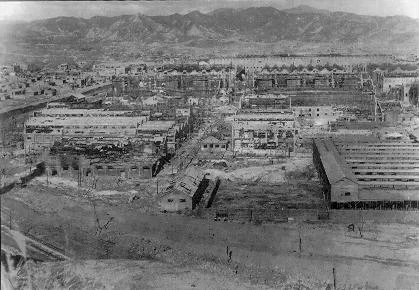
Hungnam, following US air raids in the Korean War 1950-1953
edit: The third testing info regarding a test-fire of an atomic bomb in the Gobi desert appeared after original posting, and was added subsequently.
Three pieces of information say;Silverpoint said:And where exactly was this bomb tested ? You need an extremely large amount of space to test a bomb. Testing one in Japan would be nearly impossible due to the densely populated environment. The Japanese were being pinned back on every front, so it's unlikely they could have taken it overseas for testing. I'm curious as to where exactly this device went off and why there is no mention of it in any official records.
1) On board an unmanned naval ship off the seaport city of Hungnam 窶ケツサ窶愿ャ (Konan), the test bomb detonated, creating a "mushroom cloud," a "flash of light," and an "audible tone of explosion" visible/audible from 32 km away.
One source says this is recorded in a military intelligence report dated August 12, 1945. See map for Hungnam, on the east coast facing Eastern Sea in present day North Korea.
2) Another account point to Nagoya for a planned atomic testing which never happened.
3) Yet another account tells of a test-fire was in East Gobi desert, Hsingan province, China, with Unit 731 support.
Japanese development of nuclear energy several possible Japanese nuclear testings before August 15, 1945
Wikipedia said:Supposedly...studies advanced to making one or two little experimental atomic artefacts in Hungnam 窶ケツサ窶愿ャ (Konan) Installations in Korea 窶卍ゥ窶朗 (Chosen)... these experiments continuing in Manchukuo and the test-fire was carried out in East Gobi desert in Hsingan province with support of Unit 731. (words edited for diction)
What you say could be the case, however N.Korea, including Hungnam, was captured by the USSR, together with the plans, scientists, technicians, facilities, and materials if they existed. Either Truman was not aware of Hungnam's importance, underestimated the Soviets, or was too embarassed to make public the Japanese atomic program in Hungnam, Korea, code name "*NZ PROJECT."Silverpoint said:The original argument for creating the bomb was because Germany was considered to be close to developing one, so the Allies knew they had to develop the technology first. If there was any real knowledge that the Japanese had a bomb, this would have been a propaganda gift for Truman in his argument for ending the war quickly.
True, but the revised 1995 Robert Wilcox book seems to present some gov'tal/intelligence documents that support the Hungnam atomic bomb testing.Silverpoint said:Yet, no one at the time, or since in an official capacity has ever used this argument that I'm aware of.
*NZ PROJECT is the term favored by Korean sources that also claim the code name was an exact copy of the German nuclear project. Acc. to William Pellas, however, there were two Japanese nuclear programs;
1. Project Ni IJ Army's effort, Headed by Nishina at Riken. This program was halted by the April 1945 B-29 firebombing raids of Tokyo.
2. Project F-Go What was left of Project Ni was folded into IJ Navy's program, authorised in 1943. Acc. to "Wakabayashi" it was the F-Go that acutally completed and test fired a single warhead utilising the facilities at Hungnam, Korea.
Hungnam 窶ケツサ窶愿ャ (Konan) where the alleged Japanese atomic bomb was developed and tested. One can see facilities of Choson Nitrogen Fertiliser Factory Co., a daughter company of Nippon Nitrogen Fertilzer Co., Tokyo.
Hungnam, following US air raids in the Korean War 1950-1953
edit: The third testing info regarding a test-fire of an atomic bomb in the Gobi desert appeared after original posting, and was added subsequently.
Last edited:
Silverpoint
後輩
- 17 Jul 2005
- 483
- 44
I just want to clarify at this point so that I know we're all on the same page. When I talk about "testing" to me this means actually detonating a bomb, not just trying to build one. I realise that this word could be interpreted in a number of ways, so I want to make sure we're all agreeing terms.
lexico
後輩
- 22 Dec 2004
- 2,584
- 155
Definition of "Nuclear Testing"
Good point, Silverpoint. There have been quite misleading reports such as the one done by BBC in 2004 that S.Korea had conducted a "nuclear test."
S Korea chided for nuclear tests
11 November, 2004
BBC News
In the case of the alleged Hungnam "nuclear testing" it seems pretty clear from context that it is referring to a "nuclear warhead detonating test," not the chemical properties test in a chemistry-physics lab of micorscopic scale. But it's good that you raised the point to prevent any possible confusion, thanks. It is especially so because of the obvious historical implication a nuclear program conducted by Imperial Japan will have on the August 6 dropping of the atomic bomb on Hiroshima. Now whether, and how much, the US gov't/military knew beforehand will in itself constitute a totally separate matter; still I agree with you that it is mandatory to excercise the greatest caution, whichever matter we are discussing.
Good point, Silverpoint. There have been quite misleading reports such as the one done by BBC in 2004 that S.Korea had conducted a "nuclear test."
S Korea chided for nuclear tests
11 November, 2004
BBC News
While the "nuclear test" being referred to at the time involved only 0.7 grams of plutonium and 0.2 grams of a uranium isotope to study the chemical properties, the headline gave the impression of a "nuclear warhead detonating test" causing international uproars.the government has argued that the tests were on too small a scale to be significant and only 0.7g of plutonium and 200mg of uranium were produced...
The report said that South Korean scientists had enriched a small amount of uranium to 77% uranium-235, which is close to weapons-grade.
However, it said the average enrichment during the uranium experiments was about 10.2%.
The report stated that the IAEA had found no indications that the experiments had gone beyond small-scale laboratory activities.
In the case of the alleged Hungnam "nuclear testing" it seems pretty clear from context that it is referring to a "nuclear warhead detonating test," not the chemical properties test in a chemistry-physics lab of micorscopic scale. But it's good that you raised the point to prevent any possible confusion, thanks. It is especially so because of the obvious historical implication a nuclear program conducted by Imperial Japan will have on the August 6 dropping of the atomic bomb on Hiroshima. Now whether, and how much, the US gov't/military knew beforehand will in itself constitute a totally separate matter; still I agree with you that it is mandatory to excercise the greatest caution, whichever matter we are discussing.
Last edited:
lexico
後輩
- 22 Dec 2004
- 2,584
- 155
There was also a German economic historian Rainer Karlsch who published Hitler's Bomb. He claimed that German scientists "set off a test explosion two months before the end of World War II, killing hundreds of people in eastern Germany." He also claimed that "the March 1945 device didn't achieve fission, but did scatter telltale radioactive particles at the Ohrdruf test site. It also claims that Nazi Germany briefly had a working nuclear reactor."Silverpoint said:Recently a "historian" in the UK published a book claiming that Germany had also developed a bomb, but his arguments were widely discredited. He put up what seemed like a reasonably sound argument to someone reading his book. But when you looked at the bigger picture, he had been incredibly selective with the truth in order to build a case.
Book: Nazis Tested Crude Nuclear Device
Tony Czuczkam, March 14, 2005
Associated Press
Jeremy Bernstein, who edited the Farm Hall transcripts for the book "Hitler's Uranium Club: The Secret Recordings at Farm Hall," said a key question was where the enriched uranium could have come from.
"To enrich uranium, you need an plant the size of Oak Ridge, and the Germans never had one," he said, referring to the sprawling U.S. facility that produced enriched uranium for the Hiroshima bomb.
lexico
後輩
- 22 Dec 2004
- 2,584
- 155
Nipponese Nukes
The alleged nuclear testing off shore of Hungnam (Konan) is detailed in this essay. Since the Snell report came out in 1946, and Wilcox's Secret War is the 1st 1985 edition, the so-called 1947 USO Intelligence report must have been cited in Wilcox's 1985 book. Without primary evidence, however, Tittle's account might simply turn out to be positive statements of Wilcox's speculations.
Military History: Invasion Japan
Jim Tittle
2005-08-09
The alleged nuclear testing off shore of Hungnam (Konan) is detailed in this essay. Since the Snell report came out in 1946, and Wilcox's Secret War is the 1st 1985 edition, the so-called 1947 USO Intelligence report must have been cited in Wilcox's 1985 book. Without primary evidence, however, Tittle's account might simply turn out to be positive statements of Wilcox's speculations.
Military History: Invasion Japan
Jim Tittle
2005-08-09
Copyright ©1996 - 2005 COMBATSIM.COM, Inc.INVASION JAPAN -PART 4: The definitive defensive weapon and some conclusions.
NIPPONESE NUKES
Ok so lots of people have heard that the Germans were working on nuclear physics with the ultimate aim of creating an atomic bomb, right ? The 1.8 billion dollar Manhattan Project to produce the A-bombs that effectively ended the war is well known. What about Japanese endeavors in nuclear bombs ? You thought there were none? Think again.
The chief persona of the Japanese atomic program was Dr. Yoshio Nishina who was an intimate associate of Albert Einstein. Dr. Nishina foundeded his own Nishina Laboratory of the Institute for Physical and Chemical Research in 1931 to study high-energy physics. He built the first cyclotron in Japan in 1936. It was a 26-incher. A 60-inch, 220 ton cyclotron was built in 1937. In 1938 Japan also purchased a cyclotron from the University of California, Berkeley. Cyclotrons were used to separate fissionable material from uranium.
Nishida understood the military potential of nuclear weapons, and figured that the Americans were working on a genzai bakudan (atomic bomb). Unlike his counterpart, Heisenberg in Germany, he wholeheartedly sought to solve the atomic riddle and produce a weapon. In 1939, President Roosevelt funded the first nuclear studies into fissionable weapons in the United States. This prompted the patriotic Dr. Nishina to match the U.S. research and develop a nuclear weapon. Lt. General Takeo Yasuda of the Japanese Army decided in October 1940, that such a weapons program was worthy of study and the Japanese atomic program commenced in July 1941 under the guidance of Dr. Nishina.
The well-know rivalry between the Japanese Army and Navy diluted strength of production projects as each insisted their own weapon was of paramount importance even if it was nearly identical to the other's. They perpetually wasted manpower and resources duplicating efforts. So it was in atomic research.
A completely separate atomic program run by the Japanese Navy was in simultaneous study in 1942. The project was called ツ"F-Goツ" and was headed by Professor Bunsaku Arakatsu, who studied under Albert Einstein. Arakatsu built his own cyclotron too.
The Navy's plan wisely was to harness nuclear energy as an power source in order to reduce the dependence on petroleum. As the war unfolded not favoring Japan the idea of making a nuclear weapon became more promising. Initially it was assumed that an atomic weapon could not be developed during the limited span of time of the war.
A search for uranium throughout the empire commenced. The Japanese military took what Nishina had learned so far and expanded the program. The Navy payed large amounts for uranium on the Chinese black market. And we know about U-234's unsuccessful attempt to transport uranium oxide to Japan from Germany. How far the Navy project progressed is a matter of conjecture but a member of the team was Hideki Yukawa, the first Japanese physicist to receive a Nobel Prize in 1949.
So where did the uranium ore come from? The atomic programs found a source of uranium ore in Korea. Dr. Nishina experimented with a number of methods for enriching the uranium and decided that the gaseous diffusion method was the most rewarding. Colonel Tatsusaburo Suzuki coordinated the effort for the Army and built five advanced gaseous diffusion separators based on the smaller one developed by Nishina. The fate of these separators is a mystery.
In 1938 Germany and Japan met to discuss the feasibility of the production of atomic weapons and atomic energy. Theories were explored but techinal data was not exchanged at that time. Japan later requested assistance from ally Germany but it is not known how much material Japan received. This is lost to history. All we know of for sure is the one shipment of uranium oxide that was intercepted on U-234 just after VE Day.
The program was moved from Nagoya to Konan, Korea (North Korea now) in 1943 due to increasing bombing attacks. Some 40,000 worked at the facility 25,000 of whom were engineers and scientists. The facility was partly underground. About 400 worked in the underground cave area on the most sensitive aspects of the bomb. A project director coordinated with six other reknown scientists each contributing but one phase and unaware of the others.
By August 10, 1945 the Hiroshima blast had taken place so the men assembling the bomb worked quickly. If an Allied invasion was imminent Japan would need the A-bomb to make toast of the forthcoming American invasion armada. Stalin declared war on Japan on August 8th and with enough reinforcements free from European combat Russians crossed the Manchurian border.
After midnight the device was trucked to the Konan harbor. It was loaded aboard a small vessel and final preparations were undertaken for the test. Presumably an anchorage in an inlet some twenty miles away was to be the unsuspecting and unwilling live target area. It was filled with mostly wooden fishing boats and ships with sails.
The boat with the device was robot controlled and it puttered towards the anchorage before dawn on August 12th. The vessel beached itself just as the sun's first rays of the day hit the water. The genzai bakudan triggered and the observers wearing welding goggles gasped at the immediate intense burst of light rivaling the sun.
The fire flash was about 1,000 yards in diameter and from it a mushroom cloud boiled up to the stratosphere. The vaporized water obscured the anchored vessels but most of them were burning. When the epicenter cleared some ships previously seen were completely gone without trace. The area of destruction was approximately one square mile.
But it was all too late. The Russians were hours away and the equipment at the Konan facility was smashed and the underground entrances blown up. The scientists were unable to escape and at least the top men were spirited away to Moscow for torture. The Soviets closed up the area quickly and tightly. American War Reparations personnel later were kept under constant supervision and restricted from many areas. Even a B-29 with humanitarian supplies was shot down by the itchy Russians.
On Aug. 29, 1945, an American B-29 piloted by a Lt. Jose H. Queen of Ashland, KY headed for Konan with a cargo of food and medical supplies. They were to be dropped over an Allied prisoner of war camp there. Four Yak fighters from nearby Hammung Airfield circled the B-29 and signaled the pilot to land on the too-small airstrip.
Queen did not obey and swung the big plane around to return to Saipan. Ten miles off the coast the Yaks opened up and the B-29 went down. All twelve disembarked safely but one Yak strafed and missed the radio operator. The Russians said they saw the American markings but since the Germans had used captured American planes they thought the Japanese might also. Remember this was two weeks after the official end of hostilities.
While the consensus of the Americans was that the Japanese could have been nowhere near producing an atomic bomb, that even the Germans were farther advanced, it is curious what this conclusion is based upon since no American has ever inspected the Konan facilities ! It was a dangerous game to underestimate your enemy as the Allies found in December 1944 when the Ardennes Offensive (Battle of the Bulge) shocked the Americans to the realization that they could still lose the war. When the kamikazes became a horrifying reality in a divine wind over Okinawa there was no defense for them. There were no intelligence reports on either event to suggest the Allies were not taken completely by surprise.
Yoshio Nishina died in 1951. Since World War II the Konan area has been either in Soviet or North Korean hands so no look-see has ever been possible. It has been determined that heavy water was shipped out of the area in the 1950s to Russia.
At any rate, the Japanese could very well have had the capability of cobbling together a dirty bomb that did not create a chain reaction explosion but would rather dispense radioactive material into the vicinity of the target point, as the Germans could have done. Let us guess if they would have used it over Kyushu.
Snell, David
Japan Developed Atom Bomb; Russia Grabbed Scientists
Atlanta Constitution Oct 2, 1946
Wilcox, Robert K.
Japan's Secret War: Japan's Race Against Time to Build Its Own Atomic Bomb Morrow Publishing, NY 1985
lexico
後輩
- 22 Dec 2004
- 2,584
- 155
Nipponese Nukes II
The following has more quotes in greater detail although none are conclusive evidence of a Japanese atomic testing. Scroll down to 12/1/2004, 9:04 pm EST, bluescreenofdeath's very long post.
Iran: Saudi Arabia has nuclear weapons, Archives - December 2004, www.godlikeproductions.com
The following has more quotes in greater detail although none are conclusive evidence of a Japanese atomic testing. Scroll down to 12/1/2004, 9:04 pm EST, bluescreenofdeath's very long post.
Iran: Saudi Arabia has nuclear weapons, Archives - December 2004, www.godlikeproductions.com

- 28 Jul 2005
- 5,238
- 172
A whole lot of good spade work has been done. This is information for me to learn from, without doubt. I will study it as I have the time. Thank you guys for all this nice detail. 
As for the actual bombings, and my feelings, I have no firm and fixed thoughts or conclusions. I just feel, that it happened in the 'heat of the battle', so to speak. I would strongly prefer that it had not happened. No war is for the better, no killing is either, but the social animal has it in the natural makings, it seems, to fight and, sadly, kill (not by honest error).
I sometimes wonder what 'turning the other cheek' would do for natural selection? :?
As for the actual bombings, and my feelings, I have no firm and fixed thoughts or conclusions. I just feel, that it happened in the 'heat of the battle', so to speak. I would strongly prefer that it had not happened. No war is for the better, no killing is either, but the social animal has it in the natural makings, it seems, to fight and, sadly, kill (not by honest error).
I sometimes wonder what 'turning the other cheek' would do for natural selection? :?
lexico
後輩
- 22 Dec 2004
- 2,584
- 155
Kenpeitai, Unit731, and Special Operation Unit for Nuclear Research ?
Does anyone have additional information regarding a "nuclear research" in Manchuria in the later yrs of the Sino-Japanese War/WWII/Pacific War conducted by a Unit or Special facility such as one dircected by Unit 731 ?
With a general amnesty extended to former personnel at Unit 731 and the like in exchange for collaboration, there must be enough survivors to live and tell the details of the 'nuclear testing' if it happened. Why is there so little information ? What do we know about the Japanese nuclear experiments in the Gobi desert ? Were they all required to commit suicide to secure secrecy or are they keeping silence at the request of the US gov't ?
Kempeitai ナ停?コ窶「ツコ窶佚? Political Department and Epidemic Prevention Research Laboratory 窶塗窶ーu硏窶ケ窶?ツ焦?
Kempeitai Political Department ナ停?コ窶「ツコ窶佚?
Unit 731: Epidemic Prevention Research Laboratory 窶塗窶ーu硏窶ケ窶?ツ焦?
Does anyone have additional information regarding a "nuclear research" in Manchuria in the later yrs of the Sino-Japanese War/WWII/Pacific War conducted by a Unit or Special facility such as one dircected by Unit 731 ?
With a general amnesty extended to former personnel at Unit 731 and the like in exchange for collaboration, there must be enough survivors to live and tell the details of the 'nuclear testing' if it happened. Why is there so little information ? What do we know about the Japanese nuclear experiments in the Gobi desert ? Were they all required to commit suicide to secure secrecy or are they keeping silence at the request of the US gov't ?
Kempeitai ナ停?コ窶「ツコ窶佚? Political Department and Epidemic Prevention Research Laboratory 窶塗窶ーu硏窶ケ窶?ツ焦?
Kempeitai Political Department ナ停?コ窶「ツコ窶佚?
Unit 731: Epidemic Prevention Research Laboratory 窶塗窶ーu硏窶ケ窶?ツ焦?
Wikipedia said:The Political department and Epidemic Prevention Research Laboratory, now usually associated with the name Unit 731, was initially set up as a political and ideological section of the Kempeitai military police of pre-Pacific War Japan. It was meant to counter the ideological or political influence of enemies, and to reinforce the ideology of military units.
It worked through political propaganda and as ideological representative of the Imperial Japanese Army's Kodoha ツ皇窶慊ケ窶拮 (Imperial way faction, or war party). In the first phase this section drove against communist propaganda, but extended its responsibilities in other directions, at home and overseas.
It acted in Manchukuo and other areas on the Asian mainland. It was a rough equivalent to the NKVD political sections and or politruk (political commissar) units of the Soviets; or the German Nazi SS propoganda departments. They promoted racial superiority, racialist theories, counterespionage, intelligence, political sabotage and infiltration of enemy lines. They liased with the Manchukuo military police, the Manchu intelligence service, regular Manchu police, Manchu Residents committees, Local Nationalist Manchu Parties and the Japanese Secret Service detachment in Manchukuo. The section in Manchukuo used some agents from White Russian, Chinese, Manchu, Mongol and other foreign backgrounds for special services or covert actions at home and abroad.
Epidemic Prevention Research Laboratory (Unit 731)
The founder of Unit 731 was General Ishii Shiro. Ishii was placed in command of the Army Epidemic Prevention Research Laboratory located in Tokyo Headquarters in 1932. This laboratory concentrated on chemical warfare and biological warfare. He later organized the satellite laboratory in Harbin and set up the Manchu railway lines for transport of materials and equipment. Ishii organized the secret research group "Togo Unit", for the conduct of chemical and biological investigations in Bei-inho village (100 km south of Harbin). This site is the Zhongma Fortress.
This unit later was integrated into the Kwantung Army as Epidemic Prevention Department, but divided at the same time as the "Ishii Unit" and "Wakamatsu Unit" with a base in Hsinking. From 1941 on all these units were known collectively as "Epidemic Prevention and Water Purification Department of the Kwantung Army", or "Unit 731" for short. They had support from the Imperial Youth Corps, Japanese university research, and the Kempeitai. Some sources link them with the Mitsui zaibatsu monopoly on poppy farming in Manchukuo (for production of heroin).
Other facilities under the direction of 731 Unit were:
Special Operations Units
Units with special and Unknown assignments in Manchuria and the Asian mainland. It has been suggested that nuclear research was conducted in Manchuria towards the end of the war by this branch
End of the war
Operations and experiments continued until the end of the war. With the Russian invasion of Manchukuo and Mengjiang in August 1945, these units mentioned above had to abandon their work in haste. All members of these units and their families fled across Manchuria and China to return to Japan. Behind them they left skeleton crews to hide evidence of atrocities. All facilities were to be demolished with explosives, but most were so well constructed that they survived somewhat intact as testimony to what happened there.
Ishii commanded that every member of the group take the secret of their experiments to the grave with them, threatening to find them if they failed, and ordering none of them to go into public work back in Japan. All infected rats, bacteria cultures, and human prisoners were killed and the evidence quickly destroyed. Potassium cyanide vials were issued in event the remaining personnel were captured.
Last edited:


