About a Japan calligraphy

DanielaSky

後輩
Joined
25 Jun 2022
Messages
7
Reaction score
9
hi, thank you in advance for the help. I would like to know the translation of this calligraphy, to know the seasonal context of the painted moon. is it an autumn moon? or summer or spring? perhaps in the handwriting, there is a reference to the season. I am a italian suiseki enthusiast, I use the paintings in the tokonoma, in the right season.

Arigato gozai masu. Grazie. Thank you very much.

Daniela
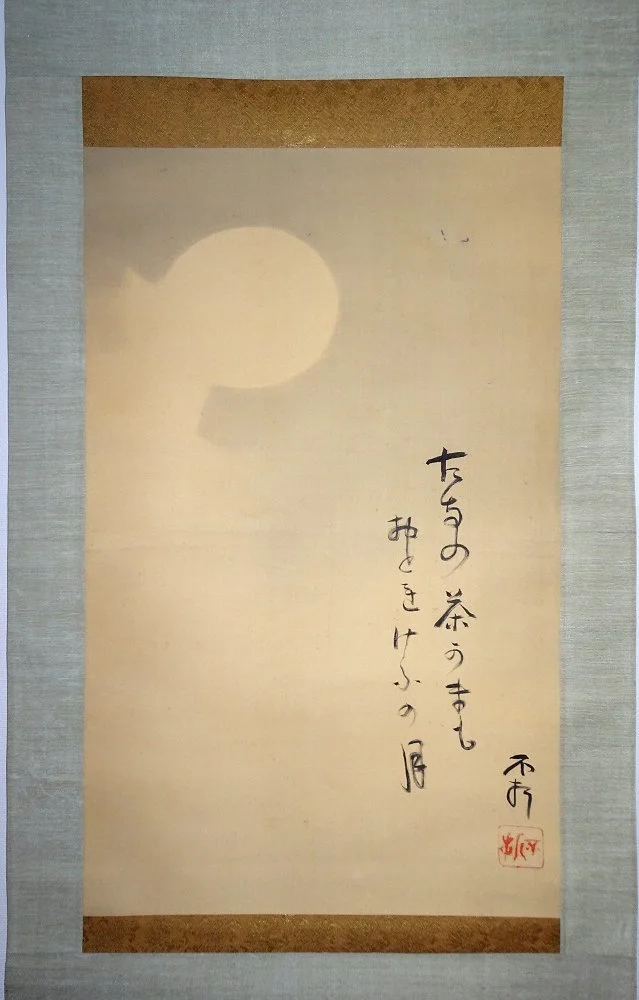
i-img639x1000-1654997816lzeslo164639.jpg
 
I can't read it except for the last few words "けふの月" which should be a reference to Autumn moon.

Well, it seems to be something like
たちの茶まも
おときけふの月
but that doesn't make any sense. Hopefully Toritoribe-san can read it.
 
Hello, thank you very much.
"けふの月" seems to be a reference to the moon on August 16th. This is already a lot, places the painting in early autumn, the date also makes me think of the Obon festival.
The calligrapher seems to be called Nakamura Fusetsu. I am aware that the information provided may be incorrect or incomplete.
Thank you very much.
Daniela
 
Yes, it looks like "Fusetsu" in both the sign and the stamp (不折). The stamp is a very stylized version, but it looks right. The signature is in a cursive style.
 
Great ! This is true. but it is strange: in the description of the object there was the name of the calligrapher, but there was no text of the haiku, otherwise I would not have asked for help. I am the buyer, the kakejiku has been shipped and will arrive on Thursday. I don't know if I can mention other details without breaking the rules of the forum. as a westerner, I can no longer access Yahoo Japan, for example, the site is no longer reachable, access has been denied. however I can shop through Buyee and perhaps the item description is not complete.
 
Ah, yes, I read about the recent restrictions on accessing Yahoo Japan from abroad. It's thinkable that you could not see the complete item description through Buyee's system. Anyway, it's good to have the seller's proposed reading of the kuzushiji. Hopefully someone can confirm the reading.

Edit: Here is the relevant part from the item description:
--
【中村不折】
洋画家・書家。東京生。名は鈼太郎。狩野派を学び一家を成す。また小山正太郎・浅井忠に洋画を学び、渡仏してジャン=ポール=ローランスに師事する。帰朝後は太平洋画会の代表作家として文展で活躍。書は六朝風を得意とする。帝国芸術院会員。昭和18年(1943)歿、78才。

【作品状態】
絹本 木軸 真筆保証(真作) 裂三段表装風帯付き ウブ幅 桐箱入り 中身寸法52.5×33 少しだけヤケ等あり 幅自体しっかりしています ※読みは「古寺の茶釜もおどれきょうの月」だと思います よろしくお願い致します
--
 
This forum is great !
I checked the announcement on Buyee and it also reports the verses cited, now that I know what to look for on the page in Japanese. Unfortunately, I don't know Japanese and the machine translation was insufficient to understand that the sentence was referring to the text of the calligraphy. I apologize for my ignorance and for my inattention and for wasting time. now I have an important starting point for moving forward in research, because in an exhibition of a suiseki it is necessary to know the meaning of any calligraphy and exhibit it in harmony with the season.
Sorry for my bad English, also.
Arigato gozai masu.
 
けふの月 is the classical way of writing きょうの月.

The rest looks correct
古寺の茶まもおどけふの月
The first two kanji are written in cursive style.
The rest is hiragana, except for the two in green which are hentaigana. Very difficult to read, but thanks to @cez you've got the whole thing.
Maybe a loose translation would be

Even the teapots of the old temples are dancing under this harvest moon.
 
Thanks a lot to everyone. Using a kakejiku without knowing the meaning of calligraphy is in my opinion inappropriate. In this case the moon is autumnal, the reference in the poem guides me and also offers me very strong evocative sensations. Suiseki are stones, without an adequate atmosphere there are only 'dead stones' but it is even worse to place them in a context chosen at random.
 
Back
Top Bottom