


- 14 Mar 2002
- 21,057
- 18,914
On Friday, the Nippon Foundation and the University of Tokyo announced that they had found over 200 million metric tons of manganese nodules, rich in rare metals, on the seabed near Minamitorishima, a remote island under Tokyo's jurisdiction. These nodules, discovered at depths of about 5,000 metres within Japan's exclusive economic zone, are abundant in rare metals like cobalt and nickel, which are crucial for manufacturing lithium-ion batteries.
The survey, which spanned a 100-square-kilometer area, was led by Professor Yasuhiro Kato and revealed that the nodules contain enough nickel to meet Japan's needs for 75 years and enough cobalt for approximately 11 years. This discovery could substantially impact Japan's resource security and battery production industry.

 www.japantimes.co.jp
This is yesterday's news: these deposits were first discovered in 2013! The good news is that China cannot possibly lay claims to these territories.


 mainichi.jp
Paywall alert:

 asia.nikkei.com
The survey, which spanned a 100-square-kilometer area, was led by Professor Yasuhiro Kato and revealed that the nodules contain enough nickel to meet Japan's needs for 75 years and enough cobalt for approximately 11 years. This discovery could substantially impact Japan's resource security and battery production industry.
Manganese nodules rich in cobalt, nickel and other rare metals were found concentrated on the sea floor near Minami-Torishima island, Japan's easternmost island, according to a 21 June announcement by the University of Tokyo and the Nippon Foundation. A research team conducted a survey from April to June to extract mineral resources scattered on the seabed at depths of between 5,200 and 5,700 metres off the island, part of the Ogasawara island chain. Based on the survey, which covered 10,000 square kilometres, researchers estimate there are about 230 million tons of manganese nodules. The concretions are estimated to contain about 610,000 tons of cobalt, equivalent to 75 years of Japan's domestic consumption, and about 740,000 tons of nickel, which would keep Japan supplied for 11 years at current rates of consumption. In the experimental operation expected to start in 2025, researchers plan to collect about 2,500 tons of manganese nodules a day with an eye on securing 3 million tons a year. Cobalt, nickel and other rare metals are used in electric vehicles, smartphones and other products that require sophisticated electronics.
Over 200 million metric tons of rare metals found near remote Tokyo island
The sea-bottom mineral concentrations abundantly contain rare metals such as cobalt and nickel — both essential for lithium-ion batteries.
This is yesterday's news: these deposits were first discovered in 2013! The good news is that China cannot possibly lay claims to these territories.
Centuries' worth supply of rare earths found in Japanese waters - The Mainichi
Rare earth deposits sufficient to meet global demand for centuries have been found in Japan's exclusive economic zone (EEZ) near one of the Ogasawara
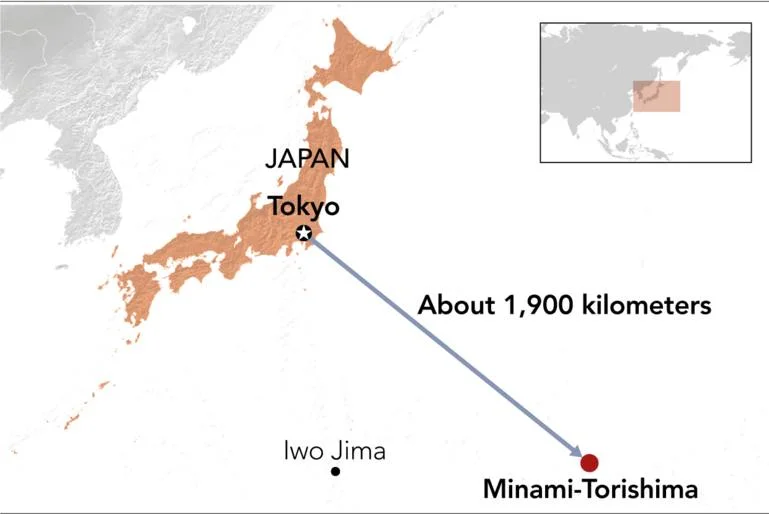
Aiming to reduce its reliance on China for rare earth metals, Japan will begin in 2024 to extract the essential materials for electric vehicles and hybrids from the mud on the deep sea bottom in an area off Minami-Torishima Island, a coral atoll in the Pacific Ocean about 1,900 kilometres southeast of Tokyo. Tokyo plans to begin work to develop extraction technologies starting next year. Mud rich in rare earth metals has been found on the seafloor at a depth of 6,000 metres in the target area. To get at it, Japan first needs to develop technologies to extract the resources from depths of 5,000-6,000 metres. The kuroshio, or Japan Current, known to be among the world's fastest sea currents, passes the target area, which is also located in the path of typhoons. Experts say there are high technological hurdles for any endeavor to extract resources from deep-sea locations in such tough conditions.
Paywall alert:
Japan to begin extracting rare earth metals from seabed in 2024
Program a part of effort to wean the country off its reliance on Chinese imports
asia.nikkei.com


