ゴッド・スレイヤー

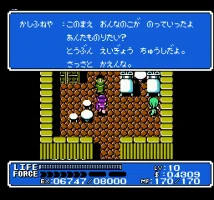
The part that says さっさと帰んな means さっさと帰るだろうな right? Referring to his business returning to normal soon?
 
That's the euphonic change of 帰りな; a rough version of the imperative form 帰りなさい.
 
I don't know about "with the boat", but, yes, it means "Hurry back".
 
This is said by the green haired girl in the bottom corner of the screenshots posted above.

お父さんったらときめきのランプが見つからなかったってとっても不機嫌なの。出直したほうがいいわよ。

Is she saying that she is 不機嫌 or her dad? My guess would be her dad since the sentence begins with お父さん.

And that って is a quotation marker? I guess her dad told her that he could not find the lamp?

Edit: And that ったら has this meaning? (typically after someone's name) indicates exasperation
 
Last edited:
Edit: And that ったら has this meaning? (typically after someone's name) indicates exasperation
たら
1[係助]《「といったら」の音変化》名詞、活用語の終止形・命令形に付く。多く「ったら」の形をとる。
1 話題として、人や物事を取り上げ、予想外であるという意や蔑視する意を表す。「彼っ―案外はにかみやね」「私の学校っ―ずいぶん古いのよ」
たら[係助終助]の意味 - goo国語辞書
In that case, it indicates "contempt".

Yes for all the rest.
 
I just realised that the text in this screenshot was said before he said I could use the boat, which means I didn't understand what he was saying, even though I thought I did.

What he seems to be saying to me is: Recently the girl was riding. Do you want to ride too? Lately business has stopped. Hurry back.

Makes no sense :/
 

Attachments

  • God Slayer - Haruka Tenkuu no Sonata (J)_013.webp
    God Slayer - Haruka Tenkuu no Sonata (J)_013.webp
    77.6 KB · Views: 147
The third sentence is future tense; "The business will be stopped for some time", and the nuance of the last is closer to "Get out of here!".
 
I see thanks, it all makes sense now I think.

Anything my character says is not shown, so I guess I asked if I could use the boat and he said "The girl was just using the boat and now you want to use it too?"
 
I find a drunk guard and he says:

煩いなあ・・・ヒック。俺はなあ大事なものをなくして・・・ウーイ落ち込んじゃってよう・・・畜生!酒持ってこい。ヒック。

I think they both may be just sounds and not actual words.
 
なあ is a particle as same as うるさいなあ.
ウーイ is an onomatopoeia to represent "drunken".
 
I see, I pulled up a lot of pages on Japanese onnomatopia and will study them thoroughly, thanks.

This is said by a dolphin that lets me ride on his back:

僕の背中へ乗ってください。どこへだっていきます

I can't find that verb at all, I tried searching for だる、だつ、だう to find the root verb but there's nothing.
 
OK, thanks.

This is said by a random person walking around town.

きゃっ!ああびっくりした。脅かさないで。化け物が出たかと思ったじゃない。

It's that last sentence I find a little confusing, is it "I didn't think a monster came out" which would translate as "I didn't think you were a monster".
 
じゃない is not negation but a sentence final particle for asking confirmation (some thing like "Do you understand I thought~?") in that sentence. The negative past of 思う is 思わなかった, right?;) Actually, this じゃない never conjugates.
present: 思うじゃない
past: 思ったじゃない
negative: 思わないじゃない
past negative: 思わなかったじゃない
 
Thank you, that makes perfect sense now.

This is said by another random person in town.

隣の島がおかしくなったのはドラゴニアの女呪術師が来てからだ。あいつが来てから・・・隣の島から人影が消えて変な化け物が住み着くようになった。あいつさえ追い出せたらなあ・・・

I am unsure of this particular verb conjugation.
 
追い出す → 追い出せる (potential) → 追い出せた (past) → 追い出せたら (conditional)

"If only we could drive her away..."
 
Thanks Ianthas, I'm still having a little trouble with this one.

隣の島がおかしくなったはドラゴニアの女呪術師が来てからだ。あいつが来てから・・・隣の島から人影が消えて変な化け物が住み着くようになった。あいつさえ追い出せたらなあ・・・

Is that first の I marked in red a nominalizer making 隣の島がおかしくなった a noun phrase?
 
Indeed, it's used to make that entire clause into the topic of the main sentence. The rest of the sentence shows when these strange things started happening.
 
This is still very confusing, but I'll give it a go.

隣の島がおかしくなったのはドラゴニアの女呪術師が来てからだ。あいつが来てから・・・隣の島から人影が消えて変な化け物が住み着くようになった。あいつさえ追い出せたらなあ・・・
The neighboring island is strange because a female shaman turned up there. After she arrived... everyone disappeared from the island and strange monsters ended up settling there. If only we could drive her away...
 
Notice that it's 来から "after she came", not 来から "because she came". It's a kind of emphatic construction, just like "It is ~ that..." in English. ドラゴニアの女呪術師が来てから、隣の島がおかしくなった。 is easily understandable, right?
~たらなあ expresses the speaker's (often impossible) wish.
e.g.
空が飛べたらなあ(= 空が飛べたらいいのになあ)
I wish I could fly.
 
Thanks toritoribe-san that all makes sense.

This is said by a guard:

俺はここでドラゴニアの襲撃に備えて見張っているんだ。
I'm keeping watch here and getting ready for Dragonia's attack.

How is that one?
 
This is said to me by thee 村の長

ああ 悪かった。ぼんやりしていて・・・私はラルフ。この村の長だ・・・
実は隣の島から使いがきて島の安全を望むなら生贄に娘を出せといってきたんだ。

I looked up ぼんやりして on ALC and got these translations:

ぼんやりして
  • in a muddle
  • in an absent sort of way
  • in an absent-minded way
  • in one's abstraction
  • out of focus(目標などが)
  • out to lunch(頭が)
  • with an absent air
I really don't know what would be an appropriate one for this sentence.
 
This is from ぼんやり(する). All of those translation mean essentially the same thing though, no? "Sorry, I was spacing out/not paying attention/..."
 
Back
Top Bottom