ゴッド・スレイヤー

Thank you 👍

The Queen now begins a long(ish) monologue:

わらわの口から真実を話す時が来た。そなたも分かっておるであろう・・・
The time has come for me to tell you the truth. I think you will understand...

That part seems simple enough, did I get it right?
 
What happened to the も after そなた? :)
"I'm sure you know this as well..." (= that the time has come)
 
What happened to the も after そなた? :)
"I'm sure you know this as well..." (= that the time has come)

I thought that particular も was used like the one below:

あまり人を頼りすぎるのも禁物じゃぞ。

Why not use は instead of も?

あまり人を頼りすぎるの is one of 禁物. あまり人を頼りすぎるのは has a nuance that あまり人を頼りすぎるの is the only one thing you should take care of.

I guess I've been over simplifying 知る and 分かる. So far I've considered 知る to mean "to know" and 分かる to mean "to understand". Why isn't 知る used in that particular case?
 
The key here is that it's 分かっておる, not 分かる. She presumes that you have already come to understand/realize by now [that things are not what they seem and that it's about time she tells you what's really going on], not that you will understand her upcoming explanation.
 
Ok, thanks, that clears up my confusion nicely.

The next thing she says is:

町の占い師はわらわじゃ。このような姿で町に出て民の悩み聞いていたのじゃ。

わらわは町の占い師じゃ。I am the towns fortune teller.
町の占い師はわらわじゃ。The towns fortune teller is me.

That is how I see that first sentence, it sounds weird to say it backwards like that second one though. Would it be translated like the first one?

このような姿で町に出て民の悩み聞いていたのじゃ。

With things the way they are I left town and listened to the people's troubles.
 
"わらわは町の占い師じゃ", or a neutral "I am the fortune teller", doesn't quite have the needed "Surprise, *I* am the fortune teller" impact. "The fortune teller isn't just some random person; it was me all along!"

このような姿 = dressed/disguised in this way (= as a fortune teller)
町に出る = leave (the castle and head) into town (to go listen to the people)
 
Thanks for the link, and that site is now bookmarked :)

The next thing she says is:

しかし本当の私は町の占い師でも・・・ポートアの女王でもありません・・・
The real me is the town's fortune teller, not the Queen.

I omitted the 女 because that doesn't seem to really work in English (unless she was pretending to be a King, not a Queen), unless I'm just plain wrong of course :)
 
How's this: But the real me is neither a fortune teller... nor Potoa's Queen.

Was I right about 女 not being including in the English translation?
 
Yes, that's a good translation. And including the 女 as in "female fortune teller" would indeed be a bit redundant.
If she's not the queen, then who is she and what happened to the real one? The plot thickens :)
 
She continues:

私はアシーア。あなたの探す三人目の賢者です。リカバーの術を教えましょう。毒や麻痺石化治せる術です。
I am Ashia, the third sage you are searching for. I will teach you the Recover skill, it can heal poison, paralysis and petrification.

How is that? It seemed easy to translate.

Edit: Is it normal for there to be no や between 麻痺 and 石化 in 毒や麻痺石化?
 
I can't edit my post but I want to update my translation: I am Ashia, the third sage you are searching for. I will teach you the Recover skill, it can heal things like poison, paralysis and petrification.
 
Your translation is correct, but isn't there a comma between 麻痺 and 石化, and を after 石化, i.e., 毒や麻痺石化治せる術です?
 
Oh damn, I missed that を, that was a typo, but yes there was one there. There is a space in between 麻痺 and 石化 but no comma (and it's all in kana).
 
Ah, then, the space performs the same function as a comma there. It's used to separate the two words.
 
Oh I see, I thought the spaces usually just come after particles, I didn't know they could serve as commas.

The Queen continues:

閉ざされた渦潮を開くことができたなら次なる術バリアーを授けましょう。
If you are able to open the closed whirling tides I will teach you the next skill, Barrier.

I guess that would mean if I'm able to open the path that those tides block she will teach me the next skill.
 
Spaces are usually not used in Japanese sentences. The reason the space is there, including after particles, would be because it's a game only in hiragana.

Yes, your interpretation seems correct.
 
OK, thank you.

私はいつでもあなたのことを見守っていますからね。

Why is あなたのこと used here instead of just あなた?

I would say this is translated as "Because I'm always looking out for you."
 
~のこと has a nuance something like not just you, but including things concerning you.
見守る means more likely "to watch over you/keep an eye on you".
 
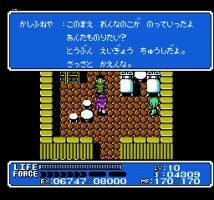
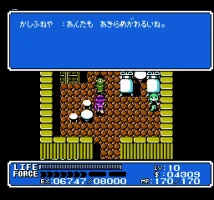
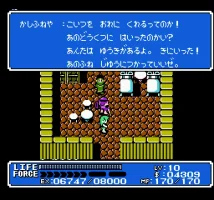
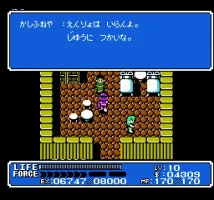
I'm inn a bit of a hurry so I'll upload the screenshots instead of typing out the whole thing.

Thee part I don't understand is 遠慮はいらん, mainly because I can't figure out what verb いらん is.
 

Attachments

  • God Slayer - Haruka Tenkuu no Sonata (J)_013.webp
    God Slayer - Haruka Tenkuu no Sonata (J)_013.webp
    77.6 KB · Views: 153
  • God Slayer - Haruka Tenkuu no Sonata (J)_014.webp
    God Slayer - Haruka Tenkuu no Sonata (J)_014.webp
    68.5 KB · Views: 150
  • God Slayer - Haruka Tenkuu no Sonata (J)_015.webp
    God Slayer - Haruka Tenkuu no Sonata (J)_015.webp
    80.8 KB · Views: 153
  • God Slayer - Haruka Tenkuu no Sonata (J)_016.webp
    God Slayer - Haruka Tenkuu no Sonata (J)_016.webp
    68.8 KB · Views: 157
It's still confusing, is he saying "restraint isn't needed" IE don't hold back?
 
Back
Top Bottom