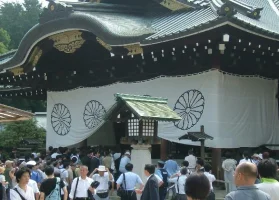
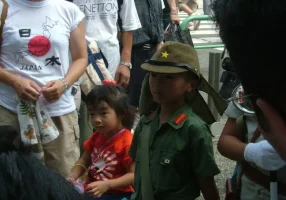
And the fun starts again...
Just to let you know, the arguments you are presenting your viewpoint are certainly not getting any better. In fact, not only are they getting worse, but they also betray your lack of respect for people (
even the Japanese, whom you wish to hold in a secluded stasis isolated from the global community). I suggest you seriously rethink your position.
McTojo said:
Even more so than that, Japanese culture treats all dead people as innocent, so the respectable visit to Yasukuni is no business to other countries. There were people like Takamori Saigo and others who were not forgiven to be in the Yasukuni, but that is merely a domestic mistake made in Japan, and that does not change the idea of forgiven ancestors.
No business to other countries? These were and are war criminals, people who have knowingly committed horrendous deeds to individuals in other countries. Koizumi knows this, yet he still visits the shrine. In fact, he also has the knowledge that what he is doing is angering other countries. Is it really to the benefit of Japan that he's pushing Japan farther and farther away from others?
That Japanese culture treats all dead as innocent does not mean everyone else should follow that same mindset. That this affects other nations suggests that the Japanese ought to take into consideration their actions on others, too. This is not simply a domestic matter.
Everybody has the right to pay respects to their fallen leaders no matter how evil or heinous they were. People still pay respect to Idi Amin , a man who was never tried in a court of law; a man who murdered close to a million Asians and Africans.
What people? And not only do you need to provide sufficient evidence, you also need to justify the morality of paying these respects, aside from saying that it's people's rights. So what is it?
I've also noticed in this example that you include the fact that since others have done similar actions, that makes it ok. This is morality at one if its lower points.
What kind of message are we trying to send here ? Are we saying that if a criminal court deems a man a War Criminal or a Genocidal Murderer we can't honor that person as a countryman of our nationality if we agree with his actions ?
So the truth of my first statement in this post holds once again. Not only are your arguments betraying your poor process of thought, it also betrays your utter contempt for humanity.
Does the judges gavel have a rubber stamp at the end of it that says " This man is Bad forever, and if you pay homage to him and the ideals he stood for then you're a criminal too"?
Sorry, we don't exist on the same level of morality as you here. Whether a judge rules it Bad or Good holds no sway for me, or, I would imagine, for the others here.
The point is is that Japan should honor its war dead and they should be honored at Yasukuni Jinjya which stands for "Peace." Now, there are many Japanese who oppose having their loved one's buried there because of matters pertaining to Buddhism and Shintoism, and of course, the negative stigma of Class-A war criminals but keep in mind also that there are no remains in the Shrine itself of any war criminals.
Source?
If the Japanese people, including heads-of-state, decide that Yasukuni is not in their best interest then let the Japanese decide this, not China.
Another poor argument on very murky morality grounds. This is not about doing things in Japan's best interest. This is not doing things in China's best interst. This is not doing things in America's best interest. This is about doing things in the international community's
long-term best interest.
Most Japanese could careless about what happened sixty years ago and neither should the world...why ? The answer is simple. Japan did no better nor worse than any other industrialized nation or superpower.
That Japanese officials are denying the importance of the visits to Yasukuni is indication that Japan is in fact doing worse than other industrialized nations.
It's so easy to point the finger at Japan, an island nation that arose from the ashes of two atomic bombings; a nation that has become the second strongest economy in the world and a hallmark of western civilization with a Democracy that actually works.
I don't understand what you're saying here. We're not criticizing Japan out of envy, if that's what you're suggesting. In fact, I wonder if the quoted passage is at all founded on any basis?
Those class-A war criminals that are enshrined at Yasukuni are there because they obeyed the Emperor who acknowledges his involvement in the war according to Herbert Blix " Hirohito and the making of modern Japan."
Sure, they obeyed the Emperor. But the only thing really admirable about this is the loyalty, but even that is questionable because it's blind loyalty without questioning the morality of it. At best they were mere pawns who served because they were told to. And let's not forget that their actions were unnecessarily cruel.
Now, if we were to contrast this it would be like German PM Schroeder going to visit a shrine in Berlin with Hermann Goering and Hitlers remains inside them, to pay his respects to German war heroes. Would do wonders for Franco-German relations, wouldn't it ? But, remember Hitler and his hordes were bent on the systematic extermination of the Jews which by far was the largest single attempt at the eradication of an entire race of people in history.
This was Hitler's mission ! He didn't care about natural resources as much as he cared about the annihilation of the JEWS and world domination.
Really don't get what you're saying. Isn't this in fact undermining your point?
The Japanese weren't bent on world domination. If that were true then after Pearl Harbour Japan would of continued her push to the mainland and eventually annexed California, but who knows...right ? No, matter how awful Nanking was the Japanese were not on a mission to annihilate the Chinese.
You're juxtaposing two different things: world conquest and conquest of China. In fact, I'm not sure what this point is even trying to prove.
Sure, blind allegiance may of led them to commit acts of savage murder but that was for fun and to regale their friends with stories of conquest in asia. These soldiers were given a hereos welcome upon returning to Japan and awarded metals of valour for courage .
This is the last time I'm going to say this. Just because another person encourages and rewards your actions does not mean it's intrinsically good. It just means it's been approved by others. And for what reason? Japan's best interest. Not anybody else's best interest. I wouldn't say courage. What is courage? It's more than the ability to step into the crossfires, it's also the ability to say what is right and what is wrong.
And here you've just reduced that issue to something for "fun and regal[ing] their friends with stories of conquest in Asia." Good job.
In the end, it should be left up to the Japanese to decide the fate of Yasukuni and not the Chinese who were the victims because if that's the case then we should issue out subpoena's to every industrialized nation for commiting some barbaric act of murder at some point in history along long time ago...boohoo...Nobody ever cried for the 70,000 plus Rwandan's who were murdered and the list goes on and on... The future Japan
It's not just about the act, it's also about the ability to take responsibility and become a mature nation in the face of growing internationalization. That Japan has not yet indicates it still has a lot to learn. Those who defend Japan's actions are not benefiting Japan in the slightest, but keeping them from growing.
Stuff I was referencing.