


- 14 Mar 2002
- 21,050
- 18,903
A new theory put forward by Japanese and U.S. researchers suggests that the first Homo sapiens to reach the Americas may have come from a region that includes present-day Hokkaido , Sakhalin, and the Kuril Islands. The researchers point to similarities between artefacts found at some of the oldest known sites in North America and tools uncovered at earlier archaeological sites in Hokkaido. They shared features, particularly in stone tool technology, suggesting a closer link between the regions than previously recognised.
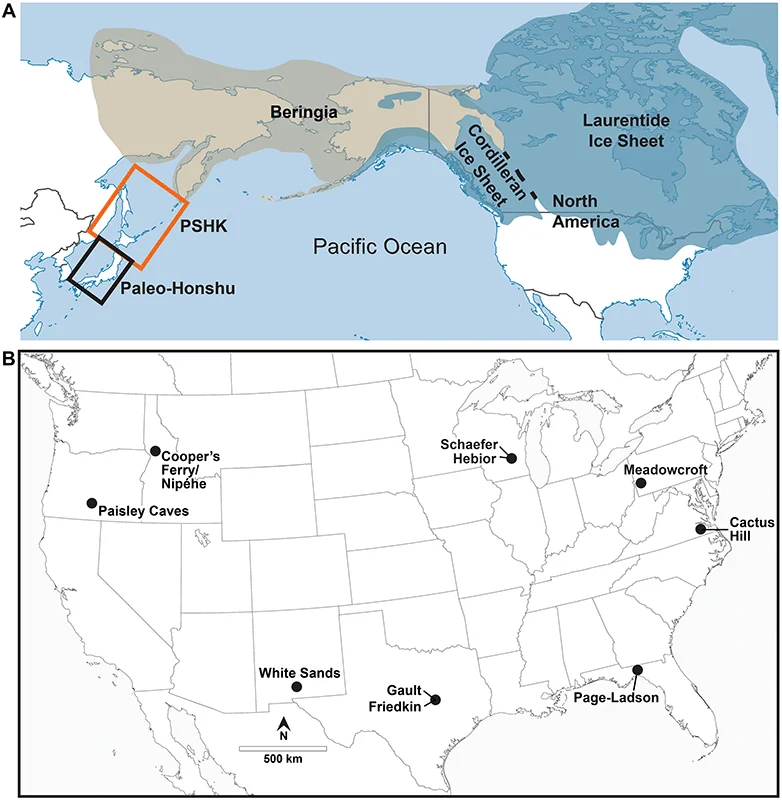
Image credit: ScienceAdvances
For many years, scholars have argued that the first Americans emerged from Beringia, the landmass that once connected Siberia and Alaska during the last Ice Age. The new study does not dismiss that route, but proposes that populations further south and west, around Hokkaido, Sakhalin, and the Kurils, may have played a more direct role than once thought. The research team, which included scholars from Tokyo Metropolitan University and Tohoku University, based their conclusions on archaeological evidence that has only recently become available. Taken together, the finds point to the Hokkaido–Sakhalin–Kuril region as a strong candidate for the ancestral homeland of some of the earliest people to reach the Americas. The study was published in Science Advances.
The so-called Jomon people, who are believed to be one of the progenitor groups for today's Japanese, likely entered Hokkaido only around 10,000 years before the present day. The Hokkaido-Sakhalin-Kuril region's population in question was likely not the direct ancestors of the Japanese and other peoples of today but rather a "ghost population" that was there earlier but has since disappeared, the scholars said.
Original article:
Image credit: ScienceAdvances
For many years, scholars have argued that the first Americans emerged from Beringia, the landmass that once connected Siberia and Alaska during the last Ice Age. The new study does not dismiss that route, but proposes that populations further south and west, around Hokkaido, Sakhalin, and the Kurils, may have played a more direct role than once thought. The research team, which included scholars from Tokyo Metropolitan University and Tohoku University, based their conclusions on archaeological evidence that has only recently become available. Taken together, the finds point to the Hokkaido–Sakhalin–Kuril region as a strong candidate for the ancestral homeland of some of the earliest people to reach the Americas. The study was published in Science Advances.
Paleogenomic studies have indicated the group ancestral to the first Americans was formed somewhere in Northeast Asia about 25,000 years ago and underwent 4,000 to 5,000 years of geographical isolation and a population decline before arriving on the American continent some 20,000 years ago or later. It has yet to be specified, however, where that "stillstand" occurred. The research team members found that 10 Upper Paleolithic sites on mainland North America, which are between 18,000 and 13,500 years old, have produced stone tools that share highly similar technological features. These resemble the lithic technology found at archaeological sites in Northeast Asia, including Hokkaido. They also found those sites have produced projectile points that have an elliptical contour with a pointed head and an elliptical cross section with sharp blade edges. Projectile points refer to pointed stone tools that were used as spearheads during hunting. The above-described shape of the points maximizes their piercing power and durability. Stone tools of this design have been found in the Hokkaido-Sakhalin-Kuril area at sites up to about 20,000 years old, whereas they begin to be found at Beringian sites of only about 14,000 years ago.
The so-called Jomon people, who are believed to be one of the progenitor groups for today's Japanese, likely entered Hokkaido only around 10,000 years before the present day. The Hokkaido-Sakhalin-Kuril region's population in question was likely not the direct ancestors of the Japanese and other peoples of today but rather a "ghost population" that was there earlier but has since disappeared, the scholars said.
Original article:


