


- 14 Mar 2002
- 21,050
- 18,903
Last Saturday, Hyper-Kamiokande was presented to the press in Hida, Gifu:
The state-of-the-art particle physics research facility currently under construction, where scientists hope to witness proton decay for the first time, remains on schedule to open in 2028. The Hyper-Kamiokande observatory, located 600 metres underground, is nearing a significant milestone, with its enormous subterranean chamber almost complete. On 28 June, the excavation site was shown to the media. With a total construction budget of approximately 65 billion yen (around $ 450 million), Hyper-Kamiokande represents the third generation of neutrino and proton decay detectors, following the earlier Kamiokande and Super-Kamiokande projects, both of which contributed to Nobel Prizes in Physics for Japanese researchers.
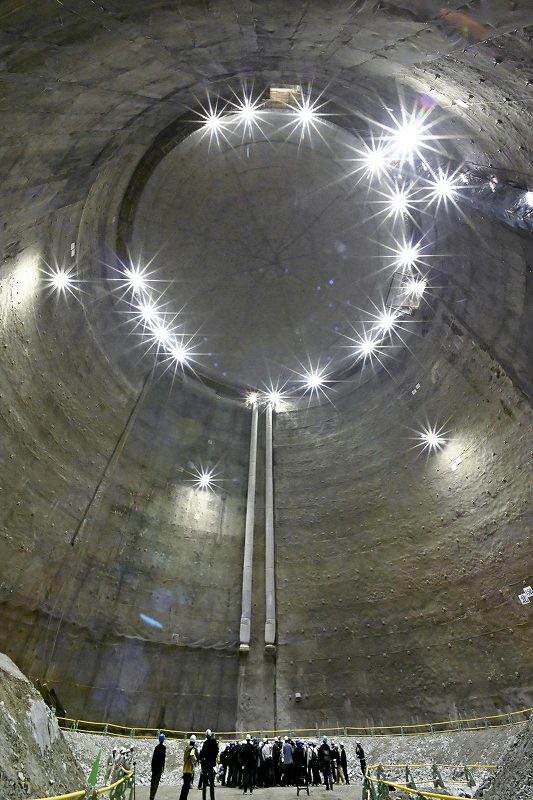
Hyper-Kamiokande Underground Neutrino Observatory
The new facility could confirm proton decay, a long theorised yet unobserved phenomenon, and perhaps secure a third Nobel Prize. In addition to this, the detector is expected to offer vital insights into the origins of the universe and the behaviour of fundamental particles. Reporters were granted access to the vast underground cavity, which measures 69 metres in diameter and 94 metres in height, making it one of the largest of its kind. The chamber was carved out of solid bedrock through continuous blasting over more than two years, and the excavation is expected to be completed by July.

 japannews.yomiuri.co.jp
Hyper-Kamiokande (also called Hyper-K or HK) is a neutrino observatory and experiment under construction in Hida, Gifu and in Tokai, Ibaraki. It is conducted by the University of Tokyo and the High Energy Accelerator Research Organisation (KEK), in collaboration with institutes from over 20 countries across six continents. As a successor to the Super-Kamiokande (also known as Super-K or SK) and T2K experiments, it is designed to search for proton decay and detect neutrinos from natural sources, such as the Earth, the atmosphere, the Sun, and the cosmos, as well as to study neutrino oscillations of the man-made accelerator neutrino beam. The start of data collection is planned for 2027.
The state-of-the-art particle physics research facility currently under construction, where scientists hope to witness proton decay for the first time, remains on schedule to open in 2028. The Hyper-Kamiokande observatory, located 600 metres underground, is nearing a significant milestone, with its enormous subterranean chamber almost complete. On 28 June, the excavation site was shown to the media. With a total construction budget of approximately 65 billion yen (around $ 450 million), Hyper-Kamiokande represents the third generation of neutrino and proton decay detectors, following the earlier Kamiokande and Super-Kamiokande projects, both of which contributed to Nobel Prizes in Physics for Japanese researchers.
Hyper-Kamiokande Underground Neutrino Observatory
The new facility could confirm proton decay, a long theorised yet unobserved phenomenon, and perhaps secure a third Nobel Prize. In addition to this, the detector is expected to offer vital insights into the origins of the universe and the behaviour of fundamental particles. Reporters were granted access to the vast underground cavity, which measures 69 metres in diameter and 94 metres in height, making it one of the largest of its kind. The chamber was carved out of solid bedrock through continuous blasting over more than two years, and the excavation is expected to be completed by July.
Hyper-Kamiokande is being built 600 meters beneath a mountain. The detector will capture the faint flashes of light that appear when neutrinos occasionally collide with electrons in water and other particles. Inside the cavern, engineers will erect a gigantic cylindrical tank 71 meters high and 68 meters in diameter, line its walls with tens of thousands of ultra-sensitive photodetectors, and fill it with 260,000 tons of ultra-pure water — about eight times the volume used in its predecessor, Super-Kamiokande. This scale will enable observations with far higher precision.
kamiokande P
japannews.yomiuri.co.jp


![-]5pace.pirat3]+](/data/avatars/s/10/10061.jpg?1412559883)