Tourism Light rail line planned for Mt. Fuji to accommodate more hikers

thomas

Unswerving cyclist
Admin
Joined
14 Mar 2002
Messages
21,050
Reaction score
18,904
A proposed light rail system connecting the base of Mt. Fuji to its 5th station aims to transport 3.36 million passengers annually. Yamanashi Prefecture's interim report outlines a plan for a double-track line with two-car trains operating every six minutes for ten hours daily. This initiative is designed to alleviate summer tourist congestion and reduce vehicle emissions. The line would follow the Fuji Subaru Line, a toll road leading to the 5th station, the starting point for one of the mountain's most popular hiking trails.
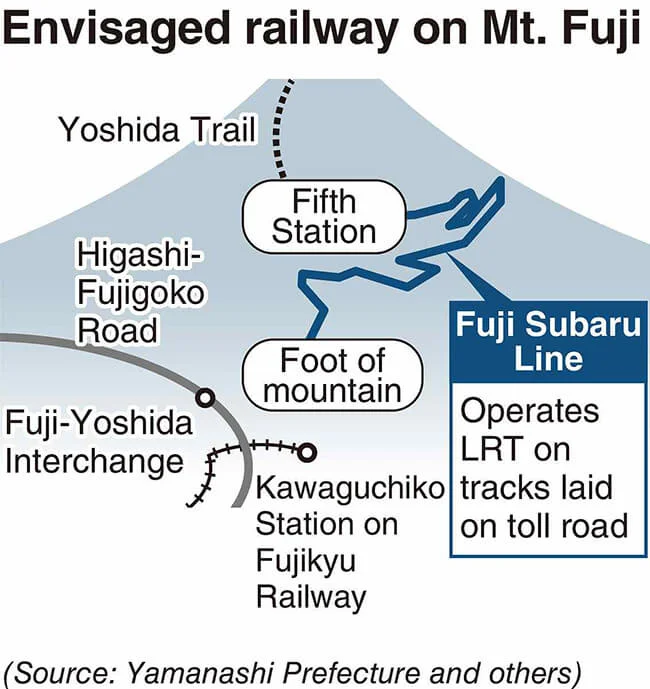
Light rail line planned for Mt. Fuji

The prefecture projects capital investment would total 148.6 billion yen ($970 million), deeming it optimal for the prefectural government to construct the tracks while a private company operates the trains. According to the report, assuming 3 million passengers per year at 10,000 yen per person, the transit system is expected to yield a profit of 184.8 billion yen for the prefecture and 420.7 billion yen for the operator over a 40-year period. Due to opposition from local residents, the prefecture plans to outline the project's future direction by the end of the year after receiving feedback.


Yamanashi Prefecture has abandoned its plan to build a light rail system to Mount Fuji's Fifth Station due to public concerns about the environmental impact. Instead, the prefecture is now considering a rubber-tired tram system—the original light rail proposal aimed to alleviate traffic congestion and reduce emissions during the peak tourist season. However, residents voiced concerns about potential harm to the environment.

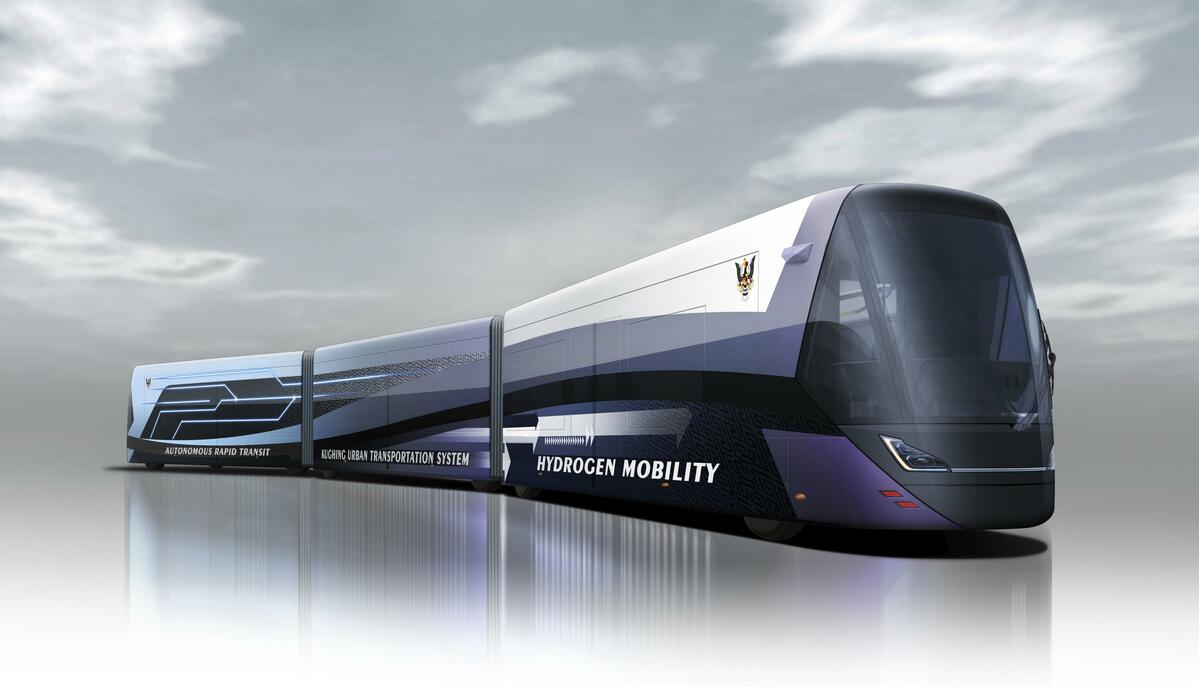
The new plan for a rubber-tired tram would utilize existing roads, eliminating the need for new rail infrastructure. The trams would follow designated paths using sensors and markers, minimizing environmental impact. This shift in approach aims to balance the needs of tourism with ecological preservation.


photo_l.jpg

Photo credit: Kyodo

The hydrogen-powered trams are expected to have two couplings and a capacity of up to 120 passengers. He said that using private cars on the road to the intermediate station will be regulated, thus reducing the number of visitors. Visitors can drive to the 5th station, the starting point of a popular climbing trail at 2,300 metres, using the Fuji Subaru Line road. The proposal had involved building a double-track line along the toll road and operating two-car trains. The Yamanashi governor promised the light rail concept in the 2019 gubernatorial election, in which he was elected for the first time. A citizens' group opposing the idea submitted about 70,000 signatures to the governor this month, demanding that he withdraw it. They expressed concerns about potential environmental destruction and avalanche damage caused by the development.


A citizens' group had petitioned the Yamanashi governor Nagasaki last year to stop the proposed construction of a light rail line up the northwest face of Mount Fuji but wasn't taken seriously. It seems the prefectural government listened to people's concerns in the end.

 
A rubber-tired tram system guided by magnetic markers embedded in the roadway has been identified as the most promising new transportation method for climbers and tourists on Mount Fuji, according to an announcement from the Yamanashi Prefectural Government on 5 June. After assessing various proposals in terms of safety, cost-efficiency, emergency response, and visitor traffic control, the prefecture concluded that a magnetically guided tram, provisionally named the "Fuji Tram," would provide the most effective solution, especially in light of rising concerns over overtourism at Mount Fuji, a designated UNESCO World Heritage site.


Fuji Tram

Fuji Tram


The envisioned Fuji Tram is set to link the mountain's base with the 5th Station, a crucial rest and staging area for climbers and sightseers situated at an altitude of 2,300 metres on the 3,776-metre peak. The service runs along the Fuji Subaru Line, a scenic toll road approximately 30 kilometres in length that winds up the northern side of the mountain from the Lake Kawaguchiko area to the 5th Station. Once the tram begins operation, private vehicles will, in principle, be prohibited from accessing the Fuji Subaru Line.

To safeguard Mount Fuji's environment and scenic landscape, the prefectural government set four key criteria for the transit system: (1) the ability to navigate sharp curves and steep gradients; (2) access for emergency vehicles; (3) absence of overhead wires to preserve the natural scenery; and (4) zero exhaust emissions. The administration evaluated five candidate transportation systems: a magnetic guidance system for rubber-tired tram-like vehicles; an optical guidance system that follows painted white lines on the road; a next-generation light rail transit (LRT) system; Translohr, a rubber-tired tram guided by a single central steel rail embedded in the road; and conventional buses. The magnetic guidance tram was judged the superior option.

 
Back
Top Bottom