This is unfortunate news. For reasons still unknown, Shuri Castle (首里城), a UNESCO World Heritage Site, was destroyed in a fire on Thursday morning. Fortunately, no one was injured, but the buildings and the artefacts they contained were reduced to ashes.
Yes, this is seriously uncool. But it has had a history of trouble such like that fire out of control situation. I think I remember it happened even before the trouble during the modern conflict on that island.
Well, I read it happened before WW2. I don't remember because I was around then, just in case any of you think I am THAT old.
It is a good thing that we don't think anyone was physically hurt, or worse. I write "don't think" because sometimes in a massive blaze such as this surprises surface later after they sift through the pieces left.
A total of more than ¥250 million has been donated by more than 18,000 people to a crowdfunding campaign set up by the city of Naha, Okinawa Prefecture, to
After the war, the University of the Ryukyus was established in 1950 on the castle site, where it remained until 1975. In 1958, Shureimon was reconstructed and, starting from 1992, the 20th anniversary of reversion, the main buildings and surrounding walls of the central castle were reconstructed. At present, the entire area around the castle has been established as "Shuri Castle Park". In 2000, along with other gusuku and related sites, it was designated as a UNESCO World Heritage Site. However, only the castle relics such as stone walls and old piles before 1950 are officially designated as the World Heritage.
The previous reconstruction cost is about 23 billion yen, so the next reconstruction will be about the same cost.
However, in 2014, a color image of Shuri Castle before being destroyed by an American attack was discovered by an American document, so the color of the roof tile will be corrected.
Previously it was rebuilt for about 15 years, but now there is also a blueprint so it will be quicker to rebuild.
A project team consisting of national and international volunteers, academics, and private companies aims at collecting one million photographic and video images of Shuri Castle to create a virtual 3D model of the castle complex that will allow visitors to virtually explore the buildings and magnify objects.
Yesterday, 31 October, marked the third anniversary of the Shuri Castle fire. Renovation works are set to begin this month, with the groundbreaking ceremony on 3 November. A two-story, steel-framed building was built in front of the castle's gutted Seiden (Main Hall) ahead of the ceremony. The building, seen in the video below, will serve as a warehouse to store and process lumber, mainly Japanese cypress, that will be used to rebuild the main hall.
A glass wall will allow paying visitors to view the workers as part of the concept of "reconstruction on display," according to the Okinawa Commemorative National Government Park. On 11 October, 107 of the 535 pieces of wood needed to rebuild the hall were brought in from various parts of the country, mainly western Japan. The rest will be collected during fiscal 2022. A temporary roof will be built starting now on the site where the main hall existed. Construction work will be carried out beneath the roof. The new Seiden hall is expected to be completed in 2026.
Last Monday, a topping-up ceremony was held at Shuri Castle in Okinawa Prefecture to mark the completion of the main hall's framework. Carpenters and others dressed in traditional attire participated in the ritual, which included installing the ridge beam on the roof. Prayers were chanted for the building's secure completion and everlasting safety.
Photo credit: Jiji Press
The restoration work for the main hall started in November 2022. As part of the work, a temporary roof was installed to keep out rain and wind. In December last year, the three-story wooden framework of the main hall was completed, followed by work to construct the permanent roof. The entire restoration work is slated to end in 2026 after detailed work on the decoration and coating of wooden materials with urushi Japanese lacquer.
A traditional ceremony has been held to pray for safety for the ongoing reconstruction of Shuri Castle in Okinawa, southern Japan. The main hall and other buildings were destroyed in a blaze in 2019.
Hope to see it when it is completed. I would like to see Notre Dame when it is finished also. Maybe do a round-the-world trip to see these things. I'm going to need some money. Better start an OnlyFans.
Five years after a devastating fire consumed Okinawa's historic Shuri Castle, hopes are rising for a full recovery in visitor numbers to the World Heritage site as reconstruction efforts progress steadily. As the former political and cultural heart of the Ryukyu Kingdom (1429-1879), Shuri Castle has endured a tumultuous history, suffering five fires due to accidents and wartime damage since its construction in the 14th century. In anticipation of the 80th anniversary of the end of World War II next year, the Okinawa Prefectural Government is actively promoting tourism to the site. One of their key initiatives is to open a bunker that once housed a Japanese military headquarters beneath the castle in 2025 or later.
Photo credit: Kyodo
The reconstruction of Shuri Castle appears to be reaching its final stages. In mid-September, craftsmen oversaw the installation of wooden boards, known as "uchinorigakugi," which adorn the perimeter of the Ryukyu King's throne. These intricate boards, measuring approximately 14 meters in width when connected, feature unique Ryukyu-style dragons and other decorations, reflecting the region's historical and cultural ties to China. Takao Shimomura, a 72-year-old sculptor from Nagasaki Prefecture, noted the challenges of adapting to the distinctive style of Ryukyu dragons, which have four fingers instead of the more typical three.
In July, the process of tiling the main building's roof with 60,000 red Ryukyu tiles commenced. The roof has been reinforced with stucco and other materials to withstand the frequent typhoons that impact Okinawa.
Five years after fire ravaged Okinawa's iconic Shuri Castle, hopes for a full recovery in visitor numbers at the World Heritage site are growing in line with the steadily progressing reconstruction work. Once the political and cultural center of the Ryukyu Kingdom (1429-1879), Shuri Castle has...
<p>Shimizu Corp., the main contractor for the restoration of Shuri Castle in Naha, has begun offering people a peek into the restoration work through a 3D virtual tour, five years after the castle was destroyed by a fire.</p>
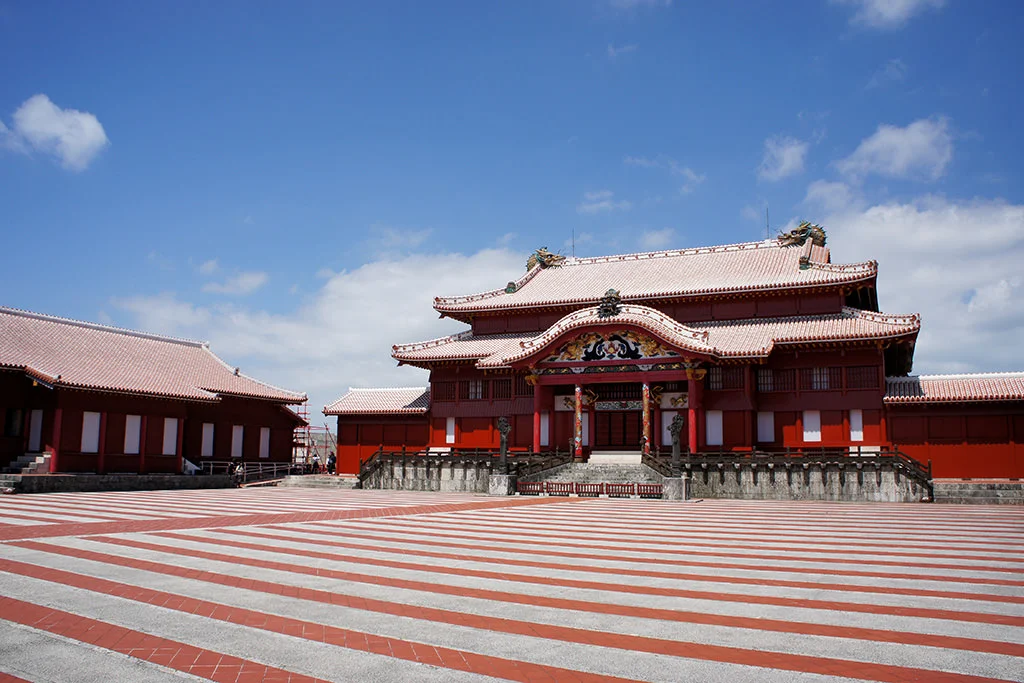
The main hall of Shuri-jō Castle has once again risen in splendour, with reconstruction work now complete and reporters given a preview of the historic site on 6 August.
The Seiden main hall of Shuri-jō Castle (Kengo Hiyoshi via Asahi)
The castle is undergoing a complete rebuild after being devastated by fire in 2019. The Seiden main hall again displays its iconic Okinawan red-tiled roof, vermilion columns, and detailed ornamentation, all meticulously restored. The reconstruction took place within a temporary enclosure to protect the site from the elements. Although the public was able to observe parts of the restoration, much of the hall remained hidden behind scaffolding, even for visitors inside the protective structure.
This time, the scaffolding was removed after the exterior's completion and the temporary structure is scheduled to be later dismantled. General visitors will be able to see the entire main hall without any obstructions from around late October. Although the 2019 blaze was not the first in Shuri-jo's lengthy history, it claimed seven buildings, the main hall among them, and damaged two others. Work on the interior is ongoing, and the entire reconstruction is scheduled to wrap up by autumn 2026.
The main hall of Shuri-jō Castle has once again risen in splendour, with reconstruction work now complete and reporters given a preview of the historic site on 6 August.
View attachment 131079
The Seiden main hall of Shuri-jō Castle (Kengo Hiyoshi via Asahi)
The castle is undergoing a complete rebuild after being devastated by fire in 2019. The Seiden main hall again displays its iconic Okinawan red-tiled roof, vermilion columns, and detailed ornamentation, all meticulously restored. The reconstruction took place within a temporary enclosure to protect the site from the elements. Although the public was able to observe parts of the restoration, much of the hall remained hidden behind scaffolding, even for visitors inside the protective structure.
awesome! I visited back a couple year while they were still carving the support beams and lintels. As tragic as it was for the old castle to burn down, it was also the perfect opportunity to pass down the traditional knowledge and techniques to a younger generation of builders. Honestly, it would be pretty cool if any of the other Okinawan castles got the same treatment, would love to have seen Nakagusuku in all its former glory.
I believe one of my karate sensei is planning to go next year to visit the castle once it's open. Considering our style is rooted in that castle's corridors, it makes for an essential pilgrimage spot, for lack of a better word.
Okinawa News Footage — Reborn Shurijo Castle Main Hall Revealed After Exterior Work Completed
(Okinawa TV, August 7, 2025)
The reconstruction of Shurijo Castle has reached a new milestone, with the exterior work on the main hall now complete. On August 7, its beautiful new appearance—incorporating the latest research findings—was unveiled to the press.
The dismantling of the large temporary roof that had covered the entire structure is underway, and the scaffolding installed on the second and third floors of the main hall has been removed.
The completed exterior of the main hall features vividly colored decorative pillars at the front and restored karahafu gables. Incorporating new insights, the main hall has been reborn in a beautiful form, presented to the media ahead of the official opening.
Koji Okumura, Construction Site Manager, Shimizu Corporation:
"I believe we've been able to create something even better than it was 30 years ago, and it's wonderful to see that quality taking shape before our eyes."
The interior of the main hall is now in its final stages, including painting work, and construction is proceeding smoothly toward completion in the fall of 2026.
"Reiwa-Era Restoration" — Exterior of Shurijo Castle Main Hall Completed and Unveiled to the Press
(Yomiuri Shimbun News Footage)
Funny that the Wikipedia article mentions the Ise Jingu, where the same phenomenon occurs every 20 years.
In Japan, the Ise Grand Shrine is rebuilt every twenty years with entirely "new wood". The continuity over the centuries is considered spiritual and stems from the source of the wood, which is harvested from an adjoining forest considered sacred.
Yes but with Shintō 's obsession with purity and cleanliness I can understand this.
I was at Kumamoto castle (a week before the earthquake) and of course the inside is modern and pristine which for me detracts from its appeal in the way Theseus's Ship would be disappointing. When I've walk around Doune castle (Python's Holy Grail filming location) or Belvoir castle (pronounced 'Beever') I get a sense of history, of antiquity. The worn flag stones upon which I walk are the same as knights and nobles walked upon. I suppose Britain doesn't get many earthquakes hence the preservation of it's antiquities whereas poor ol' Japan does
I was always disappointed in the reconstructed castles because they seemed to be built to suit a particular 1970s or 1980s idea of destination travel in Japan. Some focal point where a group would meet, take a group photo, and then go to some ryokan for a meal and karaoke and maybe another photo. The history and the authenticity of the "castles" were sort of secondary to the concept of the group (school, company, factory, club) travel. They weren't necessarily built to resemble the original. They didn't use authentic floor plans or architecture methods. They were steel and concrete with elevators and fluorescent exit signs and gift shops at the exit selling items that could have been made or sold anywhere, i.e. a keychain with Hello Kitty wearing a samurai helmet - that kind of thing.
So visiting Nijo Castle for the first time was a nearly religious experience for me. It was the first castle I visited that had been kept in its original state. Authentic, largely untouched, beautiful, some parts in need of repair, but you could imagine that it looked mostly as it looked for the past 400 years or so.
But I think the times have changed and Japanese people are also seeking authenticity in a way they weren't in the 1970s. When I visited Shuri Castle before it burned down, I was really impressed with it, and I thought it a very worthy reconstruction. So I'm glad they decided to rebuild it. In this case, we know its a reconstruction, and it hasn't really existed in any useable form for a long while I believe. I think even before the war it was already mostly in ruins. So Theseus's ship doesn't come to mind when I think of Shuri Castle, but I know what you mean. I get more of a Theseus vibe from Kinkaku-ji . I don't know why. Maybe it has something to do with being only able to see it from afar. So you can only gaze at a reconstruction of something that burnt down in the 1950s. And then had its gold leaf replaced/repaired more recently. You can't go inside, walk through its rooms, touch its beams, or sit in a corner and contemplate it. Its just a thing to look at and take pictures of. (But I still recommend seeing it, particularly if you can do it in the off-season months). Ise Jingu ... well this is the living embodiment of the paradox of Theseus's Ship. At least for us foreigners. I guess for Japanese the dismantling and rebuilding is the entire point of the structure, whereas us foreigners want to tread on the exact flag stones used centuries ago.
This site uses cookies to help personalise content, tailor your experience and to keep you logged in if you register.
By continuing to use this site, you are consenting to our use of cookies.


 mainichi.jp





 I'd forgotten about that castle.


