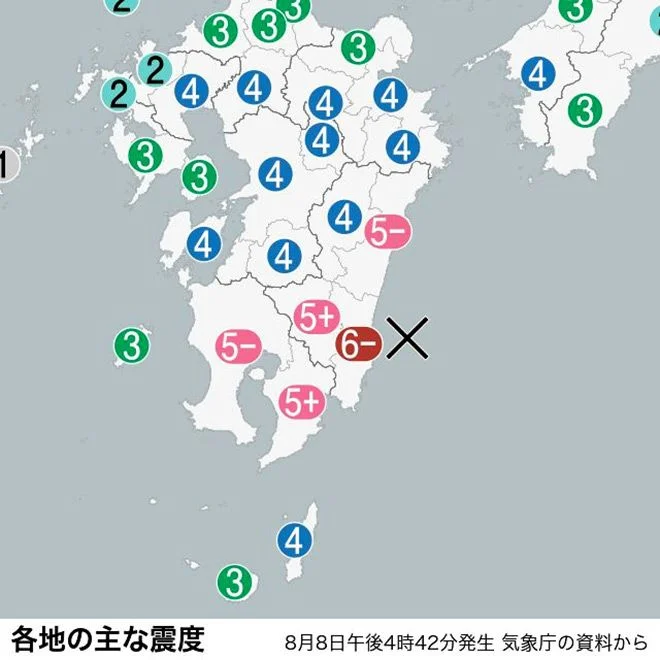
News M7.1 quake hits Miyazaki, megaquake alert declared

thomas

Unswerving cyclist
Admin
Joined
14 Mar 2002
Messages
21,050
Reaction score
18,904
A powerful earthquake with a preliminary magnitude of 7.1 struck southwestern Japan on Thursday afternoon, prompting tsunami advisories for multiple prefectures, including Kochi and Miyazaki. The quake, centred about 30 kilometres offshore from Miyazaki, registered a lower six on the Japanese seismic intensity scale, with Nichinan experiencing the most severe shaking. The Japan Meteorological Agency later revised the magnitude upward from 6.9.
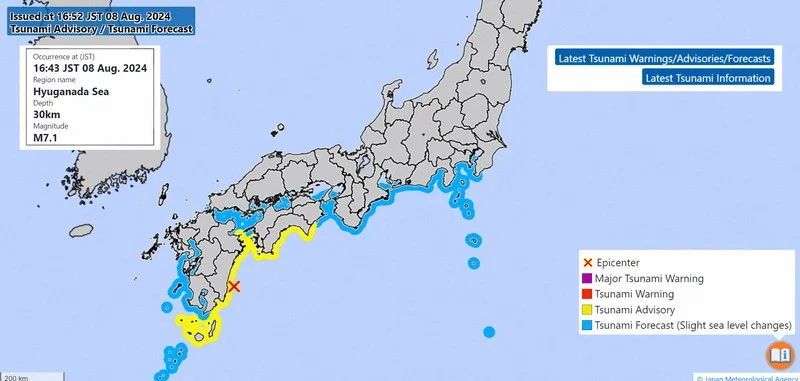

9.webp


The agency said it has started investigating whether there is a link between the temblor and a potential massive trench-type earthquake along the Nankai Trough stretching from off western to central Japan. The tsunami advisories were issued for Kochi, Ehime, Oita, Miyazaki and Kagoshima prefectures. Tsunami with heights of around 50 centimeters and 20 cm was observed in Miyazaki and southwestern Kochi, respectively, the agency said.


8439cd5d5e3ede417a975189706576b1.webp


Seismologists across the news channels are now discussing whether this tremor affected the fault under the Nankai Trough, potentially leading to a Nankai megathrust earthquake (南海トラフ巨大地震). This fault forms the plate interface between the subducting Philippine Sea Plate and the overriding Amurian Plate (part of the Eurasian Plate), which dips beneath southwestern Honshu (more on Wikipedia). If that's the case, it could be the harbinger of bigger things to come.

Megathrust earthquakes are titanic ruptures that occur where tectonic plates collide. One plate is forced beneath another, building immense pressure along their boundary. This stored energy is eventually released in a cataclysmic event, capable of generating the planet's most powerful tremors, often exceeding magnitude 9.0.

RuptureAreasNankaiMegathrust.png

The E section above hasn't seen a major quake since 1854. If it ruptures, it would affect the entire southern coast of Honshu.

Also from Wikipedia:

In 1999, the likelihood of the occurrence of a great earthquake in the Tokai area in the 2000-2010 period was estimated to be in the range of 0.35–0.45. Despite the uncertainty of when such an earthquake will occur, local authorities are already taking action to prepare residents for what they regard as an inevitability. The Japanese government estimates that a major earthquake on the Nankai Trough would cause 169.5 trillion yen in direct damage and 50.8 trillion yen in economic losses for the following year. A study by the Japan Society of Civil Engineers in 2018 estimated that the long-term damage from the earthquake could result in 1,240 trillion yen in economic losses over a 20-year period. It is predicted that the economic damage is likely to be 10 times higher than for the 2011 Tōhoku earthquake and tsunami. A death toll as high as 230,000 has been suggested for such an event.


On Thursday, Japan issued its first-ever warning of a potential megaquake along the Nankai Trough. Triggered by a magnitude 7.1 earthquake off the coast of Kyushu earlier that day, the Meteorological Agency declared the increased risk. While authorities clarified that this doesn't guarantee an imminent quake, they emphasized the need for heightened preparedness. The alert is set to last a week, but officials urge the public to maintain vigilance beyond that period. This unprecedented warning highlights the serious threat posed by the Nankai Trough, a region known for its potential to generate massive earthquakes.

Information from the agency on Nankai Trough megaquakes is delivered at two levels — an alert and a higher warning. The weather agency issued the lower level alert on Thursday, urging people to be prepared for cases requiring evacuation. No evacuations are required for the alert level. A warning means people would need to be on higher alert, and officials would urge those who wouldn't be able to evacuate quickly to do so before any large quake occurs.

 
While stationed in the Aleutians on Adak , we had an earthquake about once a month. In my head , I had a plan of what I would do , depending on where I was when it struck. Each time one hit , my feet would become glued to the floor and my mind would go blank on what to do. I'm glad I live in Maine where quakes are very rare because they scared the crap out of me.

200.gif
 
A week-long government call for heightened earthquake preparedness, triggered by an advisory warning of a potential megaquake along the Pacific coast, has officially ended. No significant seismic activity was recorded in the Nankai Trough region following the advisory issued on 8 August—the first of its kind since the system was introduced in 2017—prompting intense disaster preparation efforts from the central government and local communities. While boosting public awareness, it also negatively impacted tourism during the peak summer season.


And here's why the JMA issued the warning:

If a megaquake occurs in the area, the damage is expected to be devastating. For example, the height of a tsunami triggered by the earthquake could exceed 30 meters in areas on the Pacific Ocean side near the epicenter. The JMA called for residents to be prepared for possible earthquakes for at least one week. A trough is a seabed trench at the boundary between two tectonic plates. The Nankai Trough stretches around 700 kilometers from Suruga Bay off Shizuoka Prefecture to the Hyuganada Sea off Miyazaki Prefecture.

Nankai Trough megaquake mechanism

Image credit: Daily Yomiuri

 
While last week's megaquake alert has ended, seismologists warn of the danger of so-called "slow-slips" that could trigger megaquakes.

Nankai Trough

Image credit: Mainichi

The recent powerful earthquake off Miyazaki Prefecture and the subsequent issuance of Japan's first-ever megaquake advisory have intensified concerns over a potential major earthquake in the Nankai Trough. While government experts report no abnormal plate activity, a new development has captured their attention. Days after the initial quake, intermittent shaking began in the Hyuga-nada Sea. This unusual pattern, known as a "slow earthquake," involves gradual fault movement rather than the sudden jolts of typical tremors.

Although not causing significant shaking, slow earthquakes release the same amount of tectonic pressure as regular earthquakes.
Such events have precedent. A slow-slip earthquake preceded the devastating 2011 Tohoku earthquake, raising questions about its potential role in predicting large-scale seismic activity. As scientists closely monitor these developments, the nation remains on high alert.


A type of slow earthquake known as a slow-slip occurred after a March 9, 2011, magnitude-7.3 foreshock to the 2011 Great East Japan Earthquake, and was thought to have been related to that magnitude-9 megaquake two days later. Along the Nankai Trough, a slow earthquake will occur in the region where the boundary between the continental and the Philippine Sea plates are not firmly attached. According to assistant professor of seismology Yusuke Yamashita at Kyoto University's Disaster Prevention Research Institute Miyazaki Observatory, slow quake activity has been detected at a shallow location on the boundary of the plates since Aug. 8 and is currently picking up. The slow earthquake activity detected by Yamashita has included two types of weak shaking: low wavelength micromotion, with cycles of every 0.1 to 0.5 seconds, and ultra-low frequency earthquake every 10 to 20 seconds. To determine the exact location of the activity will require the installation of seismometers on the sea floor, but it is believed to be occurring in a roughly 100-kilometer radius area on the ocean floor at least 50 kilometers southeast of the Miyazaki Prefecture coast.

 
Back
Top Bottom