


- 14 Mar 2002
- 21,050
- 18,903
JR East conducted a trial pedestrian roundabout inside its Shinjuku Station, the busiest station in Japan, to assess how it could help alleviate congestion there. Roundabouts typically are set up as circular roads with no traffic lights for vehicles. Incoming vehicles must yield to traffic, and after entering the circle, they can leave on the road closest to their destination.
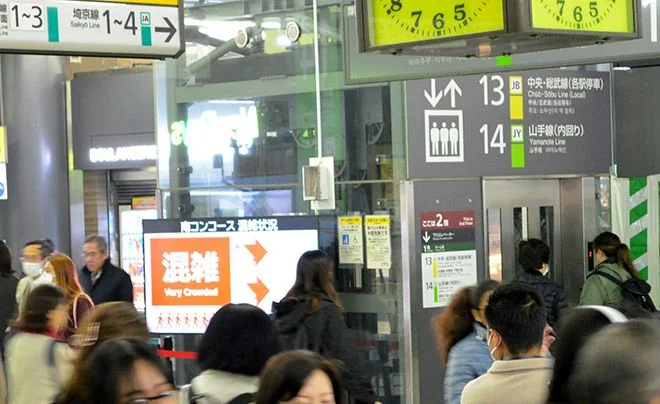
Photo credit: Ayateru Hosozawa

Photo credit: Ayateru Hosozawa
"There are few examples of experiments with a pedestrian roundabout in the world," a JR East official said. "As of now, it seems difficult to get people used to the roundabout, but we plan to continue with the experiment based on the spirit of 'slow and steady wins the race.'" [...] The trial first started in July at a concourse often congested with passengers from not only the JR Yamanote and Chuo lines, but also the nearby exit of the Odakyu Line. An elevator installed on the concourse served as the central point around which pedestrians moved in a counter-clockwise direction to get to their destination. Posters and electronic signs called on pedestrians to walk in a one-way direction around the elevator. Sensors on the station ceiling recorded congestion and pedestrian movement, and the data is being used to evaluate the effectiveness of the roundabout. In the July experiment, station staff used megaphones to direct pedestrians around the elevator to establish the roundabout. [...] But when staff stopped calling out about the roundabout, the effect disappeared as pedestrians did not appear to pay attention to the posters.
Data found a 20-percent decrease in near misses among pedestrians when JR staff used megaphones.


