Clothing, Colors, Patterns,

Ryan-

先輩
Joined
10 Nov 2008
Messages
78
Reaction score
0
Here are some random questions involving colors, clothes, and the like.
1.) What's the difference between 濃い and 暗い and 薄い and 明るい?

2.) I think the words for striped and polka-dotted are みずたまもよう and しまもよう, but how do you use them to describe things? Are they nouns? Na-adjectives?

3.) What are the correct adjectives you use to express "baggy," "tight," and "fits right" when applied to clothing?

4.) How do 紫 and 緑 function? Nouns? Na adjectives? Do they take の?

5.) What is a good way to find out why a certain kanji came to mean a certain thing? If I wanted to find out the story of why the parts of 紫 come together to mean "purple."

6.) Fabrics such as きね、めん、けがわ... how do you use them? きねの赤いTシャツ?

How about "red silk shirt with green stripes?"

Thank you in advance for any help.
 
2) 水玉模様のスカート→"a polka-dot skirt"
縞模様のパジャマ→"striped pajamas"

3) "Tight" is きつい. "Fits right" I would guess could be ちょうどいい or ぴったり合う. I'm not sure on those, though. 緩い I believe is "baggy" or just loose in general.

4) 緑 is like a noun. 紫 seems to go either way.

5) A kanji dictionary. Give me a second.

6) I believe you mean きぬ (絹) and わた (綿). I'm don't think people say めん for cotton, but I may be wrong. Those are all nouns, so they'd get の.

緑の縞模様の赤い絹のシャツ would be my guess. There are other ways, I'm sure, and perhaps better ways.


Semantic-phonological compound. 此 is an abbreviated form of the semantic combination of 止 (趾 -- foot) + 比 (line up), and it means that both feet aren't lined up right. 紫 is 糸 + the phonetic 此, and it means that blue and red don't really go together when mixed, and form a color that's in between.

Alright, I'm going to put the Japanese so that people can see where I got this and possibly make suggestions for better translations. This is from 漢字源, by the way.

会意兼形声。此(シ)は「止(=趾。あし)+比(ならぶ)の略体」の会意文字で、両足がそろわず、ちぐはぐに並ぶこと。紫は「糸+(音符)此」で、赤と青をまぜて染めた色がそろわず、ちぐはぐの中間色となること。
 
6) I believe you mean きぬ (絹) and わた (綿). I'm don't think people say めん for cotton, but I may be wrong. Those are all nouns, so they'd get の.

綿(めん) is cotten, you can also say 木綿(もめん) but these days めん is more commonly used for clothing.
綿100パーセントのブラウス: 100% cotten blouse, for example.
コットン which is imported word (cotten) is also used.

綿(わた) means cotten wool, usually for medical use or stuffing for cushions, etc.
-----
Correction (棉→綿) Thanks Glenn san and Toritoribe san!
 
Last edited:
1.) What's the difference between 濃い and 暗い and 薄い and 明るい?
濃い and 薄い refers to the density in colour. 濃い is translated as "dark" (or maybe "strong"?) and 薄い "pale".
暗い and 明るい refers to brightness in colour.
暗い is dark, 明るい is light.

4.) How do 紫 and 緑 function? Nouns? Na adjectives? Do they take の?

Both are nouns and take の.
i.e.
紫のスカート
緑のジャケット

6.) Fabrics such as きね、めん、けがわ... how do you use them? きねの赤いTシャツ?
きね should read きぬ, as Glenn san pointed out.
And けがわ(毛皮) is fur.
If you mean wool, it is 毛(け) or ウール.
 
So, 綿 is usually read めん? And when it's わた you use 棉? And めん is used on its own to mean cotton? I'm a little confused.
 
Depending on the context. When used like as the filling of 布団, 綿 is read as わた. The same kanji is read as めん, when used as material of clothes. It's the same meaning as 木綿(もめん,) as undrentide-san mentioned.:-)
(棉 is a 異字体 of 綿.)

3.) What are the correct adjectives you use to express "baggy," "tight," and "fits right" when applied to clothing?
baggy:
(サイズが)大きい also can be used.
 
baggy:
(サイズが)大きい also can be used.

How about ルーズな if it means it is designed to be loose?

(サイズが)大きい can refer to clothing too large for your size.

I think ゆるい(緩い)can mean both, depending on context.
 
Last edited:
綿(めん) is cotton, you can also say 木綿(もめん) but these days めん is more commonly used for clothing.
綿100パーセントのブラウス: 100% cotton blouse, for example.
コットン which is imported word (cotton) is also used.

綿(わた) means cotten wool, usually for medical use or stuffing for cushions, etc.
-----
Correction (棉→綿) Thanks Glenn san and Toritoribe san!

Just a note.
Cotton 〇
Cotten Х
 
How about ルーズな if it means it is designed to be loose?
(サイズが)大きい can refer to clothing too large for your size.
I think ゆるい(緩い)can mean both, depending on context.
Or, ゆったりめ?😅
Further, to the OP, if it is designed to be tight, it should be something like タイトな, not きつい. きつい, and also サイズが大きい, has a negative meaning as the opposite to "fits right."
 
Wow. Well, I guess I never thought of tight as being right when it comes to clothes. I had no idea that タイトな existed. It makes me wonder, though, whether you can say その服タイトだぜ! to mean "those clothes are tight!" (in the sense that they are fashionable). Nah, that's probably too slang for Japanese.
 
Wow. Well, I guess I never thought of tight as being right when it comes to clothes. I had no idea that タイトな existed. It makes me wonder, though, whether you can say その服タイトだぜ! to mean "those clothes are tight!" (in the sense that they are fashionable). Nah, that's probably too slang for Japanese.
VALENTI by BoA


0:57~
タイトなジーンズにねじ込む 私という戦うボディ


そのスカート、タイトでかっこいいね。
そのタイトなスカートかっこいいね。
そのタイトスカートかっこいいね。

All sentences above would make sense.
The word タイト itself is "neutral," neither positive nor negative. So I don't think その服タイトだぜ! could have the meaning "fashionable." :p😌
 
Last edited by a moderator:
Heh, interesting. The "tight" I meant doesn't mean "fashionable," though. It's just a general word for things that you like, similar to "awesome" or "cool." I don't think it gets used very much anymore these days, though. I can't recall having heard it being used seriously in a while, anyway.
 
Would 明るいピンク be analogous to our "hot pink" or "neon pink"?

Also, jisho.org has だぶだぶ and ぶかぶか as being a word for baggy, with the former yielding several sentence results. ほんとうによく使う言葉ですか?

Glenn, thanks for the information on that specific Kanji. Is there an online resource where I can look up similar information for others? 漢字源がよく分かりません。

T-Shirt with red and blue polka dots --> 赤くて青い水模様のTシャツ?
Or does that mean the polka dots are a purplish color? Would 赤い水模様の青いTシャツ be a blue T-shirt with red polka dots?

変な質問であることを知っていて、ごめんなさい。
 
Also, jisho.org has だぶだぶ and ぶかぶか as being a word for baggy, with the former yielding several sentence results. ほんとうによく使う言葉ですか?
Yes. The both mimetic words are frequently used basically in not-fits-right line. だぶだぶ could be used also in designed cases, just my opinion.

T-Shirt with red and blue polka dots --> 赤くて青い水模様のTシャツ?
Or does that mean the polka dots are a purplish color?
It would be 赤と青の水模様のTシャツ, using 赤/青 as the nouns.
赤くて青い水玉模様のTシャツ could be interpreted as 赤くて、青い水玉模様のTシャツ; a red T-shirt with blue polka dots(thus, 赤くて is modifying Tシャツ,) probably because the expression 赤くて青い is not commonly used as a color's.

Would 赤い水模様の青いTシャツ be a blue T-shirt with red polka dots?
👍
 
Last edited:
Would 明るいピンク be analogous to our "hot pink" or "neon pink"?
明るいピンク simply means bright pink of any shade, as long as it is bright.
Hot pink is ホットピンク
Neon pink is 蛍光ピンク

Also, jisho.org has だぶだぶ and ぶかぶか as being a word for baggy, with the former yielding several sentence results. ほんとうによく使う言葉ですか?
Yes.

T-Shirt with red and blue polka dots --> 赤くて青い水模様のTシャツ?Or does that mean the polka dots are a purplish color?
Red & blue polka dots: 赤と青の水玉模様の T シャツ (a bit awkward, though)
赤くて青い does not mean purplish. You're just saying it's red and blue, which is a puzzling description.

Would 赤い水模様の青いTシャツ be a blue T-shirt with red polka dots?
I'd call a blue T-shirt with red polka dots as 青地に赤い水玉(模様)の T シャツ (T shirt with red polka dots on blue)
 
濃い and 薄い refers to the density in colour. 濃い is translated as "dark" (or maybe "strong"?) and 薄い "pale".
暗い and 明るい refers to brightness in colour.
暗い is dark, 明るい is light.

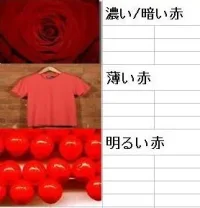
Revisiting an old topic for a moment, I'm not sure I understand this distinction.

濃い赤いと明るい暗い赤いの違いは何ですか?
薄い赤いと明るい赤いの違いは?
 
Here are some examples.
 

Attachments

  • 窶督ウ窶佚ィ.webp
    窶督ウ窶佚ィ.webp
    9.6 KB · Views: 141
Revisiting an old topic for a moment, I'm not sure I understand this distinction.
濃い赤いと明るい暗い赤いの違いは何ですか?
薄い赤いと明るい赤いの違いは?

As undrentide has already explained, the distinctions are based on hue, lightness and colorfulness.
See here:
Hue - Wikipedia
It is based on the Munsell color system:
Munsell color system - Wikipedia
 
濃い赤いと明るい暗い赤いの違いは何ですか?
薄い赤いと明るい赤いの違いは?
赤 in 濃い赤 is a noun. The adjectives 濃い/薄い/明るい/暗い can't modify the adjective 赤い. ;)
 
Last edited by a moderator:
Back
Top Bottom