- 14 Mar 2002
- 21,050
- 18,904
Another irreplaceable cultural treasure was reduced to ashes yesterday. 
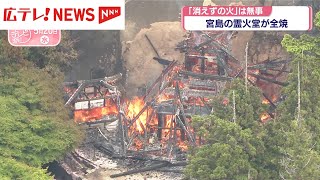
Reikadō Hall (霊火堂), a 1,200-year-old temple on Miyajima Island in Hiroshima Prefecture, was destroyed in a fire on 20 May. The hall, which was engulfed in flames, is known for housing the so-called "inextinguishable fire", a sacred flame said to have burned continuously for around 1,200 years since Kōbō Daishi, also known as Kūkai, used it in goma (護摩) fire rituals. The flame is also believed to have been one of the source fires used to light the Flame of Peace at Hiroshima Peace Memorial Park. Reikadō Hall has experienced several fires over the centuries. More recently, the structure was destroyed in a 2005 blaze before being rebuilt the following year.


 www.japantimes.co.jp
Reikadō Hall (霊火堂), sometimes translated as the "Hall of the Sacred Flame" or "Hall of the Eternal Flame", is a small Buddhist hall located near the summit of Mount Misen (弥山) on Miyajima Island in Hiroshima Prefecture. Hidden among the mountain forests, the hall is part of a long-standing religious landscape that combines Buddhist and Shinto traditions and has been regarded as sacred for centuries.
The hall is closely linked to Kūkai (空海, 774–835), better known by his posthumous title Kōbō Daishi (弘法大師), the founder of Shingon Buddhism in Japan. According to temple tradition, Kūkai undertook ascetic training on Mount Misen in the early ninth century and lit a sacred fire there around 806. That flame, known as the kiezu no hi (消えずの火), or "Unquenchable Fire", is said to have burned continuously for roughly 1,200 years.
Inside Reikadō, a large iron kettle hangs suspended above the fire. Water heated by the flame is offered to visitors, and local belief holds that it possesses healing properties. The hall has also, in recent years, become associated with prayers for enduring love, an idea tied to the symbolism of the eternal flame itself.
The fire at Reikadō later acquired national significance after the Second World War, when it was used to ignite the Flame of Peace at Hiroshima Peace Memorial Park. Through that connection, the small mountain hall became linked not only to Buddhist tradition but also to modern memorial culture in Hiroshima.
Reikadō belongs to the wider religious complex centred on Daishōin Temple (大聖院 Daishōin), one of Miyajima's most important Buddhist temples. Mount Misen itself remains an active pilgrimage site, known for its ancient forests, temple structures, and long-standing reputation as a place of spiritual practice and mountain worship.
Reikadō Hall (霊火堂), a 1,200-year-old temple on Miyajima Island in Hiroshima Prefecture, was destroyed in a fire on 20 May. The hall, which was engulfed in flames, is known for housing the so-called "inextinguishable fire", a sacred flame said to have burned continuously for around 1,200 years since Kōbō Daishi, also known as Kūkai, used it in goma (護摩) fire rituals. The flame is also believed to have been one of the source fires used to light the Flame of Peace at Hiroshima Peace Memorial Park. Reikadō Hall has experienced several fires over the centuries. More recently, the structure was destroyed in a 2005 blaze before being rebuilt the following year.
According to tradition, Kukai visited Mount Misen around the early ninth century after returning from China, where he had studied esoteric Buddhism during the Tang Dynasty. During his stay on the mountain, he is said to have performed goma fire rituals, a form of Buddhist ascetic practice involving sacred flames and prayer. The fire used during these rituals became known as the "Kiezu no Hi," or "Inextinguishable Flame." Legend says the flame has continued burning for approximately 1,200 years without going out, making it one of Japan's most famous sacred fires. The flame has long symbolized spiritual purification, protection, and prayer. Mount Misen itself has been regarded as a sacred mountain for centuries. Rising about 535 meters above sea level, it has historically been viewed as a place where gods and Buddhist deities reside. For much of its history, ordinary people were forbidden from climbing the mountain because of its religious importance.
1200-Year-Old Temple on Miyajima Reduced to Ashes
Flames broke out on the morning of May 20th on Miyajima Island in Hiroshima Prefecture, home to one of Japan
newsonjapan.com
Hall linked to Buddhist saint Kukai burns down on Miyajima
Flames spread into nearby woodland on the island later, but no one was hurt.
Reikadō Hall (霊火堂), sometimes translated as the "Hall of the Sacred Flame" or "Hall of the Eternal Flame", is a small Buddhist hall located near the summit of Mount Misen (弥山) on Miyajima Island in Hiroshima Prefecture. Hidden among the mountain forests, the hall is part of a long-standing religious landscape that combines Buddhist and Shinto traditions and has been regarded as sacred for centuries.
The hall is closely linked to Kūkai (空海, 774–835), better known by his posthumous title Kōbō Daishi (弘法大師), the founder of Shingon Buddhism in Japan. According to temple tradition, Kūkai undertook ascetic training on Mount Misen in the early ninth century and lit a sacred fire there around 806. That flame, known as the kiezu no hi (消えずの火), or "Unquenchable Fire", is said to have burned continuously for roughly 1,200 years.
Inside Reikadō, a large iron kettle hangs suspended above the fire. Water heated by the flame is offered to visitors, and local belief holds that it possesses healing properties. The hall has also, in recent years, become associated with prayers for enduring love, an idea tied to the symbolism of the eternal flame itself.
The fire at Reikadō later acquired national significance after the Second World War, when it was used to ignite the Flame of Peace at Hiroshima Peace Memorial Park. Through that connection, the small mountain hall became linked not only to Buddhist tradition but also to modern memorial culture in Hiroshima.
Reikadō belongs to the wider religious complex centred on Daishōin Temple (大聖院 Daishōin), one of Miyajima's most important Buddhist temples. Mount Misen itself remains an active pilgrimage site, known for its ancient forests, temple structures, and long-standing reputation as a place of spiritual practice and mountain worship.