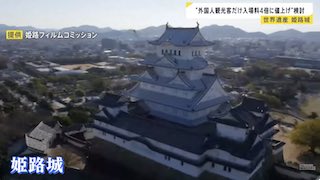
Tourism Admission to Himeji Castle to increase for nonresidents

thomas

Unswerving cyclist
Admin
Joined
14 Mar 2002
Messages
21,050
Reaction score
18,904
The mayor of Himeji in western Japan, Kiyomoto Hideyasu, is considering a significant increase in the admission fees for foreign visitors to Himeji Castle , a UNESCO World Heritage site, due to the surge in tourism. During an international symposium, he suggested that the current fee of 1,000 JPY for adults could be raised to approximately USD30 for foreign tourists while aiming to keep it around USD5 for residents. This proposal seeks to manage the growing number of tourists while preventing a financial burden on the local population. The castle, a national treasure with parts dating back to the early 17th century, is renowned for its historic wooden structure.


The city government said in a statement it will take proper measures to realize sustainable tourism as repair and refurbishment of the castle will be continuously needed. It also said many World Heritage castles abroad collect higher fees than Himeji Castle. Around 1.48 million people visited the castle in fiscal 2023, and 452,300 were foreigners, topping 400,000 for the first time since data became available in fiscal 1992, according to the city government. Amid a surge in inbound tourism to Japan, local governments are seeking additional funds to maintain tourism infrastructure by introducing or increasing fees. This includes popular destinations such as Mt. Fuji and Itsukushima Shrine.


I think $30 USD is getting a bit steep, a family of four would be $120. I think $20 ~ 3,000 JPY is more reasonable and would still be a huge increase in income. That would be about $80 for that same family of four, much more reasonable for an already expensive trip. The yen maybe weak but the plane tickets are insane!
 
While Himeji City initially proposed higher prices only for foreign tourists, it has since backed down from this plan. Instead, the city is now exploring options to double or triple the entry fee for all visitors who do not reside in the local area. Himeji is also considering introducing a premium ticket plan to cater to foreign tourists. This ticket would offer additional benefits beyond castle admission, such as luggage storage and discounts at local restaurants. The goal is to provide international visitors with a more comprehensive and convenient experience.


Himeji will introduce the new admission fee system as early as the spring of 2026 after discussing it with the municipal assembly and the Agency for Cultural Affairs. It plans to keep the entry fees the same for Himeji residents, the officials said. "Himeji Castle has more buildings designated as national treasures or important cultural properties than any other castle in Japan, and admission fees are an important source of funding to preserve and pass the castle on," one of the officials said. Around 1.48 million people visited the castle in fiscal 2023, and 452,300 were foreigners, topping 400,000 for the first time since data became available in fiscal 1992, according to the city government.


New Zealand this week announced it is nearly tripling its visitor fee, introduced in 2019 to help protect the country's natural beauty. Iceland reinstated its tourist tax this year after a brief pandemic suspension — raising the levy and expanding it to cruise ship operators — to fund conservation efforts.
In the spring, Venice began charging admission fees for day-trippers, while Amsterdam has increased taxes on overnight stays. Both cities are concerned that tourists are crowding out residents and putting a strain on creaky infrastructure.

Lest we forget, the idea of taxing tourists is not isolated to Himeji.
 
@Mikawa Ossan I can't read the Washington Post article but is Venice charging that fee to Italians as well? Is Amsterdam raising that, I'm assuming, hotel tax for everyone or just foreigners?

The New Zealand one is a bit silly in my opinion. The article mentions the massive increase in revenue from tourists, which I expect includes increases in sales tax (GST in NZ) revenue. So did they not use that increase in income to support the tourism industry? It seems like it is the same old story about increased profits and not wanting to spend even part of them on increased costs, instead pushing it onto the customer. SOP for capitalism frankly, profits above anything else. Still, from the article, it sounds like Australia and the UK do the same. Also, one area where I CAN see this as appropriate is if it is going to cover any medical coverage while in the country. All three of those places have national health care.

Edit: fixed a typo
 
Last edited:
@Mikawa Ossan I can't read the Washington Post article but is Venice charging that fee to Italians as well? Is Amsterdam only raising that, I'm assuming, hotel tax for everyone or just foreigners?

The New Zealand one is a bit silly in my opinion. The article mentions the massive increase in revenue from tourists, which I expect includes increases in sales tax (GST in NZ) revenue. So did they not use that increase in income to support the tourism industry? It seems like it is the same old story about increased profits and not wanting to spend even part of them on increased costs, instead pushing it onto the customer. SOP for capitalism frankly, profits above anything else. Still, from the article, it sounds like Australia and the UK do the same. Also, one area where I CAN see this as appropriate is if it is going to cover any medical coverage while in the country. All three of those places have national health care.
Regarding Venice, here is a link to a list of exempted people. It looks like the average Italian citizen would most likely have to pay the fee.

Amsterdam seems to be applying to anyone from outside the city. See link below.
 
Himeji City, home to the World Heritage site Himeji Castle, proposed a significant increase in admission fees for non-resident visitors in 2026. Instead of the mayor's initial plan of higher costs for foreign tourists, the city proposes doubling or tripling the current adult fee to 2,000-3,000 yen while making entry free for those under 18. Additionally, the city plans to introduce timed digital tickets on a trial basis during the Osaka World Expo.


Himeji Castle


In June, Himeji Mayor Hideyasu Kiyomoto said he contemplated quadrupling the castle's entry fees for foreign visitors to help cover maintenance costs. Some municipal assembly members have expressed concern about the idea, including the possibility that it might give foreign tourists a negative impression. According to the city government, around 1.48 million people visited the castle in fiscal 2023, 452,300 overseas visitors. This is the first time the number has exceeded 400,000 since data became available in fiscal 1992.


Himeji Castle, a national treasure, is now 'free' to visitors under 18. The policy is not to set a 'foreigner's fee'.

On 6 December, Himeji City presented a proposal to increase the entrance fee to Himeji Castle from the current 300 yen to free admission for visitors under 18, and from the current 1,000 yen to a maximum of around 3,000 yen for visitors over 18 who are not citizens. In addition, the mayor's June statement stating that the entrance fee 'only for foreign tourists' would be increased to around four times the current fee has been put on hold.

The city is considering raising the fee to cover the costs of preserving the castle and other expenses over the next 10 years. It will submit a draft amendment to the ordinance at the council meeting in March next year, with the aim of revising the fee in the spring of the following year. In addition, in conjunction with the Osaka-Kansai Expo, Himeji Castle plans to introduce digital tickets on a trial basis, with 500 tickets sold every 30 minutes.
 
I'm beginning to appreciate my MyNumber Card!

Starting next year, visitors from outside Himeji, including international tourists, will pay more than twice the entrance fee that residents pay to visit Himeji Castle, a UNESCO World Heritage site. From March 2026, the admission fee for non-residents will be set at 2,500 yen ($16.40), while the current 1,000 yen fee for city residents will remain unchanged. Officials noted that this would be the highest entrance fee in Japan for a castle where visitors can access the donjon, surpassing Osaka Castle's 1,200 yen charge from April and Matsumoto Castle 's 1,300 yen fee for paper ticket holders.

The decision to maintain a lower fee for residents aims to strengthen their connection to the historic hilltop fortress, often called White Heron Castle, due to its striking white exterior. Residency status will be verified using the My Number Card system.
Visitors under the age of 18 will be admitted free of charge, regardless of whether they are residents or non-residents. Maintenance of the world-famous castle is financed by the city's general budget account. Special extraordinary expenses will be required in the future to reinforce the stone walls to withstand a major earthquake and restore various facilities of the Edo Period (1603-1867) structure. New exhibits featuring digital technology are planned to be introduced. The city estimates that around 28 billion yen will be needed over the next 10 years to maintain the castle and cover growing personnel and other expenses. The figure is almost double the amount spent in the previous 10 years.


Kiyomoto Hidetoshi, mayor of Himeji City, said at a regular press conference on the 7th that the decline in visitor numbers following the introduction of a dual pricing system for entry to Himeji Castle had been expected. The system, which sets different admission fees for residents and non-residents, came into effect in March. He noted that overall revenue had doubled and said the city intended to strengthen safety measures, including work on the stone walls.

From 1 March, the city kept the standard admission fee for residents aged 18 and over at 1,000 yen, while raising the fee for non-residents to 2,500 yen. Officials had projected that the change would lead to a 20% drop in visitor numbers. Preliminary figures for March show around 140,000 visitors, down 17% from the same month a year earlier. The number of Japanese visitors between 1 and 26 March stood at 62,821, roughly 20% lower than in the same period last year. The dual pricing system was introduced to help secure funds for the maintenance and management of Himeji Castle, a World Heritage site and designated National Treasure. According to the city, revenue for March reached approximately 270 million yen, about double the figure recorded in the same month last year. Kiyomoto said the policy had drawn a large number of enquiries from other municipalities, suggesting that similar measures were being considered elsewhere.

Original:
 
Most of the complaints seem to have come from Japanese tourists from outside Himeji:

Overseas visitors to Himeji grew to 547,000 last year, up from 387,000 in 2018. The castle's 10-year management plan forecasts that this could reach 1.2 million annually, leading to increased wear and tear costs. Tsushi says the complaints about the system were coming from from Japanese visitors outside the city rather than foreign tourists. "What we hear from Japanese visitors is: it's a national treasure, it receives national tax money, so why do only Himeji residents get the discount … we just explain our reasoning and try to get them to understand."


The Guardian took a closer look at "Japan's overtourism" and at how communities tackle the issue.

Charging tourists more has long been quite common in ski and onsen resorts:

The practice is long-established in regional Japan, including for ferries to remote islands. Yoko Fujihara is a resident of mountainous Nagano, where charging non-residents more for ski passes and onsen hot springs is common. "There are onsen I go to where non-residents have to pay 200 yen ($1.25) more. It makes sense as some local people don't have baths at home and so go there every day – it's fine for others to pay more when they visit," says Fujihara. Elsewhere, the Agency for Cultural Affairs has decided to introduce higher admission prices for overseas tourists at state-run museums and art galleries. And nature-experience theme park Junglia Okinawa has priced its one-day ticket cheaper for those who live in Japan, at 6,930 yen ($43), versus 8,800 yen ($54.45) for everyone else.

 
Back
Top Bottom