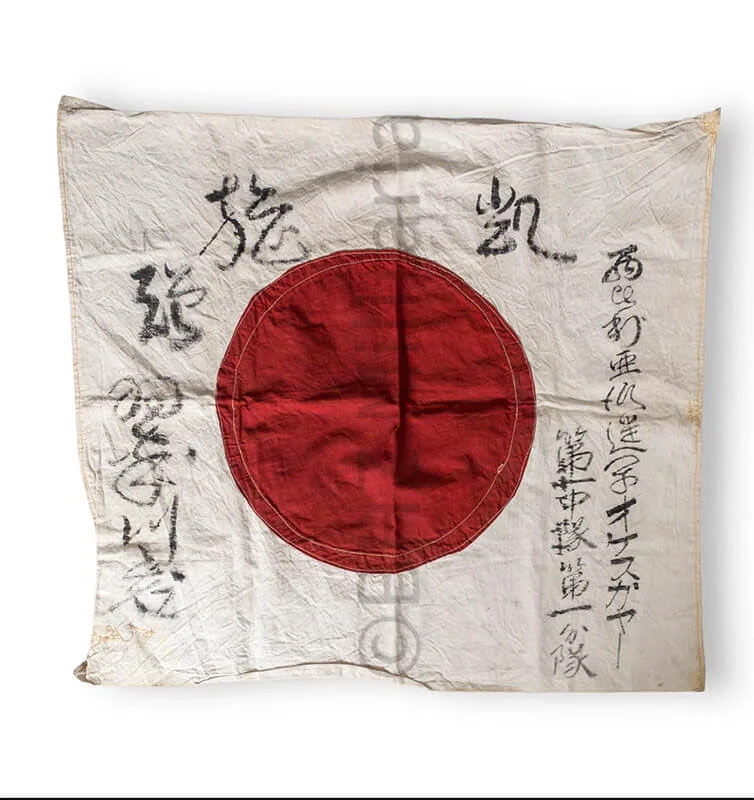
Here's one that we know is legitimate because it was carefully verified and returned to the family that it came from:
Yosegaki Hinomaru returned to Japanese family
You can also see some real examples on wikipedia,
Good Luck Flag - Wikipedia
In general, real flags are large and well crafted, they are never white but will have various signs of aging. At the very least, the cloth will have yellowed and the writing will have slightly faded. Very often there will be stains from smoke, oil, or blood, but overly dramatic bloodstains are also suspicious as the owner (if surviving) would have tried to minimize and reverse any damage so these stains are often very faint.
They will usually have one or more larger slogans ( 武運長久 'continuing good fortune in battle' is very common, but it will usually be written in reverse order, right-to-left was far more common than left-to-right writing at the time, but it may also be written vertically).
Smaller than the slogans, the bulk of the writing will be signatures of well-wishers, which will generally either radiate out from the red circle like rays of the sun, or else descend down from it. Very often there are a few signatures or personal well-wishes that go against the grain of the overall organization. Each signature should be in a different hand; while not made as deliberately distinct as a western signature, it is each person's own handwriting and some individuality shows through.
The number of signatures varies wildly, depending on the size of the town, the proximity of extended family, how late in the war it was, etc. There should be an indication of the receiving soldier's name and unit, sometimes rank.
By contrast, the current example is a nearly new white except for some yellowing on the edges, judging by the prominence of the thread it is presumably very small (or made very crudely with very coarse thread), none of the standard slogans, but some large characters that I guess are supposed to pretend to be such, and some other writing that I suppose is meant to be the soldier's name, rank, and unit.
It looks more like it was folded up, soaked and left to dry in the sun, then unfolded and wadded up and left to dry in the sun again, in order to force the wrinkles and a little bit of discoloration, i.e. it looks more like mistreated laundry than genuine aging.
I won't say there aren't flags that are different from the usual, but this flag is different in every way.
The best way to identify them is to look at plenty of real examples, but if you cannot read Japanese then it will be difficult to spot problems with what is written. Heck, even if you
can read Japanese, reading damaged examples of nearly century old handwriting is a different kind of thing altogether.