Tourism Chinese tourists flock to Japan despite seafood ban

thomas

Unswerving cyclist
Admin
Joined
14 Mar 2002
Messages
21,050
Reaction score
18,904
Despite the warnings from Chinese media, flights from China to Japan were fully booked during China's eight-day version of the "Golden Week". Voting with their feet, Chinese travellers put the state-run newspaper in an awkward position over its previous prediction that Japan's tourism figures would plummet following the release of diluted wastewater from the Fukushima Daiichi nuclear power plant.


Data from China's first proper Golden Week break since it ended strict COVID-19 policies late last year will be used to gauge the strength of its post-pandemic economic recovery. Its culture and tourism ministry said it was expecting 896 million domestic trips by road, rail, air and ferry, while spending at home could reach over $100 billion. However, overseas destinations can remain a touchy subject when China's state media argue the government's political sentiments are shared by the wider public. The Global Times op-ed described the Japanese reports as "tourism public opinion warfare," meant to undermine China's position. Not all passengers on Japan-bound flights were tourists, it said.


I wonder whether Chinese tourists will follow their government's advice and avoid indulging in Japanese seafood... :LOL:
 
Maybe these tourists are more interested in shopping for certain goods and not going out to eat fish?

And I was reading earlier that Thailand had at least a passing reputation as dangerous for Chinese--a visa exemption now but apparently some are scared to go? (if you believe the globe and mail)
 
The local media have also picked up the topic, and it seems not all Chinese (tourists) buy into their government's claims. :)

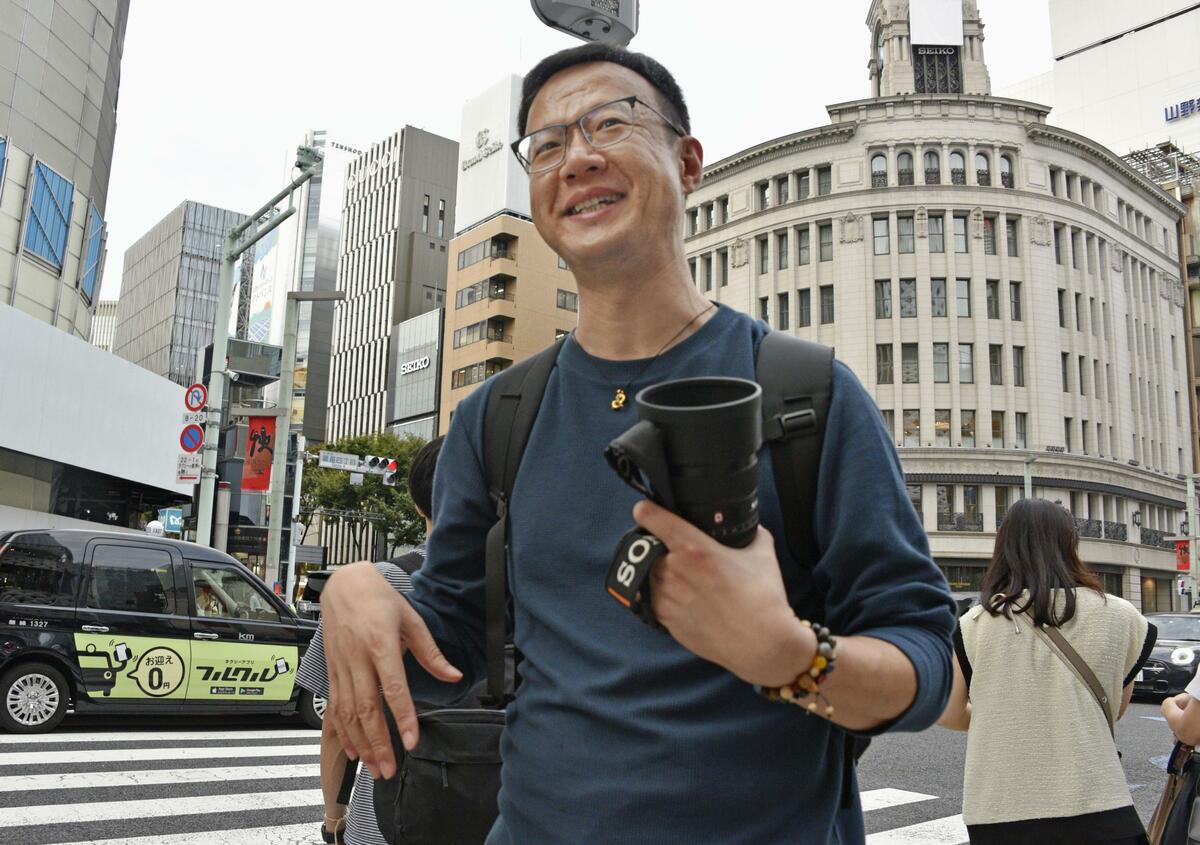
Chinese holidaymakers visiting Japan have said they are enjoying eating sushi amid Beijing's ban on Japanese seafood imports, imposed following the release of treated radioactive water from the wrecked Fukushima nuclear complex into the sea. "I eat sushi every day," said a woman in her 40s from China's Zhejiang Province while shopping in the upmarket Ginza shopping district in Tokyo during China's eight-day National Day vacation period, which kicked off on Sept. 29. "I don't care where the fish were caught."

Li Pei, another Chinese tourist who was visiting Ginza during the holiday season from Qingdao in Shandong Province, said he "has no worries" about the water discharge. "I understand that the concentration level of (radioactive) tritium in the treated water is below international safety standards and has limited effect," the 40-year-old said.


The local media have also picked up the topic, and it seems not all Chinese (tourists) buy into their government's claims. :)


I guess the tourists at least listen to news sources other than the Government/Communist Party sourced news.
 
The local media have also picked up the topic, and it seems not all Chinese (tourists) buy into their government's claims. :)


It's a report by Kyodo, a very pro-Japan organisation. It's extremely easy for such an organisation to find a few Chinese tourists eating sushi and turn it into an article implying that 'sensible' Chinese tourists are ignoring their 'stupid' government.

I've no idea about (or interest in) whether Chinese tourists are ignoring their government's advice, but such news articles are worthless. I've seen way too many spurious and petty news reports by 'respected' organisations such as NHK, such as 'The one year anniversary of China's tainted gyoza scandal', designed to make China look bad that I carry on scrolling as soon as I see an article like this – it's propaganda, nothing more, nothing less.
 
Without eateries taking demographic polls it would be hard to say for certain who is eating what, but I can imagine a couple things being true:

1) Chinese people have been inundated with government messages that boil down to "Japanese fish == dangerous." Even if they logically don't believe it, that message is repeated often enough to create a mental impression that at least causes a knee-jerk reaction to the mention of Japan or Japanese fish. This is why I've encountered astonishingly young racists in my travels, in a nutshell.

2) Even if they believe the anti-Japanese, anti-Fukushima fish propaganda, Chinese tourists are probably more likely to believe that the Japanese are exporting all the tainted fish and keeping the good stuff for themselves, therefore it's probably safe for them to eat the fish IN Japan, but maybe they'd avoid it at the grocery store back home (if it were even an option).

3) People will rationalize just about any belief or behavior they've already decided on.
 
and it seems not all Chinese (tourists) buy into their government's claims.
Waaaay back when, I guess summer of '82 to summer of '83, I spend a year teaching in Beijing. This was of course pre-internet (and internet censorship), and of course the usual media was as controlled as you'd expect.

But china is big, huge actually, with lots of mountains, too. And given that, the best kind of radio for that (bang for buck/yuan) is shortwave. So everyone there had a shortwave radio (I got one, too), kind of like now everyone has a TV (at the time there was one TV in the four-story building I was in, an during the few broadcast hours in the evenings, people there would gather in the guard office, where the TV was, to watch, sometimes 20-30 people, all watching a small B&W screen).

Anyway, the radios were tune-able (unlike DPRK), so besides chinese stations, everyone would also listen to VOA, BBC, and also Radio Moscow. My students then were older, late 20s and 30s, who had sort of been selected as prospective 'foreign experts', who would later maybe be traveling to the west for education (grad school). These folks were great, probably the best students possible--extemely bright, very eager to learn and go, and so on. Scary good sometimes.

I also had one class of older students. I was young then(!), this group, men and women both, were in their 60s. So think about that--and I mean really think about that. Someone who was 63 in 1983 was born in 1920, was 36 in 1956 (the Hundred Flowers), was 38-41 in 1958-61 (the famine), and was between 46-55 during the years of the Cultural Revolution, and since they were educated by then, they were sent to the countryside (to learn from the peasants) for at least part of that, and certainly subjected to intense criticism for that (part of which was knowing english, vs russian, and I think there had also been some missionary contact or schooling for a few as part of their early years). An aside, but I wish I could have been more aware of and appreciated the experiences of this group at the time.

Anyway (again), everybody l taught listened to VOA and BBC every night. In a day's class I could ask about what's happened, and these folks knew all the world news, almost as it was happening--far better than I did.

'Political study' was common/mandatory for everyone then, one afternoon a week (free time for me). Rather than simple indoctrination, the chinese way seemed to be to debate something so thoroughly as to 'rationally' prove it wrong, to defeat it that way rather than just repeating the approved message over and over. My students were excellent debaters, since during political study, like a debate team, they had to take one side or the other, try to prove/argue for it being right, and then switch roles and argue for the opposite side. They were excellent at something called perspective-taking, where you put yourself in the other's shoes to understand their mind (so as to prove yourself right, and 'defeat' that other point of view).

Blah, blah, blah...

Oh, and I often listened to Moscow Mailbag, with Joe Adamov. There was a lot of subtle humor in his shows. Moscow also broadcast some good jazz.
 
This was also reported by Kyodo, but I hope it will not be construed as propaganda. :)

According to an annual joint poll by Japanese nonprofit think tank Genron NPO and the China International Communications Group on public views in both countries on bilateral ties, 22.1 per cent of 1,506 Chinese surveyed said they are "very worried" and 25.5 per cent are "worried to some extent" about the water discharge.

In the poll, conducted in China in 10 cities from Aug. 18 to Sept. 1, 8.0 percent answered they are "not worried at all" about the water release and 18.7 percent said they are "not very worried," with 25.0 percent replying they "currently cannot judge."


Waaaay back when, I guess summer of '82 to summer of '83, I spend a year teaching in Beijing. This was of course pre-internet (and internet censorship), and of course the usual media was as controlled as you'd expect.

But china is big, huge actually, with lots of mountains, too. And given that, the best kind of radio for that (bang for buck/yuan) is shortwave. So everyone there had a shortwave radio (I got one, too), kind of like now everyone has a TV (at the time there was one TV in the four-story building I was in, an during the few broadcast hours in the evenings, people there would gather in the guard office, where the TV was, to watch, sometimes 20-30 people, all watching a small B&W screen).

Anyway, the radios were tune-able (unlike DPRK), so besides chinese stations, everyone would also listen to VOA, BBC, and also Radio Moscow. My students then were older, late 20s and 30s, who had sort of been selected as prospective 'foreign experts', who would later maybe be traveling to the west for education (grad school). These folks were great, probably the best students possible--extemely bright, very eager to learn and go, and so on. Scary good sometimes.

I also had one class of older students. I was young then(!), this group, men and women both, were in their 60s. So think about that--and I mean really think about that. Someone who was 63 in 1983 was born in 1920, was 36 in 1956 (the Hundred Flowers), was 38-41 in 1958-61 (the famine), and was between 46-55 during the years of the Cultural Revolution, and since they were educated by then, they were sent to the countryside (to learn from the peasants) for at least part of that, and certainly subjected to intense criticism for that (part of which was knowing english, vs russian, and I think there had also been some missionary contact or schooling for a few as part of their early years). An aside, but I wish I could have been more aware of and appreciated the experiences of this group at the time.

Anyway (again), everybody l taught listened to VOA and BBC every night. In a day's class I could ask about what's happened, and these folks knew all the world news, almost as it was happening--far better than I did.

'Political study' was common/mandatory for everyone then, one afternoon a week (free time for me). Rather than simple indoctrination, the chinese way seemed to be to debate something so thoroughly as to 'rationally' prove it wrong, to defeat it that way rather than just repeating the approved message over and over. My students were excellent debaters, since during political study, like a debate team, they had to take one side or the other, try to prove/argue for it being right, and then switch roles and argue for the opposite side. They were excellent at something called perspective-taking, where you put yourself in the other's shoes to understand their mind (so as to prove yourself right, and 'defeat' that other point of view).

Blah, blah, blah...

Oh, and I often listened to Moscow Mailbag, with Joe Adamov. There was a lot of subtle humor in his shows. Moscow also broadcast some good jazz.
Closest I've come to China was being stationed at Misawa AFB up in Aomori prefecture 2yrs and near Fukuoka - Saitozaki - Brady AirStation 66-68. Remember seeing the Red Guard as they came to Japan and were selling what looked like quality carvings , jade , and such but in my 20's and would not have known if the items were made yesterday or 1000 yrs earlier. They also had Mao's little red book for $1 US and I almost bought 1 but our job was intercepting Chinese military morse code and they were the "enemy" ! So I bought nilch. That was in Kokura (Kita Kyushu ) . My J gal at the time was worried the Cultural Revolution might spill over to Japan but it didn't. The Chinese code as well as China in general was so far behind the times but fast forward and they are the sleeping Giant but wide awake now and sure would not like to see conflict with them over Taiwan. And as much as I would like to see Taiwan remain a free state I think they will become a part of China as they have been for how many years ? Sounds like you had a interesting time in China as I had a wonderful time in Japan - going back next month for 3 weeks but Japan has so changed from the 60's but the folks are still polite and friendly. Most old haunts/cities I visit are completely rebuilt and 6 story buildings were the max back then but now up up and away. Did you become fluent in the language johnny G ? sorry for the rambling.
 
Back
Top Bottom